

Does using heavier guitar strings actually give you better tone? It's a conversation that's divided players for decades – and in the early 1980s, The Edge made his position on the debate crystal clear.
Back in 1982, The Edge accused players of becoming “lazy” because of their string gauge choices. For the U2 guitarist, anything lighter than 10s threatens to have a negative impact on your sound.
Speaking in the January 1982 issue of Guitar World, following the release of U2’s Platinum-rated October, The Edge came out swinging on the matter of string gauges.
“Light strings are a bit of a fallacy,” he claimed. “They’ll help your playing if you’re into speed, but you sacrifice sound. Jimi Hendrix and others in his day used heavy strings, and you can tell the difference on the records. People have gone a bit lazy now.”
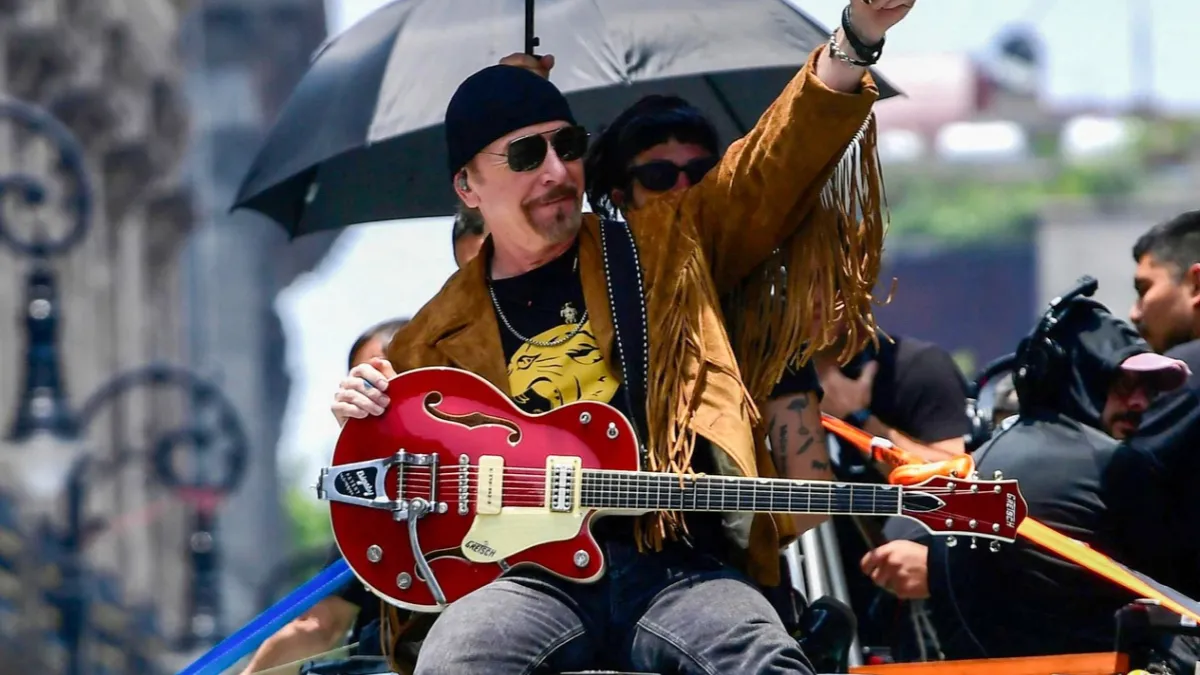
For his own personal picks back then, he used Ernie Ball 10 gauge on the Explorer and Gibson 11s (with a 56 on the low E) on the Strat. Nothing too crazy, but by no means the lightest strings, either.

Unsurprisingly, The Edge's viewpoint isn't one that's universally shared. B.B. King and Billy Gibbons, for example, would both have disagreed. After all, when ZZ Top’s Billy Gibbons crossed paths with the legendary bluesman, he got some game-changing advice on guitar tone.
At that time, Gibbons felt there was a correlation between heavy-gauge strings, and bit tone and his Pearly Gates Les Paul reflected that belief. Then his perspective was flipped around.
“When B.B. asked to try a few licks on my guitar, he quickly smiled and asked, ‘Why you working so hard?’” Gibbons recalls. “He then laid it down to show off a new set of his super-light-gauge strings.
“It was at that very moment that everything turned around. As BB then said, ‘Light is all right!’”
On the other end of the spectrum, Stevie Ray Vaughan, Dick Dale and Pete Townshend preferred thicker strings. For Townshend, it meant fuller-sounding chords; a belief that Alex Lifeson later leaned into.
And then there's Hendrix himself. Hendrix’s former guitar tech, Roger Mayer, has stated that the late virtuoso was very specific when it came to what strings he wound onto his Fender Stratocasters. His set was actually pretty standard: 010, .013, .015, .026, .032 and .038.

“The big difference there is that you're using the .015 for the third, because if you use the .017 for the third, the actual sound of the guitar is very G-heavy,” Mayer told Guitar World in 2022.
“The electrical output of the strings is dependent on the square of the diameter; if you square all the diameters and look at them, you can get much more of an idea about the balance of the guitar.”
So, perhaps, the Edge’s point about Hendrix using heavy strings was actually misguided. Of course, it all depends on what one considers "heavy". For The Edge, 10s were heavy enough.
Other players won't have time for the thicker strings, thicker tone argument. John Mayer once said that string gauges don’t matter, and called it one of the silliest arguments guitarists can engage in it. It really comes down to a matter of preference.

