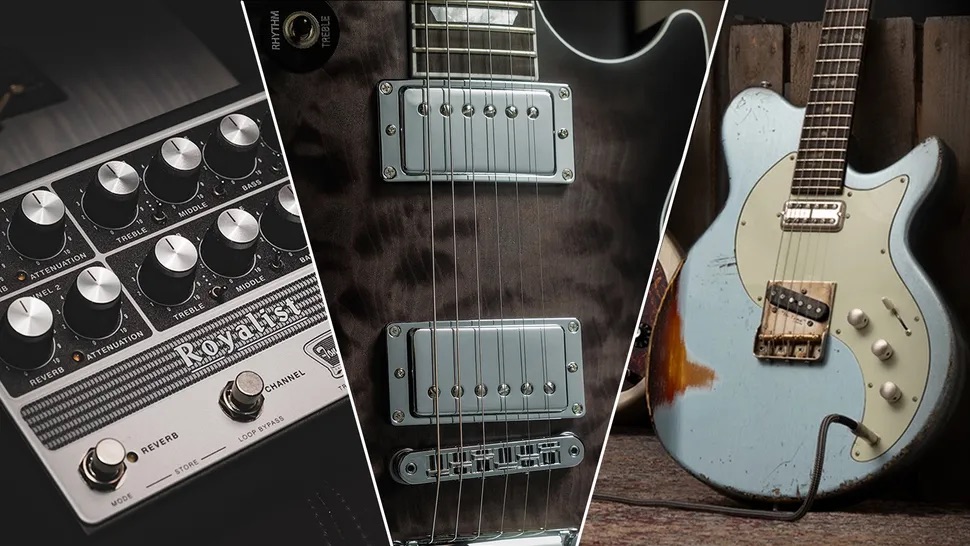


Eastman Guitars’ director of Fretted Instruments, Pepijn ’t Hart, tells us more about the company, the Kauffmann series, and some of Eastman’s principal characters – and explains how a lot of the far-out design ideas come from chief designer Otto D’Ambrosio.
Can you fill the readers in on Albert Kauffmann and Otto D’Ambrosio – what’s their individual involvement?
Otto D’Ambrosio is our chief designer and the one who designed and builds the D’Ambrosio series guitars in our Los Angeles custom shop. The story is that we were reaching out to Albert Kauffmann as we had a D’Ambrosio guitar with a chip out of the lacquer – it was nitrocellulose – and we asked him if he could repair the chip.
His answer was, ‘I can’t make it better, but I’d love to make it worse.’ Famous words that led to a range of Eastman Kauffmann series guitars.
There are three body shapes, just like the D’Ambrosio and FullerTone ranges: SC (Single Cut), DC (Double Cut) and Offset, which is the Offset version of the SC. With Albert we wanted to create a real vintage vibe, based on this newly designed guitar.
Mainly due to his colours and his Time Travel treatment speciality, these guitars turned out better than we ever could have expected. It’s really special stuff.

Why the choice of Charlie Christian pickup? Of course it’s a unit we find on the original Gibson ES-150 and solidbodies used by players such as Danny Gatton, Julian Lage, Bill Frisell and, of course, John Lennon.
When Otto and I are designing the guitars, he does all the ‘out of this world’ stuff and the pickguard is a great example
Well, it’s actually more because for each body shape we like to offer three pickup options. These are all Lollar pickups, and with the SC it’s these: SC Vintage, Lollar Royal T in the neck and Special T in the bridge; SC Classic [as reviewed this issue], Lollar Charlie Christian in the neck and Special T in the bridge; and SC Deluxe, Lollar Lollartron in the neck and Special T in the bridge.
The very first Fender prototypes and the short first run of actual guitars were pine, like the SC Classic. Was that the inspiration here, or was it for weight and sound?
Well, yes, it was for weight and sound but also because of the fact that the trees grow fast. So, to me, this is the ultimate wood for bolt-on guitars. It’s so resonant.

Eastman seems to have manufacturing facilities all over the place. Where exactly are the guitars made now?
Eastman builds guitars in China, where the majority of our instruments are built; in Pomona, California, where Otto’s workshop is located; and in Holland, where Albert Kauffmann and his team are building the Kauffmann series. Albert Kauffmann’s workshop is in the Eastman Europe headquarters in Mijdrecht in Holland.

Is there a reason the pickguard is set into the body? Or was it simply a nice thing to do – it certainly lets the neck sit lower into the body.
This is one of the brilliant things that Otto came up with. When Otto and I are designing the guitars, he does all the ‘out of this world’ stuff and this is a great example.
The Otto D’Ambrosio-designed FullerTone neck is wittily named, but it bears no relation to Fender’s bolt-on system.
And that’s why we won’t do a Fender-style neck joint. Otto’s neck is the evolution of what Leo brilliantly did – but adding more tone, more sustain and more stability. With 30 per cent more contact with the body it is, in a way, the first ‘long neck tenon bolt-on’, and it uses only two bolts. It’s one of the brilliant things of the FullerTone neck; it sits as smooth as can be.

It’s unusual to find a tilted-back (pitched) headstock on a bolt-on guitar…
Well, the unique FullerTone neck joint allows us to set the neck low in the body. So unlike most bolt-ons this allows us to add a slight back-pitch or tilt to give the correct string clearance over the body and pickups, and to the bridge.
When Otto and I are designing guitars we try to add as many beautiful elements as we can, without ever compromising the ergonomics or playability of the guitar. We use Gotoh tuners with the HAP-M mechanism, so we don’t need a string tree.
We’re presuming the colour of our review guitar is a nod to the debut album and Butterscotch Telecaster of a certain legendary artist?
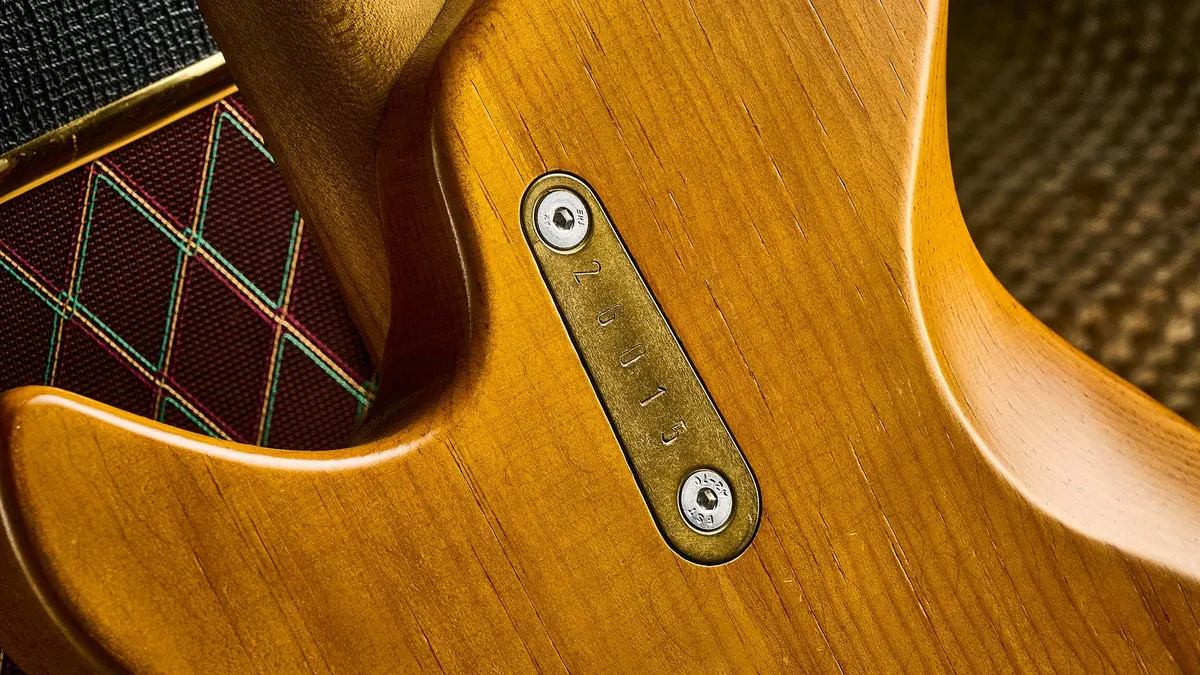
The instrument you are reviewing is kindly supplied by Mak’s guitars in London. It’s a light relic, ‘Time Travel’, and the reason why we call the colour Asbury Butterscotch is indeed a hats-off to the colour of the Telecaster – actually, it was originally an Esquire – played by The Boss – Greetings From Asbury Park.
- Find out more at Eastman Guitars
- This article first appeared in Guitarist. Subscribe and save.

