


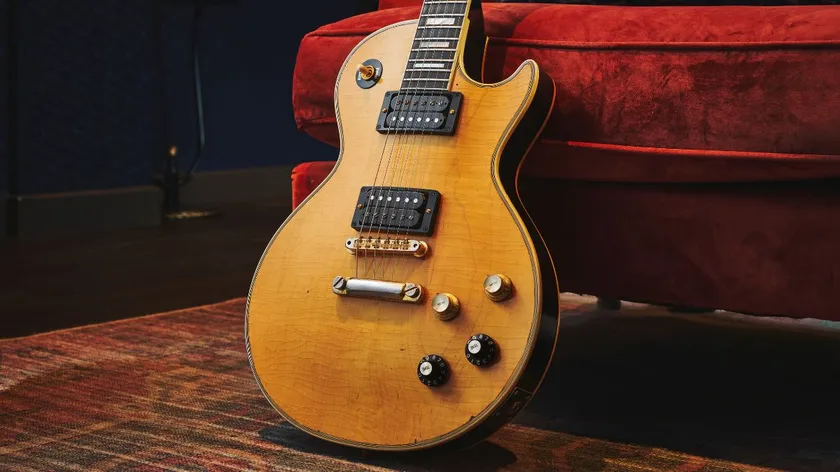


Since its launch back in 2020, Fender have described the Squier Paranormal series as a line of “unconventional and unique” instruments that “combine classic features with unexpected twists.”
Similar terminology could be used to describe the work of Queens of the Stone Age guitarist Troy Van Leeuwen, the musician who’s often regarded as Josh Homme’s right-hand man and hailed as the band’s secret weapon.
Alongside Dean Fertita, who switches between keys and guitar, they form the core of QOTSA’s midrange assault – a kaleidoscopic jigsaw of textures that echo and reverberate into infinity above Homme’s signature furnace of smoldering fuzz.
This year, Van Leeuwen is teaming up with Fender for his third signature offering, following on from his Jazzmasters released in 2014 and 2020. Except this time, it’s a completely different style of guitar being released through Squier.
The new electric XII is a Telecaster with double the strings, to create what the company describe as “rich harmonic depth and shimmering complexity,” while also staying true to “the mystique and bite that made the Tele famous.”

Like the 2020 Jazzmaster, the new model comes in a fetching Copper Age finish. You could say a player like Van Leeuwen was practically born for the Paranormal series, given his highly individualistic and experimental approach to layering and dialing in otherworldly sounds.
“This guitar is probably the most stripped-down out of the ones with my name attached,” he says, a few weeks after the release of Easy Street, the lead single from upcoming ninth full-length Perfecth. “For me, there’s nothing more straightforward and simple than a Telecaster.
“You know what you’re going to get. It does the twang sound I’ve always loved. But adding 12 strings creates this extra lushness within that direct Tele-ness. It’s a cool but simple idea.”
This Paranormal took inspiration from your Paul Waller Masterbuilt Fender Custom Shop guitar. What’s different aside from the price tag?
The Custom Shop has a more vintage-style bridge. I didn’t want that – I wanted something that was user-friendly right out of the box. Functionality is so important because it’s hard to get a 12-string bridge to work right. When you’ve got 12-strings, you really need them to stay in tune.

It’s been in your hands for quite a while now.
Yeah, it started showing up more over the last four records. I’ve used it quite a bit, especially on stage. It’s a guitar that Dean and I shared for a while, because he occasionally plays 12-string. I’ve also played it live with Iggy Pop.
It’s just a good, solid no-frills guitar. You know what you’re going to get. I used it on the new album for this cover we did of Iggy Pop’s Sunday. I’ll break the 12-string out whenever I can because when you have three guitarists in one band, you have to find your spot. That guitar has a point that can always be heard in the mix.
It’s two double tracked EBows, a tip of the hat to Heroes or Teenage Wildlife I love that era of Fripp playing with Bowie
Easy Street is way more laid back than what you’d normally choose for a lead single.
That’s what a lot of this record is about – going back to basics, letting the songs do what they’re supposed to do and staying out of the way. Creating space and letting go a little bit. There’s no bass on Easy Street, or drums, but there are claps and acoustics.
It could be the simplest QOTSA song ever written, mainly based around classic C and F shapes.
Yeah! It’s the most “church chords” song we’ve done. We recorded the music quite a while back and let it marinate over time. When we were sifting through songs for this new record, Easy Street popped up and we wondered, “Wow, what if we did this?”
It came together within an hour or two – mixed and done. There’s a sense of liberty when you let things be and try not to get too clever. We complicate things quite naturally; this kind of expression is the opposite.
Is that a harmonized EBow we’re hearing towards the end?
I definitely picked one up. You can hear my Robert Fripp-ness in there. It’s two double tracked EBows that are harmonizing, like a tip of the hat to Heroes or Teenage Wildlife from Bowie. It’s where my inspiration came from. I love that era of Fripp playing with Bowie.
We can imagine there must be seriously irregular finds in your collection. Which would you say are the coolest?
I have this Teisco DelRay ET400, which was like their version of a Jazzmaster/Jaguar offset made around the late ’60s. It has three pickups, as well as this weird handle in the body, plus a giant baseball bat neck. It’s quirky and interesting.
I have an early ’60s Hofner Verythin hollowbody with three pickups. I’ve got a 1963 Jaguar. I like new guitars, too, especially signature models – I have an Epiphone Noel Gallagher Supernova in blue with the pickup selector on top. I like the Billy Duffy Gretsch White Falcon. I like checking out other artist signatures.

On the last tour you mainly relied on your GMI amps, the Eventide H9 you never go anywhere without, your Electro-Harmonix Superego and some Way Huge and EarthQuaker pedals. Is anything changing for the next album cycle?
I’m going to reimagine and simplify things a bit. But those are my go-tos. The H9 does so many great things. Basically, whenever it says Eventide on it, you know it’ll be good. I like to build different gain stages, so my tone shifts in different ways. There’s always a boost pedal, some kind of filtering option and then a couple of fuzzes.
With three guitarists, we try to spread ourselves frequency-wise
When I talk about filtering, I usually mean my signature Dr No Raven pedal. It has three notches, so you dial in the frequency, hit the boost and it’s like instant Brian May. Or even harsher, like Michael Schenker’s half-cocked wah.
With three guitarists, we try to spread ourselves frequency-wise. Josh has the main classic QOTSA sound, very low-mid driven. Dean and myself play around that. That’s why I use a lot of single-coil guitars to poke through the mix, plus reverbs and space for background ambience.

A lot of the QOTSA guitar tone has been attributed to the Peavey Decade amp. Recently you’ve been using a 10 Years pedal to recreate that sound.
Honestly, a lot of it comes down to that amp. Josh even put his own version out a while back. We use a little jam room to warm up and there’ll be four Decade amps in there. You can plug bass, guitar, synth or whatever into those things.
Before the 10 Years pedal existed, I would take the amp on the road and connect the direct out to the front. That was my Decade pedal... an actual Decade! This is much smaller. There’s something about the circuit that cuts through in a certain way.
Interestingly, QOTSA has never been a Strat band.
I don’t know why! It doesn’t seem to fit right. For that matter, we’ve never been a Marshall band either. It’s one of those things I guess we’ve avoided. As classic as they are, for us it feels a little too on-the-nose for what a rock sound should be.
I mean, you’ve got Jimi Hendrix, that was his rig. You can’t really outdo that. He did it so well, I don’t see us ever trying to chase that sound.
- For more info on the Paranormal Troy Van Leeuwen Telecaster XII, head to Fender.com.

