





Guitar World Verdict
The Marcus King El Dorado easily hits the benchmark that Epiphone has set for itself over the last few years in that it’s a nicely built, well-equipped guitar with a set of very capable sounds that compares well with instruments costing at least twice as much.
Reasons to buy
- +
A well-made and nicely voiced dreadnought.
- +
It has an extra helping of collectability.
- +
Quality electronics
Reasons to avoid
- -
A little weighty and not everyone’s a fan of larger dreads.
You can trust Guitar World Our expert reviewers spend hours testing and comparing guitar products so you can choose the best for you. Find out more about how we test.
What is it?
The history of the Epiphone El Dorado might seem a little convoluted, but bear with us while we offer a thumbnail sketch of this model’s past.
Originally made in Gibson’s Kalamazoo factory in Michigan, the El Dorado was introduced into the USA catalogue in 1963, its square-shouldered dreadnought shape and large 412.7mm (16.25 inch) body width mimicking Gibson’s own recently released Hummingbird and Dove acoustics.
It was dropped from the USA line at the beginning of the 1970s, when Epiphone manufacture was switched to Japan, and was subsequently built at the Matsumoku factory. Here it became known as the FT-350 and enjoyed a few cosmetic changes while keeping its large dread credentials.
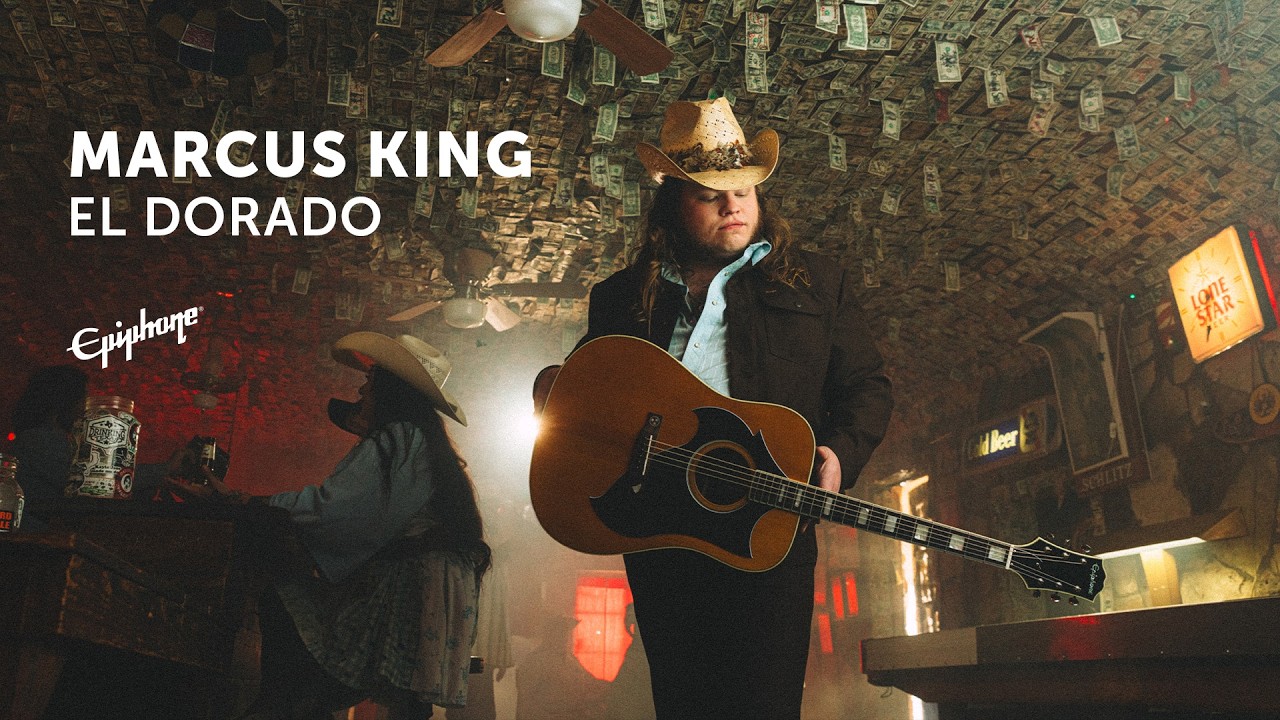
It was a Japanese El Dorado that became the soulful, genre-straddling guitar virtuoso Marcus King’s first guitar. And in honour of this, Epiphone has released a time-limited, made-in-China edition that sits just underneath that all-important £1k price point.
Casting a casual eye over the Epi El Dorado we have in front of us, it doesn’t exactly scream ‘signature guitar’. But then the eye is drawn to the outline of Marcus’s home state of South Carolina in mother-of-pearl on one side of the bridge and Tennessee’s Tri-Star emblem on the other.
Flip the guitar over and just above the neck volute it’s possible to make out Mr King’s signature in gold. All very subtle touches, devoid of any unnecessary flash. We like it. Meanwhile, if you were wondering about the somewhat ‘mod art’ pickguard, this apparently is modelled after the one on Marcus King’s original ’70s guitar.

Perusing the El Dorado’s spec, we find a spruce top, unspecified as to which exact type, but Sitka would be very high on the list of suspects as it’s a fairly common timber to find on Chinese-made instruments. In any case, it looks very fit for purpose and the Antique Natural gloss finish sets it off a treat and offers a subtle helping of vintage chic along the way.
The guitar’s back and sides are rosewood (again, no precise designation, but we suspect Indian) but the finish hasn’t done the grain pattern any favours on our example as it’s barely visible. A shame, because rosewood can be a beautiful wood to look at.
But, of course, results may vary from guitar to guitar and so on other models it might be more apparent. The neck is mahogany, with a rosewood ’board, festooned with real mother-of-pearl block inlays.
The fixtures and fittings on the El Dorado reach far beyond its modest retail price
From what we’ve seen so far, the fixtures and fittings on the El Dorado reach far beyond its modest retail price, especially when we mention that the guitar comes in a very attractive black hard guitar case, itself embossed with Marcus’s signature in gold.
Elsewhere, we find bone used for both the 43mm nut and compensated saddle, plus Epiphone’s own Kluson-alike Deluxe tuners with metal buttons and a headstock shape that once again doffs its cap to Marcus King’s original Japanese-made model. There’s also an onboard pickup in the form of an LR Baggs Element Bronze VTC, with the controls tucked away out of sight at the top of the soundhole.
Overall, it’s an attractive package, especially if you’re a fan of larger dreadnought guitars. And if you’re curious as to what it sounds like, so were we…
Specs

- Price: $999 | £949 | €1,099 (inc hard case)
- Origin: China
- Type: Square-shouldered dreadnought
- Top: Spruce
- Back/Sides: Rosewood
- Max Rim Depth: 124mm
- Max Body Width: 407mm
- Neck: Mahogany
- Scale Length: 629mm (24.75 inches)
- Tuners: Epiphone Deluxe
- Nut/Width: Bone/43mm
- Fingerboard: Rosewood
- Frets: 20
- Bridge/Spacing: Rosewood with compensated bone saddle/55mm
- Electrics: LR Baggs Element Bronze VTC
- Weight (kg/lb): 2.49/5.5
- Left-Handers: No
- Finish: Antique Natural gloss poly
- Contact: Epiphone
Build quality, usability and sounds

Turning the guitar over in our hands, there are no badly polished frets to contend with, and no sharp edges as we run our fingers along the neck, so we can assume that Epi’s Chinese-based quality-control department is well up to speed.
There were a couple of ‘pings’ from the nut when we were tuning the guitar, but these soon disappeared after a while and afterwards the Epi held its tuning well throughout the time we spent with it.
The neck is what Epiphone refers to as a “rounded C” and feels slightly chunkier than a ’60s Strat but is far from being unwieldy. We did notice that the guitar feels weightier than we would have expected. At approximately 2.49kg (5.5lb) it’s certainly a lapful, but that’s far from a deal-breaker.

Experimenting with a few campfire chords, we found a full and strident voice – if you’ve ever picked up and strummed, say, a Gibson Hummingbird, then you’ll know what we mean. There’s quite a reserve of power to the dynamic range and the guitar remained perfectly musical from a whisper to a roar.
We tried some fingerstyle as well and the El Dorado gave a very good account of itself here, too. If we were being hypercritical, we’d say that there are a few notes around the F# in the lower register that don’t ring out quite as stridently as the rest, but these weren’t dead spots as such, and possibly merely a foible with this particular instrument.

It’s always difficult to look into the future and foretell how an acoustic guitar will develop given the passage of time. But, from what we hear today, there’s every chance that the El Dorado could turn out to be quite an investment.
The LR Baggs does a very good job of enhancing the natural sound of the guitar and setting a sound we enjoyed was quick and trouble free
We tried it through the acoustic channel of our handy Boss Katana-50 EX and hit our first hurdle as the battery that comes with the guitar was flat. This has happened often in the past – and it’s really nobody’s fault – and we always have an emergency battery standing by just for this sort of eventuality.
It did remind us what a faff it is to slacken off all the strings and wrestle with the little Velcroed pouch attached to the neckplate, though. But all the detuning and retuning got rid of those ‘pinging’ strings we mentioned earlier and so the journey was worthwhile.
What we heard before we retrieved our precious Duracell was what we expected. The LR Baggs does a very good job of enhancing the natural sound of the guitar and setting a sound we enjoyed was quick and trouble free.
Verdict
Verdict: ★★★★½

What can we say? A perfectly capable-sounding dreadnought with a bit of history and collectability thrown in for good measure, for under a grand?
The Marcus King El Dorado easily hits the benchmark that Epiphone has set for itself over the last few years in that it’s a nicely built, well-equipped guitar with a set of very capable sounds that compares well with instruments costing at least twice as much.
Furthermore, despite the fact Epiphone isn’t saying exactly what ‘time-limited edition’ means in this context, it’s got to be factored in that it could very well hold its value and even sport the sort of second-hand premium that signature models sometimes attract in the future.
Guitar World verdict: If you ever find yourself in the market for a fully equipped and stage-ready dreadnought then the Epiphone Marcus King El Dorado should definitely feature on your shopping list.
Hands-on videos
Marcus King

- “Even with their sub-$500 tickets, these guitars have been built with some degree of care and expertise”: Epiphone J-45 Studio and J-200 Studio review
- This article first appeared in Guitarist. Subscribe and save.

