


Guitar World Verdict
By no means a gimmick and certainly not a novelty that will wear off any time soon, Jacob Collier’s five-string guitar is a genuinely eye-opening and enlightening instrument that will force you to think about new ways to play the guitar.
Reasons to buy
- +
Presents a new and fresh way to play the guitar and encourages creativity.
- +
Super playability and excellent build.
- +
Fascinating entry point into the world of five-string guitars.
Reasons to avoid
- -
Won't be for everyone.
- -
$999 for quite a niche instrument.
You can trust Guitar World Our expert reviewers spend hours testing and comparing guitar products so you can choose the best for you. Find out more about how we test.
What is it?
Jacob Collier has become an unlikely guitar hero over the past few years, but true to the Grammy-winning, multi-instrumentalist's own unique style, he hasn’t done it the ol’ fashioned way. Indeed, he hasn’t sought to go toe-to-toe with the contemporary greats who are reinventing conventional technique. He’s found a way to borderline reinvent the acoustic guitar itself.
Some of you will be familiar with Collier’s exploits in the guitar world. He has signatures with Strandberg and Taylor (the latest of which I have in front of me here), and they’re all linked by one quirky specification: they only have five strings.
The five-string approach has informed Collier’s guitar playing for some time now, after the multi-instrumentalist cut his teeth on a four-string tenor that served as his formal introduction into the world of guitars.

Collier also devised his own unique way to approach the instrument, settling on a five-string setup and a mirrored open tuning (D, A, E, A, D) that opens up a whole new avenue for guitar playing. Open chord shapes, easy arpeggios - a reimagined vocabulary at your fingertips…the world of five-string guitar is an enticing prospect indeed.
And it’s not a gimmick at all. This writer spent an hour with Collier in 2025, learning the ins and outs of his unique playing style and getting to grips with the five-string guitar. Having it come across my desk for review purposes was particularly thrilling because –since I'd played this exact model during a guitar lesson with Jacob – I was already well-versed in its sound and style. Getting the chance to spend a little extra time with it and put it under the microscope, allowed me to confirm what I was already beginning to suspect about this guitar…
Specs

- Launch price: $999 | £1,099 | €1,199
- Made: Mexico
- Body shape: Grand Concert
- Body top: Walnut
- Top bracing: X-bracing
- Back & sides: Layered walnut
- Neck/shape: Neo-tropical mahogany, C profile
- Scale/length: 24.875" (631mm)
- Nut/width: White TUSQ nut / 43mm
- String spacing at bridge: 54mm
- Fingerboard/Radius: Smoked eucalyptus
- Body depth: At deepest point 10cm
- Finish: Natural walnut
- Bridge/pins: Smoked eucalyptus/black plastic
- Tuning Machines: Paddle, standard
- Electronics: Fishman Presys VT
- Weight: 4.1lb/1.9kg
- Case: Academy Series Gig Case
- Left-handed options: No
- Contact: Taylor
Build quality

Build quality rating: ★★★★½
I’m yet to play a Taylor that isn’t built to near-perfection, and I’ve played plenty of the affordable models, too. My early-edition GS Mini is still going strong, and has fared wear and tear far better than some of the other models I’ve had in my collection over the years. The Academy 22e version of Collier’s signature model, while by no means cheap for a five-string guitar, is certainly no different, and a testament to Taylor’s expert quality control and craftsmanship.
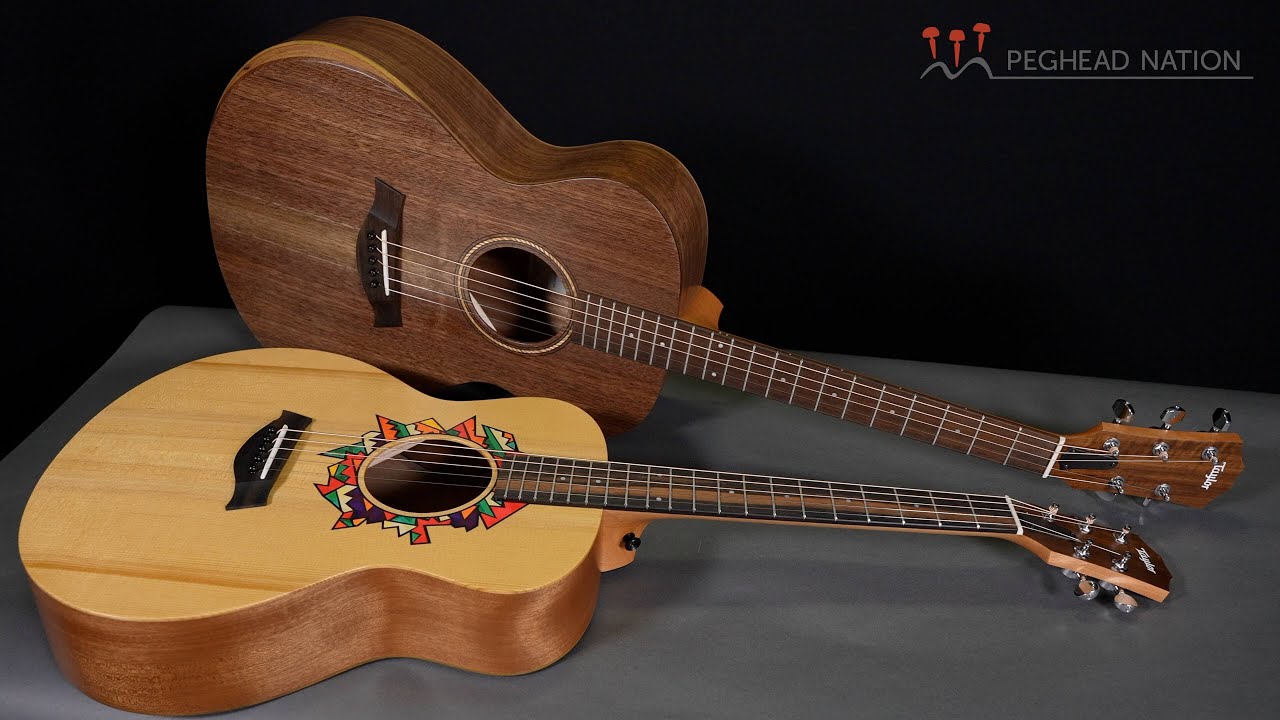
Arriving in a sturdy, padded gig bag that oozes with premium charm – and that would give me complete peace of mind if I were to travel with this – the Jacob Collier Academy 22e features an interesting tonewood combination of a walnut top, with layered walnut back and sides. It also has a mahogany neck and smoked eucalyptus fingerboard, all of which are adjoined in a very expert manner.
The slightly porous, tactical grain of the mahogany and walnut is really inviting and is delightfully presented, with the top curve benefitting from a subtle bevel that you can’t really see at a distance, but one you can definitely feel. The layered walnut offers a really rich aesthetic that doesn’t feel cheap, and the top has a stunning, earthy hue to it that offers something a bit different from your regular spruce – both visually and sonically. The wood examples chosen here are exquisite.

Interestingly, this is proportioned exactly like a six-string, meaning it has a regular fretboard size and a nut width of 43mm. An excellent design choice, because not only does it avoid the potential issue of this feeling like a novelty instrument, it gives the five-string setup the space and respect it deserves.
As we’ll find out, this is a guitar well-suited for fingerpicking, so the regular string spacing of 54mm is beautifully primed, and the super-smooth fret ends are wonderfully finished. The three-plus-two tuner configuration looks a bit odd, but it works, and tuning stability is worth noting.
Let’s not forget this is a $999 acoustic, so by no means cheap, but there really is no cause for concern here. There is a separate Jacob Collier Taylor for $2,799 – a sizable sum for a five-string, let’s be honest – so what you get here for just shy of $999 is really nice.
Playability

Playability rating: ★★★★½
The guitar itself feels completely ordinary, in the best way possible
Because this is proportioned like your standard six-string, the form of the guitar itself feels completely ordinary, in the best way possible. The Grand Concert body hasn’t been downsized so has a nice silhouette that feels comfortable and translates nicely into playing. The neck is a modest C that’s well-shouldered but doesn’t feel too hefty in the hands. The smoked eucalyptus fingerboard is a nice touch, and though it’s not quite my thing (I think ebony would’ve looked killer here) it certainly plays into the Collier style of doing things a bit differently.
All that is to say, if this had six strings, you wouldn’t have any problem with it whatsoever. That aforementioned bevel really is a nice touch, and although I’m not usually the biggest fan of beveled guitars, the contouring here is so minimal that you really can only feel it once it’s under your strumming arm.
Things change when you start playing, of course, and the whole five-string setup can take a while to get used to. Taylor and Collier’s decision to put five strings on a six-string-sized guitar, rather than try and fashion a downsized instrument to accommodate the lesser string count, is a wise choice.
Not only is this approach probably much cheaper (we can’t imagine Taylor would gear production for such a complex and niche instrument in that way) but it also makes it way more accessible for the average guitar player.

Because of this, there is so much room between strings, to the extent where the fingerpicking hand has ample room to rest a digit on each string and have space to flex and pick. Coming from someone who has tried to do Collier’s five-string thing on a regular acoustic, this really is the best and only way to really explore its potential.
The tension across the strings is also nicely dialed in, especially given the D, A, E, A, D open tuning this thing ships in. Again, I’ve previously tried to force my own acoustic into that tuning, and I’ll tell you this for free: the B string absolutely hates being put up to D.
Here, because it’s been specifically set up for the five-string tuning, the strings have a slinky, tactile, bendable feel to them at a 24.8” scale, meaning you do not have to fight to get a tune out it. That goes for the fretting hand, too. A tiny bit more distance and stretch is required for certain things – most notably flourishing hammer-on runs that span two or three strings – but nothing major.
This really is a fingerpicking instrument, and the tuning – through which open chord shapes and arpeggios can be really easily formed – is an excellent access point to exploring some interesting shapes and intervals. Barring across, with one finger placed two frets up on the middle string, forms a major chord. Knock that finger down a fret for a minor chord.
In other words, it’s seems it would be easier to learn a D major chord on a Collier guitar than it is on a regular acoustic, which is why I can see this being a good option for beginners.
Yes, barring can be tricky at the best of times, especially for beginners, but because at a basic level you need only one finger to make this work, you remove the necessity to form additional shapes with your ring, pinky and middle fingers underneath. Plus, regular chord shapes (D in particular) can be a bit of a challenge for un-trained fingers.
Will that chain beginners to this tuning? Possibly, but in my mind it can only help build confidence on the guitar. The quicker aspiring guitarists can start strumming a tune with minimal ease – and start exploring their own voice and shapes right from the off – is only a good thing.
For example, 1-5-6-4 progressions are so easy, and there are no radical shape changes required. And, because the tuning is mirrored, everything you do on the top two strings, you can do on the bottom ones. Already that encourages experimentation, and forces you to think outside the box.
Sounds

Sounds rating: ★★★★
There’s a lot of ‘different’ about this acoustic, from the string configuration to the setup, so it’s nice to see the reliable Fishman Presys VT system present to give this some sonic familiarity. With the benefit of soundhole-mounted volume and tone controls, the Presys performs as reliably as usual, and transforms this experimental instrument into a genuinely giggable workhorse.
It’s not extraordinary by any means, and there are acoustic pickup systems out there that would perform better than this one, but for an Academy guitar it’s a solid option.
With that in mind, I much prefer this as an unplugged acoustic. When I played it with Jacob, we mic’d it up and it sounded really nice, and a large part of that is down to the tonewoods used. The walnut/layered walnut combo really does offer something a bit different to your usual maple, spruce or rosewood combinations, and when fashioned in a Grand Concert size you get really good output and a surprising amount of depth.

It’s a good all-rounder, no-nonsense acoustic tone…
There isn’t an abundance of low-end, and there’s definitely more of a pronounced mid and high-end to this, but not overly so, and there’s a nice balance that positions this well as a strummer for chordal accompaniment and presence for fingerpicking melodies.
It’s a good all-rounder, no-nonsense acoustic tone that might not blow your socks off that way a more premium Taylor might, but there’s enough there to give a versatile and usable voice that doesn’t get in the way of the nicely layered voices and unusual inversions that the tuning requires.
Verdict

Jacob Collier’s five-string guitar is an enlightening instrument, and I had much joy getting to grips with it and re-familiarising myself with the oddball setup. Speaking from experience, it can force you to think about new ways to play the guitar, but it serves a very specific purpose that might not be for everyone.
Could it replace your six-string? No. Is it a useful tool to have in your collection? Possibly. Should you prioritise spending $999 on this over something else? It depends on your goals and priorities. If you already have a few acoustics in your arsenal, and need something that will light a fire under your creative tendencies, this will certainly do that for you. I know it did that for me.
It can give a whole new palette that no other guitar can give you
This isn’t primed just for Jacob Collier fans, and I’d advise against assigning the artist connection too much value in this case. Similar to how the Silver Sky is a great electric guitar, regardless of the John Mayer association, the JC Academy 22e is an excellent tool if you need something different.
I’d liken this somewhat to the rubber bridge guitar. It might not be a go-to for the vast majority of players, but it serves a purpose, and can give a whole new palette that no other guitar can give you.
Guitar World verdict: Jacob Collier’s Taylor Academy 22e guitar is a fascinating entry point into a whole new world of guitar playing. A solid option for beginners, as well as those looking to push their voice into new directions, this is an enlightening creative tool that will help you rethink your relationship with the instrument – and perhaps make you a better player for it.
Test |
Results |
Score |
|---|---|---|
Build quality |
Excellent build with some unique tonewoods to boot. |
★★★★½ |
Playability |
Five-string experience on a six-string-sized acoustic, hugely accessible. |
★★★★½ |
Sounds |
Not world-beating but solid workhorse tones. |
★★★★ |
Overall |
A fascinating entry point into a whole new world of guitar playing. |
★★★★½ |
Also try


Guitar World

Peghead Nation
Taylor