Guitar World Verdict
There’s no magic bullet at play here, but feed it an already-great signal from a high-end instrument, and the Mantle will reward you with a veneer of studio polish. The analog cliches all apply here, and to end on another one, it’s the final 10% that’ll lift your signal from ‘decent’ to ‘damn!’.
Reasons to buy
- +
Easy to operate.
- +
A different take on pedal-based tone shaping
- +
Studio-style processing in a stompbox.
Reasons to avoid
- -
You really need to understand what it's for, as well as what it's not.
- -
No PSU included.
- -
Price is somewhat exclusive.
You can trust Guitar World Our expert reviewers spend hours testing and comparing guitar products so you can choose the best for you. Find out more about how we test.
What is it?
Think of a classic recorded bass tone, then think about how it was created. The bass and its pickups, the amp, the mic or direct signal (or both), the environment in which it was captured, and of course, the small ingredient of the player themselves all contribute to the sound we’re hearing.
But there’s something we often overlook that’s omnipresent on our favorite recordings, and that’s the signal chain after it leaves the jurisdiction of our rig. Chances are, if the tone you’re imagining was made in a pro studio, then it will have run through some choice outboard or mixer-based preamps, adding significant qualities to the tone thanks to analog circuitry.
This is summed up in modern-day language with cliches such as ‘warmth’, ‘grit’ and ‘punch’. But they’re cliches for a reason, because what we’re really trying to describe here is the know-it-when-you-hear-it fattening-up of our sound thanks to harmonic distortion imparted by classic analog designs.

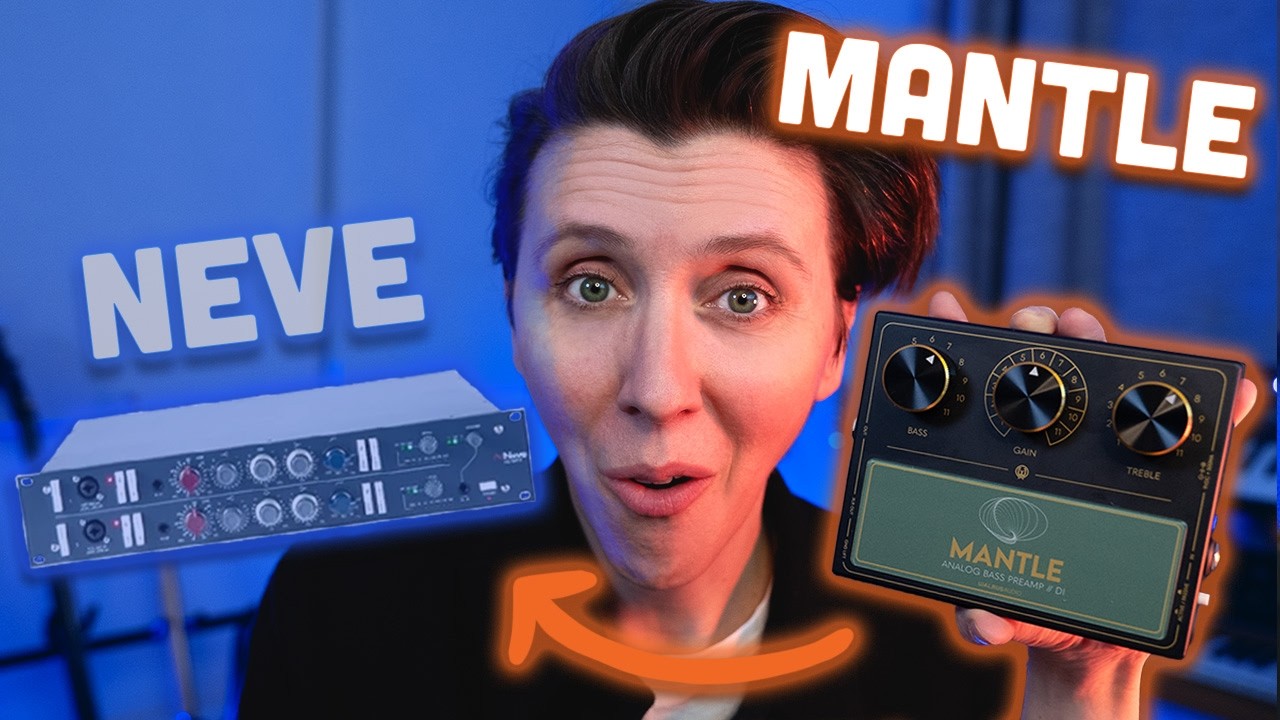
Two of the most famous names in the studio preamp game are Neve and API, whose aural fairy dust has been sprinkled on countless recordings.
Now, Walrus Audio has teamed-up with session bassist/bass educator/tone connoisseur, Ian Martin Allison (who most recently caused panic-buying with the MXR Bass Synth) to deliver the flavor of these elusive tonal radiators in a preamp pedal courtesy of transformers, stepped, preset EQ and ‘musical’ gain. Meet the Mantle.
Specs

- Launch price: $749.99 | £749 | €859
- Type: Bass preamp pedal
- Controls: Bass, Gain, Treble (11-step increments)
- Features: Active/passive switch, Ground Lift, custom Sapphire input and output transformers.
- Connectivity: Input (w Active/Passive switch), output, XLR output
- Bypass: N/A
- Power: 9V DC 500 mA (not included)
- Dimensions: 155mm x 120mm x 58mm
- Weight: 2.2lbs (962g)
- Options: N/A
- Contact: Walrus Audio
Build quality

Build quality rating: ★★★★½
You’ve probably already clocked the Mantle’s $749 price tag, so you’ll be glad to hear that this pedal feels like a premium, luxury design.
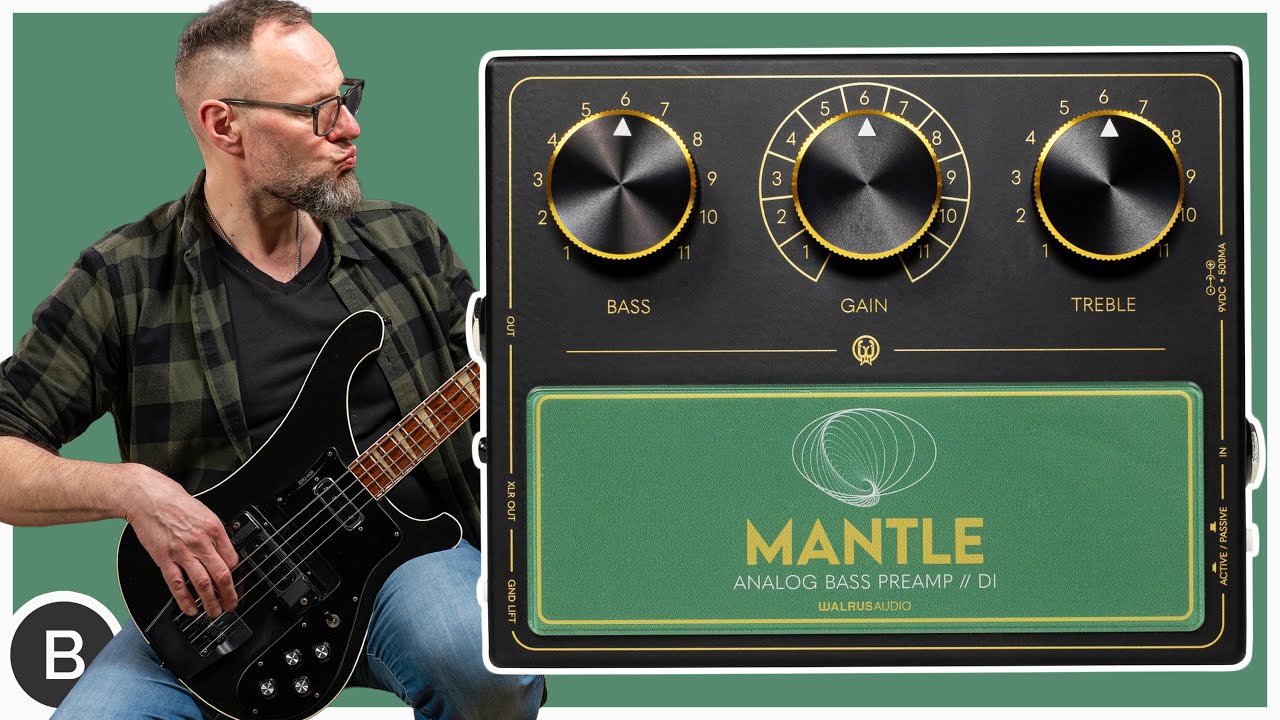
The first thing you’ll notice is the weight, at 2.12lbs (962g), the Mantle clocks-in with substance, and it’s continued with the classy design. I’ve already established the ‘golden age’ reference to studio outboard gear, but there’s a definite air of simplistic confidence and consideration - the matte black powder coating meets the subtle gold lines and labelling, and another retro nod sees the Walrus/Mantle branding preserved under a raised plexi window. What’s more, it illuminates when switched on.
It all adds up to a pedal that looks like you’ve just unearthed a lost relic from Rupert Neve’s ‘to-do’ drawer, which could go some way to reassuring you of that outlay.
The high-end finishing continues with machined, knurled aluminum control knobs, outlined with more gold. But to place the romanticism aside for a moment, these are stepped to eleven positions, and held onto the pots via a grub screw.
The first turn indicates that there’s a little bit of give before each one moves and clicks into position, something I resolved with a quick tighten from an Allen key. With that addressed, they feel purposeful and expensive, and most importantly, like they’re going to remain where you put them.

On either side of the Mantle sit push buttons for applying a -10db Active/Passive pad and a Ground Lift. Their defaults are in the ‘out’ position (passive, ground connected), which seems a logical starting point for the majority of users.
However, this does mean that the (fairly thin) switches sit proud. I can’t help but wonder if a slider switch or reverse-wiring might have served these functions better, but with that said, if you intend to use the Mantle mounted on a pedalboard, it’s unlikely that they’re going to be vulnerable to damage.
Talking of ’board-mounting, the Mantle is juiced-up at 9v, 500mA. But, there’s no power supply included, so you’ll either need to use a dedicated supply, or free-up a 500mA output from your pedalboard power supply in order to get it fired up.
Usability and features

Usability and features rating: ★★★★
There’s no power supply included, so you’ll either need to use a dedicated supply, or free-up a 500mA output from your pedalboard power supply
It’s a straightforward concept with the Mantle: you plug into the input, plug the ¼-inch (unbalanced) output into your amp or any other pedals, and you can use the balanced XLR socket to send your DI signal to FOH or an interface.
There’s no hidden functionality, no dual-pressing of buttons and no emulation. Your signal goes in, the mantle does its thing and it goes out to wherever you want to send it. But while you might think that three controls and some connectivity solutions makes this a simplified design, there’s a bit more going on with those stepped controls.
As mentioned, each control features eleven positions. Position six on all three gives you a flat sound, turning them counter-clockwise introduces a cut, while clockwise turns past the sixth position introduce boosts. In the ‘cut’ positions, the Bass and Treble controls introduce a -18dB per-octave hi-pass (Bass control) or low pass (Treble control) filter, which shifts the cutoff frequency as you cycle through.

The lower-numbered positions for each control introduce the most extreme cut, so in the case of the Bass control, you can select 120Hz, 100Hz, 80Hz, 50Hz and 30Hz from positions 1-5, while the Treble control does the same, ranging from 1kHz, 2kHz, 4kHZ, 6kHz and 8kHz.
When boosting, the center-frequency is fixed at 60Hz for the Bass knob and 4.9 kHz for the Treble control. They react in the same way, so cycling from positions 1-7 on the controls introduces a bell-curve EQ, the higher the setting, the narrower the Q becomes and more gain is applied ranging from a +3dB, wide-frequency boost on position 7, through to a narrowed +15dB bump on position 11.
If you’re thinking that all of that seems like quite a lot to remember, you’d be right. But in reality, it’s a lot more intuitive than that in operation.
Sounds

Sounds rating: ★★★★½
From the description of the controls in the previous section, it might be apparent to you that this is not your forensic, surgical EQ. Nor is it an amp/pedal-simulating overdrive unit. Instead, the order of the day with the Mantle is broad strokes.
Walrus helpfully includes a card with some of Ian’s favorite settings, which, after comparing a reference direct tone to the flat settings, I quickly delve into.
These range from problem solvers such as the Cab Filter (which smooths out the top end), Rumble Remover (you can guess) and Big & Bassy, which sees the Bass control dimed for a huge low end which I found worked particularly well with my flatwound-equipped Jazz Bass for big, weighty vintage tones.
The nature of the EQ circuit means that making relatively bold EQ moves is quick. Unlike a graphic or parametric EQ, you’re working within preset parameters, so rather than having to scrutinize your signal in detail, it’s a case of simply identifying what you want to do and selecting a position.
Too much mud? Turn the Bass control counterclockwise until you find a position that removes it, without killing your fundamental. Need more zing? Move the Treble control clockwise until you find it. And because the frequencies have been fixed at useful points, you can be confident that you will find it.

This is not your forensic, surgical EQ. Nor is it an amp/pedal-simulating overdrive unit.
It’s a similar process with the Gain control. It’s not going to take you into all-out wooly mammoth territory, and it doesn’t claim to either. In some ways, the Gain control could have been renamed ‘harmonics’, ‘dimension’ or ‘vibe’, because that’s essentially what it’s adding.
If the EQ is capable of drastic cutting and boosting, then the Gain control should be viewed as more of a subtle enhancer. The Mantle is designed to be a set-and-forget, always on type pedal (you’ve probably noticed there’s no bypass switch), and as such does a great job of conditioning your tone, particularly if you’re using digital pedals too.
If you want to effectively remove it from the chain then you can just dial everything to noon. When you do you’ll realise that something’s missing, and that’s where Allinson and Walrus can claim success.
Verdict

It’s important (about three-quarters of $1000 important) to really understand what the purpose of the Mantle is in your chain.
It’s important (about three-quarters of $1000 important) to really understand what the purpose of the Mantle is in your chain. If you’re the type of player who likes to get into the weeds with micro-adjustments that forensically carve-out your tone, the Mantle isn’t really the solution.
Similarly, there are many preamps out there stocked to ape the front end of an amp while also delivering dynamics processing, a more zoomed-in parametric EQ and true bass-friendly overdrive. In terms of value, it’s hard to argue for the Mantle if those are the features you require. But again, that’s not what the Mantle is attempting to do. Instead, think of this as a gold-standard direct box with specific quality very much positioned over quantity.
There’s no magic bullet at play here, but feed it an already-great signal from a high-end instrument, and the Mantle will reward you with a veneer of studio polish. The analog cliches all apply here, and to end on another one, it’s the final 10% that’ll lift your signal from ‘decent’ to ‘damn!’.
Guitar World verdict: There’s no magic bullet at play here, but feed it an already-great signal from a high-end instrument, and the Mantle will reward you with a veneer of studio polish. The analog cliches all apply here, and to end on another one, it’s the final 10% that’ll lift your signal from ‘decent’ to ‘damn!’.
Test |
Results |
Score |
|---|---|---|
Build quality |
It feels premium and with the exception of a little bit of play on the control knobs, is very well put together. |
★★★★½ |
Usability and features |
No menus, no dual-function buttons, just dial it in and what you see is what you get. |
★★★★ |
Sounds |
There's a lot of tonal mileage in this, and if adding vintage-style warmth to your signal is your goal, it ticks all the boxes. |
★★★★½ |
Overall |
The Mantle achieves what it sets out to, but it comes at a high price relative to its nearest (available) competition. |
★★★★½ |
Also try
Hands-on videos
Walrus Audio

Bass the World
Savage Fridays