





Guitar World Verdict
As far as 3/4 size acoustics go, there’s a reason the Taylor BT1e Baby Taylor has been at the top of the game for the past 30 years. The combination of excellent tone, fantastic playability, and rock-solid build quality makes it a brilliant addition for any player, whether you’re looking for your very first instrument or you’re an experienced guitarist who wants something comfortable for songwriting sessions and sofa noodling.
Reasons to buy
- +
Sounds phenomenal considering the size.
- +
Flawless build quality and compact body shape.
- +
Neck will be very playable for beginners and younger players.
- +
Onboard electronics deliver a great sound for live playing.
- +
Comes with a nice semi-solid case.
Reasons to avoid
- -
Gets a little harsh when strummed hard.
- -
It’s neck heavy in your lap and on a strap.
You can trust Guitar World Our expert reviewers spend hours testing and comparing guitar products so you can choose the best for you. Find out more about how we test.
What is it?
Having a small body acoustic guitar around the house can be a real boon to your guitar playing, particularly if you position it somewhere in sight of your sofa. The easy pick up and playability of these instruments has made them incredibly popular over the past few decades, with nearly every major acoustic guitar manufacturer offering one. The Taylor BT1 Baby Taylor was one of the originals, though, and has been popular for going on 30 years now.
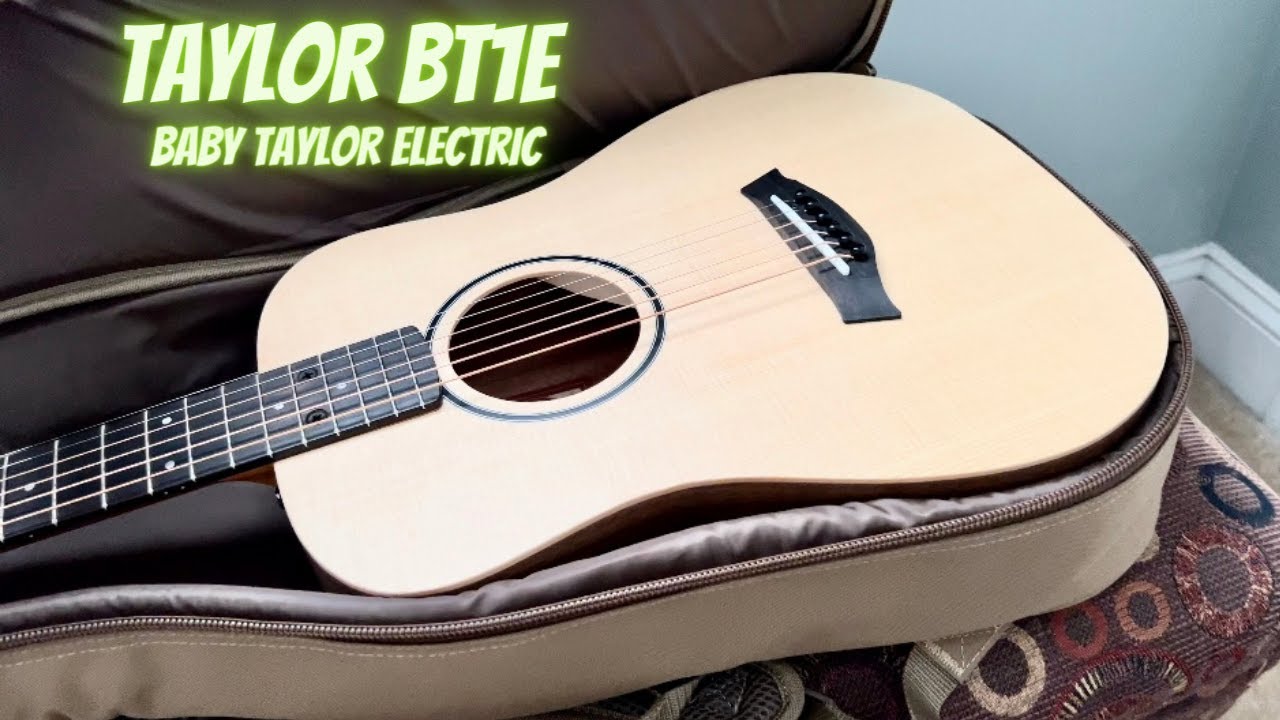
Much like the early successes of guitars in the 50s and 60s, the recipe for the BT1e hasn’t changed at all in the three decades since it launched as one of the world’s first mass-produced travel guitars. It’s got the same arched back in lieu of back bracing, those unsightly screws in the fretboard at the 16th fret, and the same 3/4 acoustic guitar scale length that makes it cosily appointed. The only thing that’s changed really is the competition, with a huge number of guitars available in a similar format.

It’s a dreadnought body shape with layered walnut back and sides and a torrefied, solid spruce top with X-bracing underneath. The neck wood is tropical mahogany with an ebony (or eucalyptus, depending on availability) fretboard, and the fret markers are 4mm dots made composed of acrylic. It’s got a Tusq nut and micarta saddle material, and the bridge is made from ebony. Die-cast tuning machines and Taylor ES-B onboard electronics complete the specifications lineup.
Specs

- Launch price: $549 | £399 | €359
- Made: Mexico
- Body shape: Dreadnought
- Body top: Solid torrefied spruce
- Top bracing: X-bracing
- Back & sides: Layered walnut
- Neck/shape: Tropical mahogany
- Scale/length: 22.75" (577mm)
- Nut/width: TUSQ nut / 43mm
- String spacing at bridge: 52mm
- Fingerboard/Radius: Ebony
- Body depth: 85.7mm
- Finish: Natural, varnished
- Bridge/pins: Ebony, plastic
- Tuning Machines: Die-cast chrome
- Electronics: Taylor ES-B
- Weight: 1.5kg
- Case: Taylor structured gig bag, tan
- Left-handed options: Yes
- Contact: Taylor
Build quality

Build quality rating: ★★★★★
The Taylor BT1e comes in a semi-solid gig bag similar to what you get with the GS Mini, which is a nice touch considering the price of the instrument. Pulling it out, I’m reminded of how absolutely tiny it is compared to a regular dreadnought. It’s super lightweight at just 1.5kg, and feels not that much heavier than the case it comes in.
Doing a close visual inspection of the body, I can find little out of place in terms of aesthetics. The solid top wood is well joined to the body with a clean line separating the two, and there’s also a lighter colored wood visible where the back meets the sides, showing what is presumably a poplar layer between the two pieces of layered walnut. The back is arched outwards, although it’s a very slight hump that’s not all that noticeable when playing.

Sitting the guitar on my lap, I can see gaps where the frets have been hammered in, which on more expensive models would usually be filled or covered with a binding. The frets themselves are very well installed, though, and everything is even up and down the dark wood of the fretboard.
The neck sits at an angle against the body near the soundhole, ever so slightly proud of the spruce top, so you can see a tiny sliver of the mahogany showing. This is part of the bolt-on neck design rather than a flaw, however, as this guitar can be easily shimmed instead of having to completely reset the neck as you would with a joint that’s glued in.
It’s that typical Taylor build quality I’ve experienced on basically every model I’ve played, and the tuners and bridge are similarly well-appointed. Interestingly, the finger joint that glues together the neck and headstock is quite visible, with the headstock wood being significantly darker than the one used for the neck, but the grain of the two woods is very well matched. The joint itself is very smoothly done, though, and when looking down at the neck side-on, you can barely see it.
Playability

Playability rating: ★★★★½
Despite the small dimensions, it doesn’t feel cramped at all
Sitting down in front of my TV with the BT1e on my lap, I proceed to start testing it with some gently fingerpicked melodies to get a feel for the fretboard. Despite the small dimensions, it doesn’t feel overtly cramped near the nut. Coming from a 3/4 classical guitar that I normally play in this position, it’s a very comfortable neck profile, and I’m able to play everything from melancholic Radiohead-inspired arpeggios to classical standards with ease.
Its neck-heavy nature does make itself immediately noticeable every time I sit up to pause playing, however, and the guitar naturally wants to fall out of my lap when I do this. With my right arm over the body in the typical playing position, it’s not all that noticeable, though, so just something to be mindful of if you decide to quickly reach for your phone or the TV remote.
An Eb major barre chord at the 11th fret is as comfortable as I can reach with my picking hand touching the body, but for single notes, I can get all the way to the 15th fret for some pentatonic scale runs. I can even hit the notes on the 16th fret above the screws for the neck joint, and they ring out just as clearly as those around it, but to be honest, I can’t see many players ever needing to go higher than this when playing this style of guitar.

Taylor doesn’t list the neck profile of this guitar on its official website, but to my hand it feels like a very soft ‘V’ profile. This is most likely due to the narrower-than-usual nut width, which means there’s less wood from which to carve a ‘C’ profile while still keeping the neck slim and playable. It’s noticeable coming from a guitar with a more usual ‘C’ profile, but it doesn’t stop it from feeling very comfortable with a variety of different playing styles.
Getting my ruler out and placing my finger on the 1st fret, I measure the action at 2mm at the 12th fret, and it certainly feels comfortable for the more fleet-fingered stuff. The short scale means it feels very quick, and full tone bends are nowhere near as difficult as they are on a full-size dreadnought. This is partially aided by the light, 12-gauge acoustic guitar strings that come with it from the factory.
Sounds

Sounds rating: ★★★★½
When played fingerstyle, the tone of the Taylor BT1e is absolutely gorgeous. It’s quite a bright-sounding guitar overall, so it responds really nicely to more gentle touch of fingerpicking. The notes sustain really well, ringing out with some lush overtones as I pick a mixture of chords with open drone notes.
Switching to a pick for some hard strumming, it’s pretty easy to get it to compress with a good whack of an open E major. My current strum tester track is the opening of ‘Master Exploder’ by Tenacious D, and when attacking the BT1e with a guitar pick, it’s a very bright sound, with heavy strumming leading to a slight harshness in the upper frequencies.

I’d be more than happy to put it into a PA system for live playing
It’s not designed to be a hard strummer, of course, you’ll need a full-size dreadnought or jumbo acoustic for that, and with a more measured pick attack, it’s a lovely-sounding guitar. There’s not a huge amount of low end, but it’s balanced across the spectrum, with plenty of clarity across all the notes, whether I play barre chords, open chords, or single note licks.
Plugging it into my audio interface to test out the onboard pickup and electronics, I find a surprisingly lifelike sound. It’s not as good as it sounds in the room, and there’s that very present ‘plink’ sound you get from most acoustic guitar pickups, but overall, I’d be more than happy to put it into a PA system for live playing.
I did find it needed a significant gain boost even with the onboard electronics at max volume, adding around 15dB to get it peaking at -6dB in my DAW meters, so if you are planning on playing this guitar live, it’d definitely be worth adding an acoustic guitar pedal to help shape and boost the sound.
Verdict

Despite its toy-like dimensions, the Taylor BT1e Baby Taylor comes across as a very grown-up acoustic indeed. The unplugged sound is phenomenal for everything shy of the hardest strumming, and sitting on the sofa playing fingerstyle is a joyous experience with this excellent acoustic. With a surprisingly usable onboard electronics system, it can also do the job for live playing, should you wish to take it out of the house.
Those with very large dimensions might struggle at the upper registers
Those with very large dimensions might struggle at the upper registers, and it is very neck-heavy, but these are two flaws small enough to forgive when the overall playing experience is so comfortable and sounds this good. It doesn’t respond particularly well to really hard strumming, but then that is the nature of small body acoustics as they compress more easily due to their size.
Guitar World verdict: As far as 3/4 size acoustics go, there’s a reason the Taylor BT1e Baby Taylor has been at the top of the game for the past 30 years. The combination of excellent tone, fantastic playability, and rock-solid build quality makes it a brilliant addition for any player, whether you’re looking for your very first instrument or you’re an experienced guitarist who wants something comfortable for songwriting sessions and sofa noodling.
Test |
Results |
Score |
|---|---|---|
Build quality |
A superbly put-together instrument with nothing out of place |
★★★★★ |
Playability |
Great for beginners and small to medium dimensions, but bigger players may find it cramped |
★★★★½ |
Sounds |
Phenomenal fingerpicked tones and light to medium strumming, struggles with heavy picking though |
★★★★½ |
Overall |
One of the best 3/4 acoustics ever made, well-suited to a huge variety of players |
★★★★½ |
Also try
Hands-on videos
Marty5150
Matthew Finch

Rimmers Music

