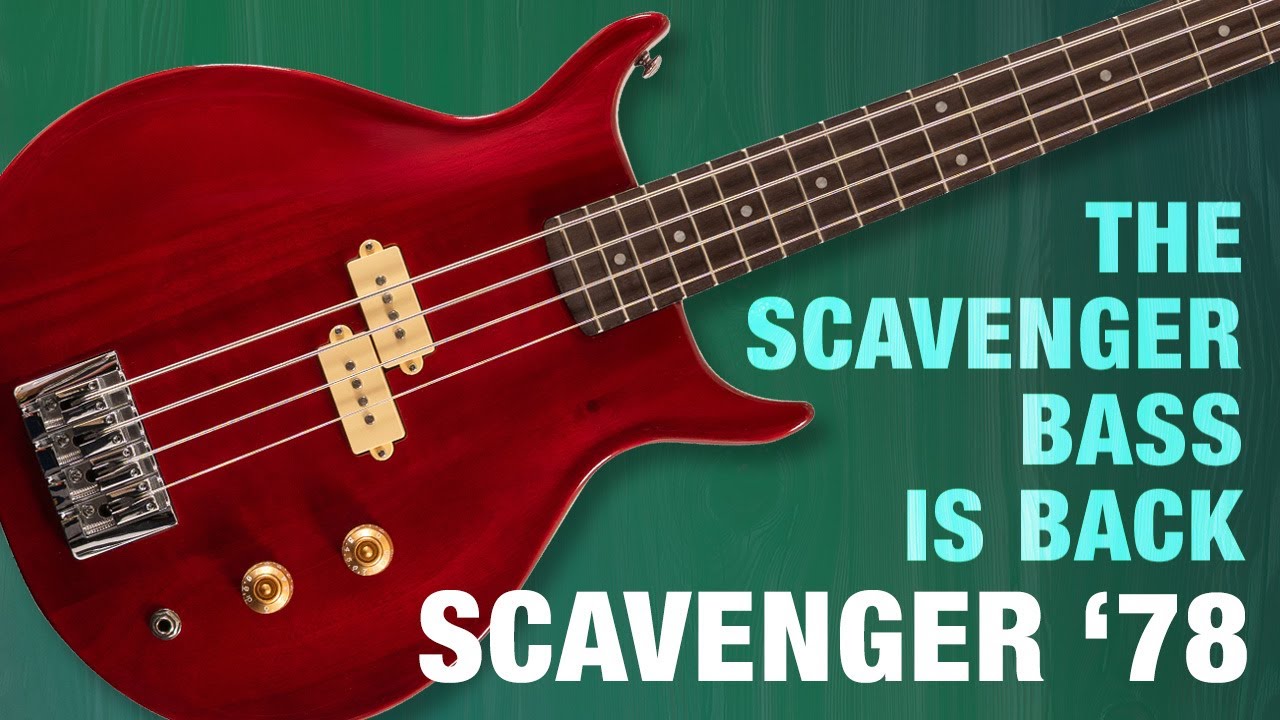
Guitar World Verdict
The new Scavenger reissue proves that Washburn still has much to offer, even by simply returning to its back catalogue. It's a fun, lightweight, playable instrument with a killer, aggressive P-bass growl. If you like the ‘70s throwback styling, you'll surely enjoy the rest of the package too.
Reasons to buy
- +
Lightweight, playable and would doubtless be lots of fun to thrash around onstage.
- +
No-nonsense, growling P-bass tone.
Reasons to avoid
- -
The satin neck finish looks and feels a little cheap, and the neck-to-body join is clunky.
- -
If you're used to Fender ergonomics, it'll take some getting used to.
You can trust Guitar World Our expert reviewers spend hours testing and comparing guitar products so you can choose the best for you. Find out more about how we test.
What is it?
Where did Washburn go? For those of us who follow the instrument industry, it's quite a shame to see the way in which this storied American brand has disappeared from the limelight in recent years.
With a dwindling model line-up, and even a shock split from their highest-profile and longest-serving endorser, Nuno Bettencourt, the company has seemed notably down on its luck lately. Now, though, there are signs of life with – and a rebirth of a cult-classic range from the company's more fruitful 1970s and ‘80s era.
That was a time at which the Gibson-inspired double-cutaway guitar was in vogue, with the likes of the boutique Hamer Special, and the more affordable Ibanez Artist and Yamaha SG, all doing a roaring trade. Washburn got in on the action too, releasing the distinctive Japanese-built Wing series in 1978 – the near century-old company's first proper foray into electric guitars and basses.
The narrow, pointed cutaways and the neck-through construction of the posher models set them apart; they're an interesting retro curio today. For 2026, though, the Wing returns – we've already looked at the Hawk guitar from the series – and brings with it a reissue of the range's best-known bass: the Scavenger.
Priced at $699, it wades into a market that's absolutely bursting with choice, from entry-level Fenders to Soundgears, Sires and Sterlings. Of course, the Scavenger's name begins with ‘S’ too, which augurs well – but the point is, it needs to impress.
Specs

- Launch price: $699 | £569 | €589
- Made: Indonesia
- Type: Four-string electric bass
- Body: Mahogany
- Neck: Mahogany, C profile
- Fingerboard material/radius: Rosewood, 16” radius
- Scale length: 34”/864mm
- Nut/width: Bone / 41 mm
- Frets: 22
- Hardware: String-through-body bridge, Grover tuners, chrome
- String spacing at bridge: 19mm
- Electrics: Washburn P Style Split-coil, volume, tone, 3-way toggle switch
- Weight: 7.5lb/3.4kg
- Left-handed options: None
- Finishes: Ruby Red (as reviewed), Black
- Case: None
- Contact: Washburn
Build quality

Build quality rating: ★★★★☆
It really does look like the original from ‘78
There's no getting around the fact that it's a bit of an acquired taste, aesthetically. Some will be turned right off it but, personally, I'm a fan of its overtly retro vibe – it really does look like the original from ‘78.
The fundamental construction quality feels more than good enough overall - no rough edges to speak of, not necessarily a given at the price.
The mahogany body and neck are both finished in transparent cherry-red; gloss lacquer for the former and satin for the latter. Many players will prefer a satin-finished neck, of course, and it's adequately executed, but there's one sticking point for me – it looks and feels a little cheap when compared to an open-grain finish, for example. The heel of the bolt-on neck is very large and cumbersome too, which doesn't help.

Componentry is a mixed bag; the chrome die-cast sealed tuners look a little weedy and ‘budget’, but then the bridge is a very solid, high-mass item with chunky saddles. It's even set into the arched top of the body for the correct string angle – and it provides the option of through-body stringing, which is how this example has been set up. Very nice.
Playability

Playability rating: ★★★★☆
I'd done a bit of research into the original Scavenger, becoming slightly apprehensive when I read about examples tipping the scales at 11lbs or more
I'd done a bit of research into the original Scavenger, becoming slightly apprehensive when I read about examples tipping the scales at 11lbs or more. I needn't have worried about that; this example is, in fact, quite a lightweight at around 7.5lbs.
From the box, though, it needed a fair bit of adjustment - the neck was bowed too far back, causing open strings to choke out. Thankfully, after letting in some relief at the truss rod, and adjusting the bridge saddles to compensate, the Scavenger started to come good. This done, the playing experience is much better – the neck is a good, comfortable shape, and it’s an enjoyable instrument with a nice natural ring to it.

Balance can be a bit of a sketchy subject on symmetrical double-cutaway instruments like this; it’s certainly a bass that sits on your lap differently, and hangs a little oddly on the strap compared to a Fender-style equivalent.
One saving grace is the strap button’s position on the inner horn – it looks a bit awkward, but it does pivot the bass’s neck upwards into a slightly more useful position.
Sounds

Sounds rating: ★★★★½
There are no fancy tricks whatsoever with the Scavenger’s electrics. With a classic split-coil pickup in the traditional middle position, and a simple Volume and Tone control layout, it’s classic P-bass territory all the way down.
So, my direct comparison is my own beloved P-bass of choice - actually, a 1983 Ibanez Roadstar, but with that same traditional layout; a bass that would have been a contemporary of the original Scavenger.
And the Washburn gives a great account of itself - like my old Ibanez, it doesn’t sound like a vintage-spec Fender, but that works in its favour for all sorts of hotter tones.

With my go-to Ampeg SVT and Acoustic 360 emulations, the P-bass sounds of the late ‘70s and ‘80s come roaring out of the Scavenger - it could probably do Motown if you wanted, but this bass seemingly yearns to slam out punk, new wave and alt-rock riffs.
If your tastes run heavier, consider that abrasive sludge-metallers Kowloon Walled City also favor old Washburn basses like this too.
Verdict

As I hinted in the opening to this review, I've a soft spot for Washburn as a bit of an ‘underdog’ brand. To add to this, I also have a curious obsession with ‘70s and ‘80s Japanese instruments so, admittedly, I rather wanted to like the Scavenger to begin with. Thankfully, there is plenty to like.
I can see it going down a storm with players who want a gnarly P-bass sound
I can see it going down a storm with players who want a gnarly P-bass sound, but in a format that looks and feels a bit different and left-field.
With its hot and powerful tone, it will suit more aggressive players down to the ground, and its cult-classic aesthetics will only add to that appeal. On this basis, let's hope for more interesting products to come from Washburn.
Guitar World verdict: The new Scavenger reissue proves that Washburn still has much to offer, even by simply returning to its back catalogue. It's a fun, lightweight, playable instrument with a killer, aggressive P-bass growl. If you like the ‘70s throwback styling, you'll surely enjoy the rest of the package too.
Test |
Results |
Score |
|---|---|---|
Build quality |
It's not a fancy build, but the construction and hardware are perfectly solid. |
★★★★☆ |
Playability |
Once set up, it's great fun to play and feels lively and resonant. The ergonomics are a bit strange if you're used to Fenders. |
★★★★☆ |
Sounds |
It's a hot, punchy-sounding Precision Bass sound, nothing more and nothing less. An evergreen sound. |
★★★★½ |
Overall |
The Scavenger is a really interesting addition to the market, and one that deserves to do well. |
★★★★☆ |
Also try
Hands-on videos
Washburn TV