

Far from the world of acoustic guitars, basses really come to life when you pair them with an amp. And, as with seemingly everything nowadays, price is as big a consideration as anything when buying gear, which is why we’ve put together this list of the best budget bass amps you can currently get your hands on.
Whether you’re playing in your bedroom at home or gracing the stage down at your local venue, our pick of the best budget bass amps all deliver the powerful low-end punch that you need when playing this glorious instrument. Thanks to modern technology, many of the best budget bass amps even double as recording interfaces.
Some are super simple, with basic EQ and volume controls; others might be more feature-packed. The best budget bass amps cover all genres too, so it doesn’t matter if you’re sitting back, playing it cool with some clean, mellow grooves, or you’re right up in the mix with gnarly, driven bass tones - there’s something here for everyone.
And if you want to know my top pick right off the bat, it's the Laney Digbeth Foundry DBF100, thanks to its wonderful clean tones, EQ options, and versatility.
For more information, check out my FAQ section below - and don't forget to take a look at my glossary of key terms to help you choose the right budget bass amp for you.
Best overall

✅ Buy if you want a top-performing bass amp for a great price: With great tones, lots of EQ options and plenty of volume, this is a cracking bass amp.
❌ Avoid if you just want a straightforward amp: There might be too much going on here for first-time players
The Laney Digbeth Foundry series builds on the company’s heritage but brings it into the modern world. It blends old-school, tube-style tones with functionality and affordability that results in an incredible bass amp that will sit nicely on any stage or in any studio.
These things are very reliable. It’s got hard-wearing vinyl covering the amp, and the metal corners protect it when you’re loading and unloading it from the car to the venue. It’s also fitted with a premium 12” speaker that can handle serious volume and low-end.
What I really like about this amp is the ability to choose between Drive and FET channels but also blend them allowing you to get gritty, aggressive sounds while still being clear and articulate.
You’ve also got lots of options in terms of EQ too so you can really fine-tune your sound. It sounds incredible, and it’s got that classic Laney look. A great bass amp that I think deserves top spot in this list.
Best for beginners

✅ Buy if your a new player who needs a basic amp: This is a stripped-back bass amp that's ideal for beginners - but will also suit veterans thatnls to its Drive function.
❌ Avoid if you want more from your amp: What's here is great for the price, but more experienced players might be looking for some extra tweakability.
Blackstar’s Debut series aims to provide everything payers need in an amp, and nothing they don’t. Here’s a very simple, stripped-back bass amp that provides quality tones, a basic feature set and solid build quality.
What’s really nice about this amp is that it actually looks and feels more premium than its price tag might suggest. The knobs have a nice amount of resistance when turning them and the whole thing is reassuringly solid. It’s super easy to use, and there’s a drive button that lets you add in some grit when you need it.
Where it really punches above its weight though is the sounds. You get a lot of low end and even more volume - for its size, this thing is loud! It’s fine for at home, but you could also manage playing with friends and even rehearsals (depending on how loud your drummer is).
You can’t adjust the amount of drive you get when you engage the button, but it will suit most players just fine.
Best for effects
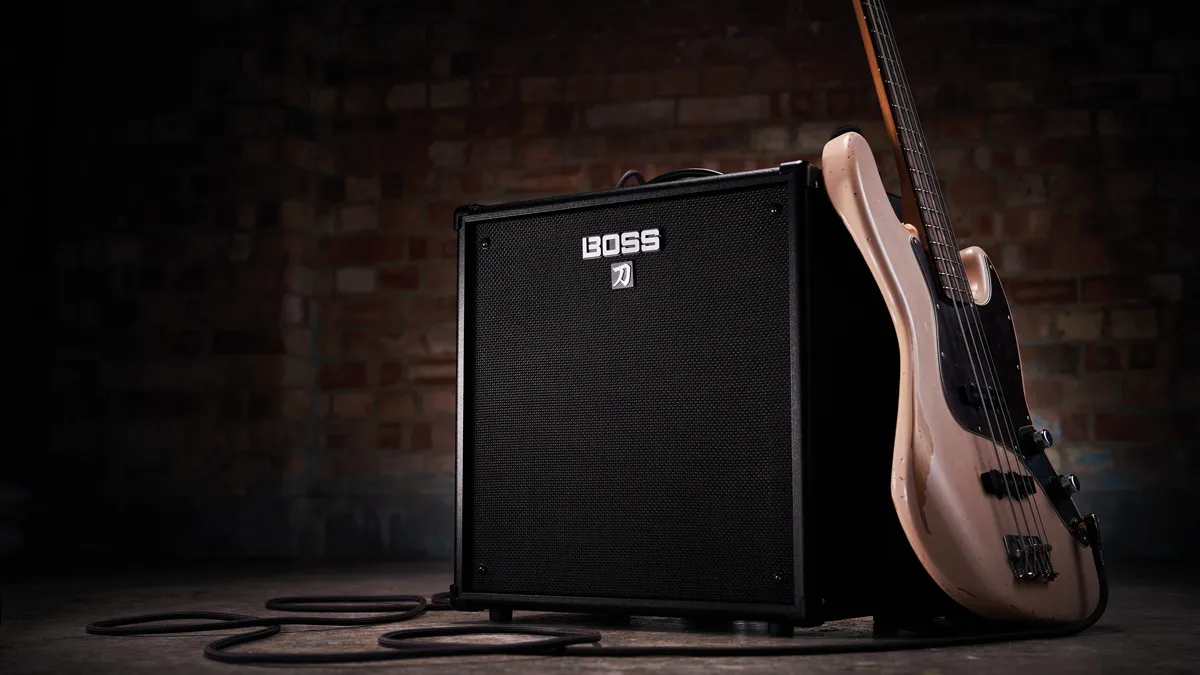
✅ Buy if you're looking for a robust bass amp to gig with: The Boss Katana Bass 110 is packed with cool features and the sounds it produces are excellent.
❌ Avoid if you're just starting your bass journey: With so much going on under the hood, operating this amp could be overwhelming for first-time players.
Boss have really nailed the world of sub-£/$500 amps with much of their Katana range. The KTN-110 is a 1x10”, 110W modeling bass amp aimed at beginners and more advanced players alike. It’s an outstanding solution for studio, home and live use, so you’re covered in any eventuality.
Packed full of features, the KTN-110 has an array of knobs and buttons on the top panel, as well as a whole bunch of connectivity options. So, not only can you get a wide range of sounds, you can also use the amp with headphones, as a recording interface, alongside footswitches and more. Like anything wearing the Boss badge, it’s built to last and has been made with gigging players in mind.
The controls allow you to dial in whatever sound you want; from vintage to modern with everything else in between. You’ve got access to compression and drive as well as any other legendary Boss effects plus the EQ section lets you choose exactly how your bass sits in a mix. The quality of sounds you get from this amp is excellent. Lots of low end, plenty of clarity; the overdriven tones are amazing and the effects are great too.

"You’re getting an impressive array of sounds for your money with this amplifier, and as such, it’s highly recommended."
Read our full Boss Katana 110B review
Best for overdrive

✅ Buy if you're after a no-nonsense amp: The RB110II has plenty of power and is a no-frills, big, beefy performer.
❌ Avoid if you want more bells and whistles in your bass amp: This might not cut the mustard for players looking for a multitude of effects.
Ampeg are one of the biggest names in the world when it comes to bass amps and as such, you’ll see them at every level of live music - from dive bars to stadiums. The Rocket Bass RB-110 has been designed to give you that classic Ampeg sound at a budget price point.
With its 50W of power, you’ll be able to generate some serious noise - possibly even enough to play live with, depending on how loud your drummer is. There is an XLR output on the back though so you can hook it up to a PA system.
The amp has a really cool finish on the surface as well as the vintage style silver grill. The metal corners help protect it when moving it around, and the control panel on top is nicely laid out snd functions exactly as it should . The only downside is that the handle feels a little cheap.
Tone-wise, the amp is superb. It’s a nice, articulate clean sound but it comes alive when you engage the SGT (Super Grit Technology) which aims to replicate the legendary sound of a tube-equipped Ampeg breaking up.
Best for modeling

✅ Buy if you want to mess around with a variety of sounds: The LT25 has loads of sounds and effects to experiment with - and it's easy to use.
❌ Avoid if effects galore aren't quite your thing: Not everyone will need access to all the extras in this amp.
The Fender Rumble LT25 represents the big F’s entry point into the world of bass amp modeling. Even with its modest price tag, it’s a great bass amp for those just starting out but also for experienced players that want to experiment with different sounds.
Even though the Rumble LT25 gives you access to loads of different sounds and effects, it’s relatively easy to use. Everything is dialled in via the knobs at the top - even programming your own sounds. It’s also built really well - the casing is sturdy and the ported wooden cabin helps it resonate nicely.
From clean and mellow tones to gnarly and bright, this amp covers all the sounds you could ever want - and more! It’s incredibly versatile, it’s got tons of neat features and the quality of the tones is also very impressive.
"With the LT25, Fender has used its platform as innovators to build an amp that wants you to join the innovation."
Read our full Fender Rumble LT25 review
Best for live

✅ Buy if you want an extremely portable bass head for gigging: The BQ250 small size is perfect for lugging around between gigs and it sounds terrific.
❌ Avoid if you want an all-in-one amp: You're going to need a cab so the BQ250 might not be an ideal fir for your playing.
Want a portable head for live shows? Then look no further - the TC Electronic BQ250 is a small, lightweight 250W bass head. Boasting a super modest price tag and an impressive feature set, it’s ideal for anyone on the gigging circuit, regardless of what level they’re playing at.
Its size and weight make it perfect for taking out on the road when space is not a luxury you have. Coming in at 69 x 255 x 233 mm and weighing just over 2kg, it’ll fit in a standard rucksack so it’s easily transportable. The casing is made from hard-wearing steel too so it can withstand the rigours of touring.
Plus, it sounds great. You can blend in some overdrive if you want a more aggressive sound, and, a feature I really like about this amp - you’ve got a compressor built in that can be dialled in using one simple knob.
A four band EQ takes care of tone-tweaking and an active/passive switch means that you can get the most out of whatever kind of bass you’re using.
Best for portability

✅ Buy if you want an ultra-portable amp for practice sessions: Powered by batteries, the Laney MINI-BASS-NX is a great little practice amp.
❌ Avoid if you're after a more substantial bass amp: A bigger amp is going to beef up your sound, so this isn't really meant for live shows.
Want a portable bass amp to get warmed up with before shows? The Laney MINI-BASS-NX has you covered. Powered by six AA batteries, this 6W mini bass amp can be taken with you anywhere, or it can sit on your desk without taking up much space, ready for when inspiration strikes.
It features some of the same styling as Laney’s classic Nexus range which gives it instant vibe. It’s well constructed and the four little finger grooves on the back of the amp make it easy to pick up and carry. Details like this aren’t game-changing but they’re certainly a nice touch.
The sounds are pretty good too. Of course, you don’t get as much bottom end or projection as you would with a bigger amp, but when portability is key, this thing really delivers.
There are some versatile tone-shaping features too like the Tilt and Tone knobs, and you can blend in some hard-hitting gain. You can even connect the amp to your smartphone to access more tones.
Best value

✅ Buy if you're a bass player on a tight budget: It's hard to argue with the price of this Vox, especially with its classic design and warm tones.
❌ Avoid if you have a bit more cash to splash: This is a budget amp, so don't expect massive slabs of bass when you're playing.
Vox is a huge name in the world of amplifiers, largely thanks to its close association with the sound of emerging British music in the 1960s. The Pathfinder range gives players the chance to get a piece of that history without having to spend a ton. If you’re after a simple, good-sounding budget bass amp for home use then this is one to consider.
It’s a nice little practice amp that is well-built and the handle feels solid which makes transporting it easy. It also sports the classic Vox aesthetic which could be a big draw for some players.
A simple four knob (plus one switch) layout makes crafting your sound a piece of cake, and you’ve got the option of plugging in headphones for silent practice.
It’s a small, affordable bass amp and the sounds do reflect that. You’ve got a drive knob so you can blend in some overdrive but it’s still fairly basic. For its size, you do get some decent low end, but it’s only really suited to playing at home.
Best practice amp

✅ Buy if you're after a rock-solid bass amp that's perfect for practice: The Bass LX is extremely durable and has plenty of options to fine-tune your playing.
❌ Avoid if need more bottom-end punch: You might want to look elsewhere for a really hard-hitting bass delivery.
This budget bass amp has loads of features on board which make it the perfect at-home practice amp. It’s got five different preamp types, an array of effects, built-in looper and on-board backing tracks. It can also be powered by batteries so if you need something to dish out your low end on the go, then this is perfect.
Boss are known for making quality gear that lasts for a long time and the Dual Cube Bass LX is no exception. It’s built solidly, the buttons and knobs feel reliable and the handle is nice and sturdy. Even though the amp is capable of doing a lot, it’s fairly easy to use - there are no LCD menu screens here.
You’ve got extensive connectivity options on the back as well so you can use this for recording, and even gigging. The backing tracks are useful for improving your timing and groove, and the looper means you can experiment with layering your own parts.
You’ve got plenty of different sounds to choose from, from vintage to modern so it will suit any style of bass or music that you’re playing. The amp is compact but it still delivers a nice low-end punch and if you want to explore different sounds and textures, then the effects can help you do that. All in all, it’s a very comprehensive amp with tons of useful features for the modern player.
How to choose
You’re keeping an eye on your cash, but you want some beefy low end - that’s where the best budget bass amps come in. But which one should you choose?
Aside from price, some key considerations to make include power, features, effects, head vs cab and of course tone. Some of the best budget bass amps may give you a more modern sound and others might go down a more classic route. Some may even allow you to do both.
Of course, modeling amps are starting to become more commonplace in the world of bass amps, as well as guitar amps so if you want, you can have access to the sounds of multiple amps all in one unit.
You can ask yourself some questions to help narrow the choice down - where will you be using the amp mostly? Is this just for home use, or are you playing with other musicians? Are you looking for a bass amp for live use, and if so - do you want it to be the same amp that you play at home? Are you travelling with the amp? What style of music do you play?
FAQ

How powerful does my bass amp need to be?
Here’s one of the most common questions you’ll hear when talking about the best budget bass amps. How powerful it is - that is, how many watts it’s rated at, largely determines how loud the amp will be.
If you’re just starting out and you want a bass amp that will simply make your bass a bit louder and give you the low end you need in a fairly small space, then you don’t need much - anything above 30 or 40W is probably overkill.
But, if you’re thinking of playing with other people - particularly a drummer - in the near future then it might be worth considering something more powerful. Depending on the style of music you play, drummers can be pretty loud so you’ll want a bass amp that can keep up. 50W will probably do it, but if you’re playing live then go higher if you can - 100W or more.
Do I need effects on a bass amp?
It’s completely up to you whether you opt for a bass amp with or without effects, so no, you don’t need them as such.
Many players like to experiment with different tones, sounds and textures and effects are essential for that though. If you’re unsure but you like the idea of enhancing your sound a bit, then maybe look for something that has compression, chorus and overdrive as a minimum.
Can I just use a guitar amp for bass?
You really shouldn’t. While your bass will still work through a guitar amp, you won’t get the most out of your instrument and you run the risk of damaging the amp.
Bass guitars sit an octave lower than standard guitars and as such, bass amps are built to withstand much lower frequencies. Guitar amps are designed for their frequency range so if you run a bass through it, you’re putting strain on the speaker.
What do we mean by budget?
Essentially we’re referring to anything that’s unlikely to be seen in a touring professional’s rig. Not that cheaper gear isn’t up to the task, but we’re generally looking anywhere under the $/£500 mark.
What’s a bass modeling amp?
Modeling amps have been become increasingly popular in recent years. They aim to emulate the sound and response of various different amplifiers - usually ones that are sought after and highly regarded.
Should I get a bass head or combo?
When looking for the best budget bass amp, you might be faced with the option of going for a head or a combo. Heads require an external speaker cabinet to make any noise, whereas combos are an all-in-one solution.
If you’re gigging a lot and playing with other bands, you might find that either the venue or other bands have a cab that you can use, so you’ll only need to bring your head which makes travelling a whole lot easier.
Of course, if you just want to make some low-end noise without having to rely on others or buy a separate cab then a combo is the way to go - it’s got both the amp and speaker built in.
Does my bass amp need a DI?
Many bass amps feature an XLR output (often labelled as DI or direct out) that enables you to take a cable from your bass amp to an interface or front of house console (PA system). This means that for live gigs, the sound engineer can easily mix how loud your bass is, regardless of your volume on stage.
Glossary
Head: The preamp part of an amp, without the speaker. Needs to be plugged into an external speaker cabinet to make any sound.
Cab: Speaker cabinet - for heads to be plugged into.
Combo: This features both the amp and speaker all in one unit.
EQ: Short for equalization. Refers to the different frequency bands. In context of bass amps, a three band EQ would usually be low, mid, treble.
Drive: Short for overdrive. Old amps would gradually distort as you turned them up. Overdrive controls on bass amps emulate this.
Compression: One of the most common effects for bass. Essentially, it evens out your dynamics making your quiet playing a little louder, and your loud playing a little quieter.
DI: Stands for Direct Input. Technically, it should be DO for direct output as many bass feature an XLR output that lets you run a cable from the amp to a bigger sound system. At this point you then input the cable into a mixing desk or similar, hence DI.
How we choose the best budget bass amps

Here at Guitar World, we are experts in our field, with many years of playing and product testing between us. We live and breathe everything guitar related, and we draw on this knowledge and experience of using products in live, recording and rehearsal scenarios when selecting the products for our guides.
When choosing what we believe to be the budget bass amps available right now, we combine our hands-on experience, user reviews and testimonies and engage in lengthy discussions with our editorial colleagues to reach a consensus about the top products in any given category.
First and foremost, we are guitarists, and we want other players to find the right product for them. So we take into careful consideration everything from budget to feature set, ease of use and durability to come up with a list of what we can safely say are the budget bass amps on the market right now.
Read more about our rating system, how we choose the gear we feature, and exactly how we test each product.
Why you can trust us

✅ A global audience of 3.8 million guitarists monthly
✅ 1,200+ reviews on GuitarWorld.com
✅ 30+ years of product testing at Guitar World
Guitar World boasts over 44 years of expertise and stands as the ultimate authority on all things related to guitars. The magazine and website feature expertly written gear round-ups and top-quality, authoritative reviews penned by a team of highly experienced industry professionals.
Guitar World's inaugural print issue hit the shelves in July 1980, and ever since, it has been captivating players and enthusiasts with engaging lessons, insightful interviews with the most prominent guitar heroes, and priceless buying advice for newbie players.
Furthermore, GuitarWorld.com continues this legacy online and serves as the hub of the world's foremost authorities on guitar playing. The site not only hosts content from Guitar World but also showcases articles from respected publications such as Guitarist, Total Guitar, Guitar Techniques, and Bass Player. With a reach extending to 3.8 million players each month, GuitarWorld.com is a go-to destination for guitar fanatics globally.
Meet the experts

After spending a decade in music retail, Richard is now a freelance writer for MusicRadar, Guitar Player, Guitar World and Reverb, specialising in electric and acoustic guitars, bass, and almost anything else you can make a tune with. When his head’s not buried in the best of modern and vintage gear, Richard runs a small company helping musicians with songwriting, production and performance, and plays bass in an alt-rock band. Otherwise, you'll probably find him out walking the dog!

Ross has been a music lover and guitar player since the age of 8. He has spent the five years since graduating from university working in music retail, selling guitars, amps and more. Ross is particularly interested in electric guitars, pedals and amplifiers and his current rig includes a trusty 2009 American Standard Stratocaster and Vox AC30S1 with a few Walrus Audio and Way Huge pedals in between.
Latest updates
08/04/26: The guide has been completely rewritten from the ground up and now has a new roster of budget bass amps alongside "At A Glance" panels highlighting the pros and cons of each. Expert verdict panels have been added where applicable while the FAQ section is completely new. We've also added sections on how to choose the best budget amp and a section detailing why you can trust the Guitar World team. There's also now a glossary with all the key terms and we've now included a section on how we test products. Finally, we've added a "Meet The Experts" section so you can get to a bit more about the authors of the guide.
Read more
You can trust Guitar World Our expert reviewers spend hours testing and comparing guitar products so you can choose the best for you. Find out more about how we test.
- Best bass strings: Get the best tone, feel and lifespan from your bass
- Best budget bass guitars: our top pick of basses under $500/£500
- Best gifts for bass players: ideas for birthday and beyond