

Guitar World Verdict
Like its Lionheart stablemate, the Ironheart Foundry series makes clear that traditional solid-state amps are still very much a viable proposition for today’s guitarists. It’s not always easy to balance both channels, but you can get some fabulous tones from the IRF60-112 - and with plenty of modern convenience to boot.
Reasons to buy
- +
Easily loud and tough enough to gig with.
- +
The XLR direct output is really useful for bigger gigs, or easy recording.
- +
Both channels sound great, with a wide range of adjustability.
Reasons to avoid
- -
Overall ease of use would be improved with a footswitch – but it's not included.
- -
It can only be carried two-handed, which isn't always optimal.
You can trust Guitar World Our expert reviewers spend hours testing and comparing guitar products so you can choose the best for you. Find out more about how we test.
What is it?
Laney has done more than most manufacturers to bolster the reputation of the humble solid-state guitar amp in recent years.
Transistors have often been considered a bit of a poor relation to the tube amp's golden child - detractors will say that they’ve neither the versatility of modeling gear, nor the ultimate tonal quality and power of a glass-powered amp. That's quite a generalization, of course – but then, plenty of guitarists are haunted by memories of flatulent practice amps from their early days of playing.
However, there are still those who want neither the complexity of in-depth modelers, nor the added weight of valve power – just simple, rugged, loud amps that do a good job, without breaking the bank. Laney has seized that opportunity.
Along with the well-received Crush series from fellow Brits Orange, the storied Black Country brand has led the charge on higher-output, gig-ready and affordable combos and heads, built around analogue solid-state tech. The recent Lionheart Foundry series (a counterpart to Laney’s retro valve-powered Lionheart range) has garnered no shortage of praise since its release.

Now, it's the turn of the modern, high-gain Ironheart series. We’ve seen shrunken, solid-state Ironheart heads (the single-channel IRF-Leadtop and the twin-channel IRF-Dualtop) but not combos – until now.
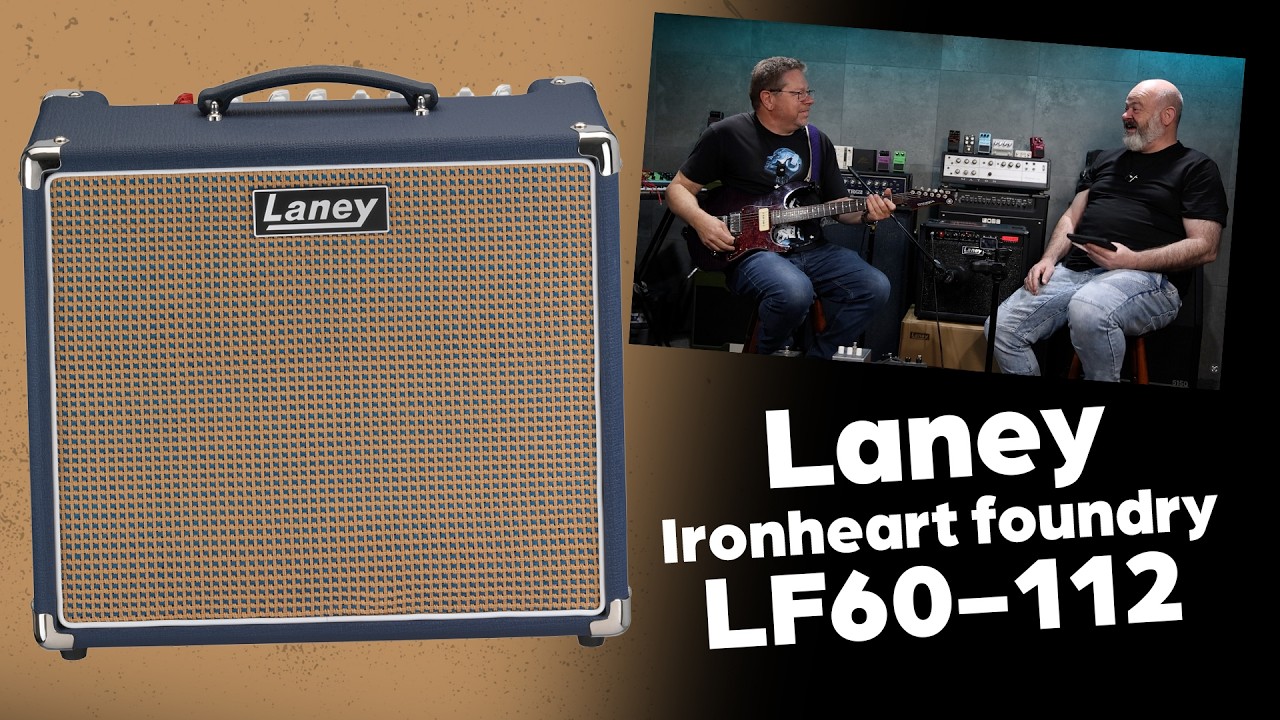
Following the launch of three Ironheart Foundry series combos (plus a fuller-featured 120w Foundry head), today I'm taking a look at the mid-range IRF60-112 combo.
Specs

- Launch price: $599 | £349 | €399
- Type: Solid-state guitar combo amp
- Origin: China
- Output: 60 watts
- Speaker: 1x12”, HH H1260
- Channels: 2
- Controls: Front panel - Boost on/off switch, Boost level knob, Channel 1 clipping switch (Asym/Clean/Sym), Channel 1 Gain, Volume, channel select switch, Lead Gain, Lead Volume, Channel 2 voicing switch (Bright/Flat/Dark), Bass, Middle, Treble, Reverb. Rear panel - Power on/off switch, Power Mode switch (60w/1w), 3-way LA:IR cab emulation selector, Ground/Lift switch.
- Connectivity: Front panel - ¼” instrument input. Rear panel - mains IEC input, 2x ¼” Remote outputs, FX Send/Return, 3.5mm Aux In, 3.5mm headphone output, XLR DI output, USB-C output.
- Footswitch: Not included
- Weight: 12.2kg/26.9lb
- Dimensions: 486 x 437 x 261mm
- Contact: Laney Amplification
Build quality

Build quality rating: ★★★★½
Solid-state amps do rugged simplicity very well. With no valves to worry about, it's also possible to make them smaller and lighter. The Foundry is a compact amp and, at 12.2kg, far from heavy.
Like other Ironhearts, it's transported via two very sturdy-feeling metal cut-out handles on the top edges, balancing the weight equally (also looks pretty cool) – but this does necessitate a two-handed carry. An additional top handle wouldn't go amiss.

Those handles give a great first impression of the overall solidity of the amp, but there are no notable weak points elsewhere. It feels tough, all of a piece, as though it'd cope easily with regular gigs – and looks great too.
Usability and features

Usability and features rating: ★★★★☆
Unlike the smaller 1x10 Foundry combo, the IRF60-112 has two full channels, everything being laid out neatly and easy to understand. The clean and lead channels have individual gain and volume controls, but share EQ and reverb. The EQ pots have a centre-detent at 12 o'clock; you cut and boost from flat, similar to an active circuit.
Sturdy metal mini-switches change channels, introduce clipping into the clean channel, and make some broad-stroke voicing adjustments to the lead channel. There's one more, for the built-in boost circuit - controlled by a single, red knob, this gives a healthy kick to the clean and lead channels alike.

The rear panel isn't short of features, either. There's an effects loop, and a pair of footswitch inputs – although not having a switch included is a little mean.
Then an aux input, a headphone socket, Laney's proprietary LA:IR emulated XLR output and, finally – a low-power switch to take it from 60 watts down to just one watt, for quieter home practice. But it's a little solid-state combo – how potent can it be?
Sounds

Sounds rating: ★★★★☆
In fact, you’ll be glad of the low-power switch – the IRF60-112 is Loud. For such a wee beast, it kicks like a mule; easily enough for small stages, and then you can send it direct for anything louder.
Channel 1 is your clean sound, but there's also the option of either asymmetrical or symmetrical clipping – I'd argue that just one or the other would have been sufficient, as they’re only subtly different. With clipping engaged, though, and the right guitar, there’s plenty beyond the stereotypically ‘lifeless’ solid-state clean to be found here.
The Foundry can offer some really nice low-gain tones with plenty of warmth and character. The built-in reverb adds to this, although it starts to sound pretty overwrought with the dial anywhere beyond about 11 o’clock.

Channel 2 is what makes the Ironheart tick, though, and there’s much to like. With either single-coils or humbuckers, the IRF60-112 blasts out heavy, saturated distortion that retains a good amount of definition for modern rock and metal tones.
Despite its small stature, it’s not lacking in low-end, and has masses of tight, punchy gain on tap (but modern metallers might like a noise gate to tighten it further).
The Bright switch dials up the aggression and clarity, while Dark seems to have an EQ curve closer to the Clean channel – I ended up using this mode, then pushing the shared Treble control higher to give both channels a similar type of top-end, but I found many other useful tones along the way.
The shared control set does create issues when dialing the Boost, however – the additional input gain makes the second channel more saturated while the clean tone just gets louder, throwing your levels off-balance.
Then there’s the reverb – it’s useful for the clean channel, but you likely don’t want it on your high-gain rhythm tone. Both of these can be operated via the footswitch… after you buy it separately.
Verdict


So, the IRF60-112 is a seriously loud, punchy amp that provides great low and high-gain tones (although having these co-exist these can take some work).
LA:IR means you can feed it into the PA if you find yourself on a bigger stage, and makes home recording easier too. This alone really elevates this amp
It’s also full of useful features, it’s small and lightweight, and far from expensive. LA:IR means you can feed it into the PA if you find yourself on a bigger stage, and makes home recording easier too.
This alone really elevates this amp in terms of usability and means that, even with its small stature, you won’t necessarily grow out of it in a hurry.
Laney’s decision not to include the footswitch does leave a sour taste but, once you’ve got one of those, this is an amp that many metal guitarists could enjoy for years to come.
Guitar World verdict: Like its Lionheart stablemate, the Ironheart Foundry series makes clear that trad solid-state amps are still very much a viable proposition for today’s guitarists. It’s not always easy to balance both channels, but you can get some fabulous tones from the IRF60-112 - and with plenty of modern convenience to boot.
Test |
Results |
Score |
|---|---|---|
Build quality |
A really solid build, especially given its reasonable price; an extra top handle would be useful. |
★★★★½ |
Usability and features |
Simple and intuitive layout, with lots of great features - but not having a footswitch included does hamper usability. |
★★★★☆ |
Sounds |
It gets a lot right and there's plenty of adjustment, but can be tough to dial in the ideal clean and dirty sound simultaneously. |
★★★★☆ |
Overall |
The IRF60-112 is a solid and gig-ready solid-state workhorse – once you've got a footswitch. |
★★★★☆ |
Also try

Hands-on videos
Laney

Sweetwater x Bernth

The Pedal Picassos