


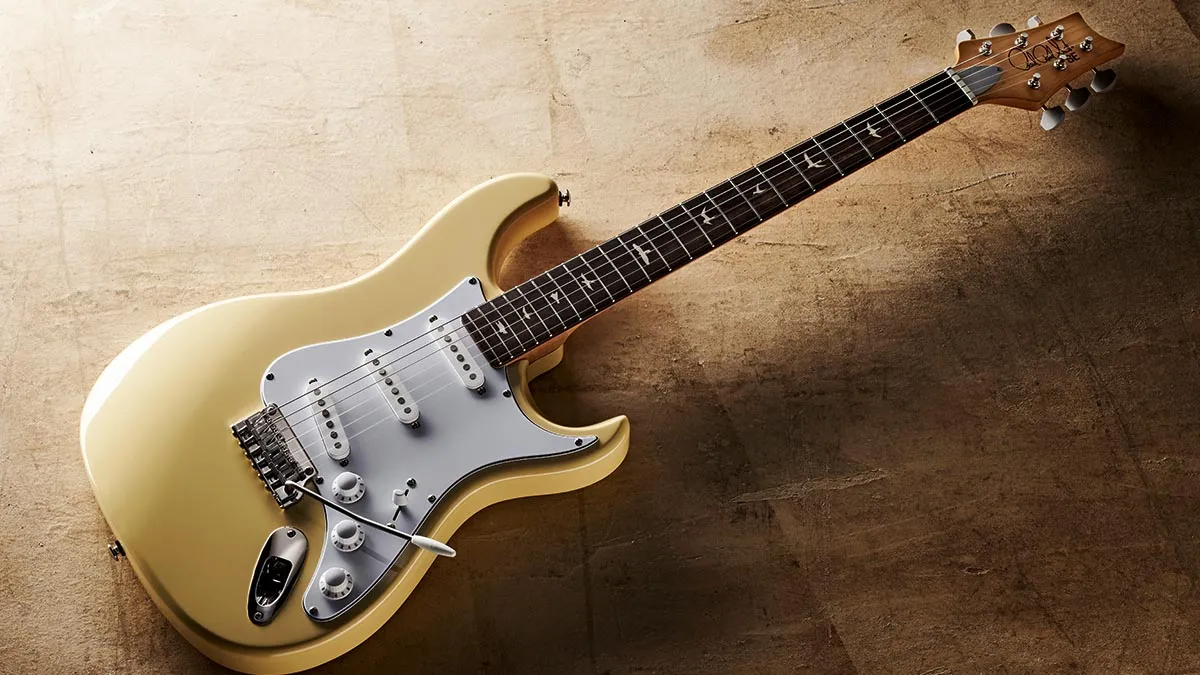
When PRS dropped its USA-made Core Silver Sky in 2018, they weren’t just releasing a John Mayer signature six-string, and they weren’t trying to break the internet; they were reinventing the wheel, to speak.
The wheel in question was the Fender Strat, a guitar brandished by everyone from Jeff Beck to David Gilmour to Mayer himself. But Mayer – and Paul Reed Smith – wanted something different, something fresh, new and inventive. This would require forward thinking, painstaking effort and, to be frank, balls. Of Mayer’s general mentality toward the Silver Sky, Smith says, “He’s not messing around. If he had a guitar that he liked better, he would use it.”
The Silver Sky, be it the Core or SE model, has been a sensation since its release. But beyond its favored status, it's a guitar that Mayer actually plays.
“I’m so glad I don’t have to pretend to love them,” he says. “I’m not playing something else in the studio, because this is the guitar I always wanted to own. I can’t outplay it. That’s the dream.”
Now that Mayer’s dream has become a reality, has his appreciation for the Silver Sky grown? “Let me answer it like this: I love guitar players. I adore their minds – they’re closed until they’re open, and when something opens it, they tend to give respect to whatever it was that could manage to change it.”
Mayer knew that changing – and opening – minds would take time. “I knew the Silver Sky would take years to take its place in the world,” he says. “And I say this cautiously, but it feels like it’s become pretty widely accepted. You can accept it and still not dig it, but what’s happened over the past several years is that people have kind of agreed it has a right to exist.”

The Silver Sky has continued to be a bestseller. PRS now offers an affordable yet high-quality SE version, making the guitar accessible to a broader audience.
The Silver Sky is on our list of the 50 most important pieces of gear of the last 25 years. What does that mean to you?
The ultimate dream is to see it in the hands of people who don’t even consider themselves a fan of my music. That’s how you know you’ve created something worthwhile
John Mayer: It’s definitely one of my proudest accomplishments in my life. I wanted to design – or redesign, to get ahead of any objections there – an instrument that players can use to make their music on. The guitar is usually referred to as a Silver Sky without my name attached.
I love that, because my favorite thing is to see how other guitarists use it to express themselves. The ultimate dream is to see it in the hands of people who don’t even consider themselves a fan of my music. That’s how you know you’ve created something worthwhile.
Paul Reed Smith: It’s an honor. Watching John get the tones he gets out of it has been fascinating. He said, “This is what I need it to do when I play it. I don’t want to look down and try to find where I’m at.” I thought he really did a great job when we released it.
After playing Strats for so many years, John, what led to the guitar's creation?
Mayer: It’s been a dream for many years to have more input on the design of a guitar than simply having a signature model. I was looking to create something based on the past but fully updated to have a modern-day ethos. And PRS saw the vision there.

As you were retooling an iconic instrument, the Silver Sky’s general specs were important. What went into them?
I said to him, “If I can measure the Strat’s pickups on my pickup machine, I can do it”
Paul Reed Smith
Smith: We spent a huge amount of time on the headstock shape, pickguard shape and body. We retooled the knobs, jack plate, pickup covers, bobbins, magnets and windings. The way we finished the body, how we leveled the necks, frets and nuts we used was different from anything we’d done before. There wasn’t anything that was left untouched until John was happy.
What was your goal for the pickups and their voicing, John?
Mayer: I wanted to sound like I’ve been known to sound, but with a little less midrange dip. As I get older, I understand and enjoy a little more midrange. It’s pleasant to me now.
Those deep EQ carve-outs are super-fun, but after thousands of hours of playing, certain frequencies have made permanent grooves in my brain, and I want to cut new ones next to, but not on top of them. Maybe that’s the definition of evolution, I don’t know. [Laughs]
Paul, what went into voicing the pickups?
Smith: We went to a soundcheck with a Silver Sky prototype at this huge indoor arena in Washington, D.C. I was standing on the stage, and John had his ’64 Strat that he played Gravity on, and he compared it to the Silver Sky prototype. And the Strat’s pickups had 6dB more bass and 6dB less harsh high-end – they were louder.
Everything about them was different. I had wound the Silver Sky pickups exactly the way you see on the internet, but they were off by 6dB in every direction. I said to him, “If I can measure the Strat’s pickups on my pickup machine, I can do it.”
John said, “I can live without it for one day.” His tech, René Martinez, gave me the Strat. I put it in the back of our car and said to my wife, “Whatever you do, don’t get in a rear‑end accident.” [Laughs]
What did you find while evaluating the Strat’s pickups?
Smith: I did the sacrilegious thing: I unsoldered the bass pickup, which I don’t think had ever been done before, took it out, and put it in my pickup machine. What came up on the screen was something we’d never seen the likes of. I was like, “Whoa!”
We soldered the bass pickup back in, put the guitar back together, took it back to John, and I started calling electrical engineers about why I was seeing wildly different results. It was that bass pickup that Gravity was recorded on, right? And we got it.

Not only did we get it, you’re talking about having to do it exactly the same – it’s not easy. The magnets, wires and bobbins are from different factories. But we got it. It was very difficult, but it also was joyful.
You also reworked the neck profile, correct?
Mayer: Before creating this guitar, I didn’t understand what neck radius meant. I just looked at the guitars I loved the most, and they were 7.25”. That was my measuring stick.
Now that I know the math behind it, I still don’t think about it. The difference between 7.25” and 9.5” is less significant than your strap being an inch higher or lower. I’ll fight anybody on that.

The reason I believe this is because every guitar is different and has about 100 points of variation. Neck profile helps sort out neck profile, which is only one of many details. So the only way to truly compare radii is to build two molecularly exact copies of the same guitar with just that difference.
But we have to try and organize these details in some less-chaotic way, which is why we debate 7.25” vs 9.5”. I can do everything on this neck that I could do on a 9.5”. If the guitar is set up correctly, if the frets are level – which these are – you can do anything you want in regard to bending strings on this neck radius.
Why has the Silver Sky resonated with so many people?
Mayer: I think it’s because I really play them. I designed a guitar that I track-tested. It’s like a sports car that can hug a turn at 100 mph – whether you’re on the track or just driving down the coastline, you know the performance capability is there.
- This article first appeared in Guitar World. Subscribe and save.

