


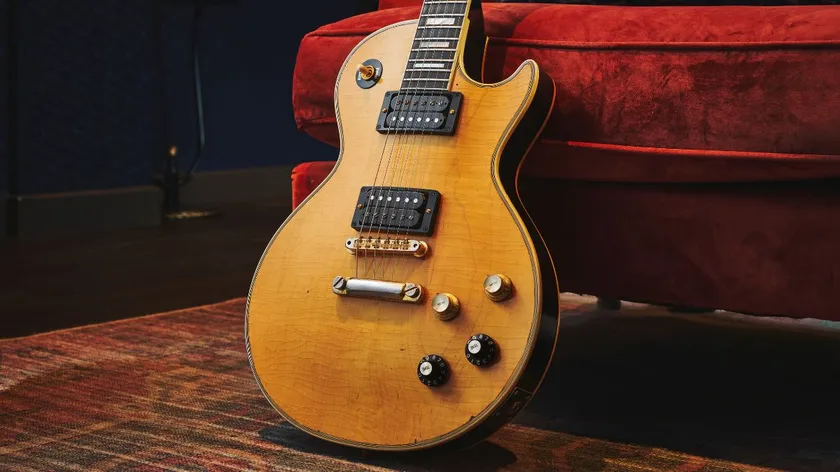


It started life as the worst guitar its owner had ever played, and was modified with a grab bag of parts from bargain bins. It features arguably the most provocative slogan to be scrawled on a guitar since Woody Guthrie added “this machine kills fascists” to his acoustics in 1943. And it’s covered in cartoon hippos.
As an instrument, Arm the Homeless is an unlikely candidate for the signature guitar treatment – but 30 years at Tom Morello’s side has cemented it as one of rock’s most iconic electric guitars.
This is the divining rod that brought the world explosive riffs like Bombtrack and the radical toggle-switching technique and whammy whoops in Know Your Enemy, which lit the molotov cocktail that was Rage Against the Machine’s 1991 debut (Killing in the Name came courtesy of Morello’s drop-D tuned Sendero Luminoso Telecaster – surely on the cards for its own replica down the line).
Bulls on Parade, Sleep Now in the Fire, Guerrilla Radio, and Audioslave’s debut album – written before ATH’s successor, the Soul Power Strat, came on the scene – were all chiseled into shape by Morello’s hands on this guitar – or, as he calls it, his “artistic co-worker”.
“We’re collaborative partners,” he tells me over Zoom. “The chemistry that that guitar and I accidentally backed into has forged this career of 22 albums, thousands of shows… and a lot of dangerous music.”
With no brand name to speak of, fans wondered if an authentic Arm the Homeless replica would ever become a reality. Ibanez had previously made a backup version. But Fender ended up winning the gig, after Morello and CEO Andy Mooney met via – what else – a school fundraiser.
The Soul Power Strat was their first collaboration in 2020, bottling the early-noughties magic of Morello’s main squeeze in Chris Cornell-fronted supergroup Audioslave. Mooney hinted that a Fender Arm the Homeless was on the cards. That was five years ago. But the new guitar proved to be a difficult birth: this was no cookie-cutter Stratocaster. It required a whole new approach.
“The challenge with Fender was: ‘How do we recreate something that is so imperfect?’” Morello laughs. “For example, I have no idea what that neck is. It was the one that I got on a particular day. They got a machine over there that makes a bunch of different necks. They don't got one that makes this.”
Fender persevered. After “20-25 iterations”, they mastered the neck, along with the guitar’s many idiosyncrasies: the indestructible killswitch, the Gotoh locking tremolo, EMG pickups and, of course, the hippos, hammer and sickle, and rabble-rousing slogan. Heck, the strings are even uncut at the headstock end – to our knowledge, it’s a first for a production-line guitar.

Like all of Morello’s signature gear, there’s a charitable component to the release. Part of the proceeds will be going to teen homeless shelter Covenant House and LA’s Midnight Mission shelter, where the Morello family volunteer on a regular basis.
“If you're going to put ‘Arm the Homeless’ on a guitar, I want to make sure there's a component of giving back. I want to make sure that there's a Robin Hood factor to this as well – that while we're making this guitar for fans and collectors who want this thing, we're going to be able to give back to people who are in need.”
I sat down with Tom Morello to find out how Fender got the details right and why, for a man who once declared that “gear doesn’t matter”, he’s finally coming round to the importance of his most iconic guitar.
Walk me through the process of recreating Arm the Homeless with Fender: how did it start?
While the Soul Power guitar is complicated, it uses parts that exist in the world. The Arm the Homeless guitar is from the island of Misfit Toys
When we were talking about doing the guitar, I said, “OK, this is a bigger challenge because, while the Soul Power guitar is complicated, it uses parts that exist in the world. The Arm the Homeless guitar is from the island of Misfit Toys.”
It has a neck that I found in a used neck bin at some off-brand store. Originally I had it made at a local guitar shop in Hollywood, and it was the worst guitar I'd ever played in my life. I didn't know. I made all the wrong choices with regard to fretboards, frets, whammy bars, electronics, everything about it. Over the course of the next few years, I changed everything out multiple times looking for a sound I never found.
And probably in late 1988 or so, I just gave up. And I was like, “I'm going to stop whining, and I'm going to start creating. I've spent all my money on making this guitar. I had no more money left. This just has to be my guitar. I'm stuck with it. So I'm going to start writing songs.”
And that's exactly the Arm the Homeless guitar. I drew the hippos on it back then. A couple of years later, I scrawled Arm the Homeless on it in Magic Marker, and from that day to this, that's what it is.
I wanted this guitar to be absolutely interchangeable for me. I wanted to use this guitar without losing any miles per hour. The neck on the Fender Arm the Homeless guitar must have gone through 20-25 iterations to get it just right. I was always sending it back. I'm like, “Well, nope, nope, nope.” We finally got that right.
The Gotoh whammy bar was not exactly the one that anybody wanted, but that's the one that worked for me. One thing that I ended up loving about it was the imperfections of it. After a while, the actual bar becomes really loose in there. Not what you want with a whammy bar… or do you?
Because I was able to use that to create some sort of helicopter sound, some sort of monkey sound – there was something in that particular whammy bar that, because it's the one that I was stuck with, I made the most of, and it helped me forge my signature sound.
What about the pickups? It’s an unusual configuration.
The single coil really differentiated my sound from a lot of metal players. It allowed the songs to lock in with the rhythm section in a very different way than a lot of metal or nu metal players would
It's two EMG pickups, and the pickup in the neck position is basically a single-coil pickup disguised as a humbucker, and that is what provided the springiness to the riffs in a lot of those songs, from Fistful of Steel to Sleep Now in the Fire, Guerrilla Radio, and that, I think, really differentiated my sound from a lot of metal players. It allowed the songs to lock in with the rhythm section in a very different way than a lot of metal or nu metal players would.
The bridge pickup was my tip of the cap to my metal roots. It's the distorted sound of Know Your Enemy. It's the outro to Bullet in the Head. It's the sound for all of my guitar solos – when I kick on the echo pedal and just start space-jamming.
The toggle switch, too. The normal toggle switch that is in a Gibson guitar or whatever, if you use it like God intended, which is a lot, it'll burn out. It'll burn out quick. The toggle switch that is in my Arm the Homeless is the one in this, so you can just go to town on that baby.
Did you road-test the guitar at all?
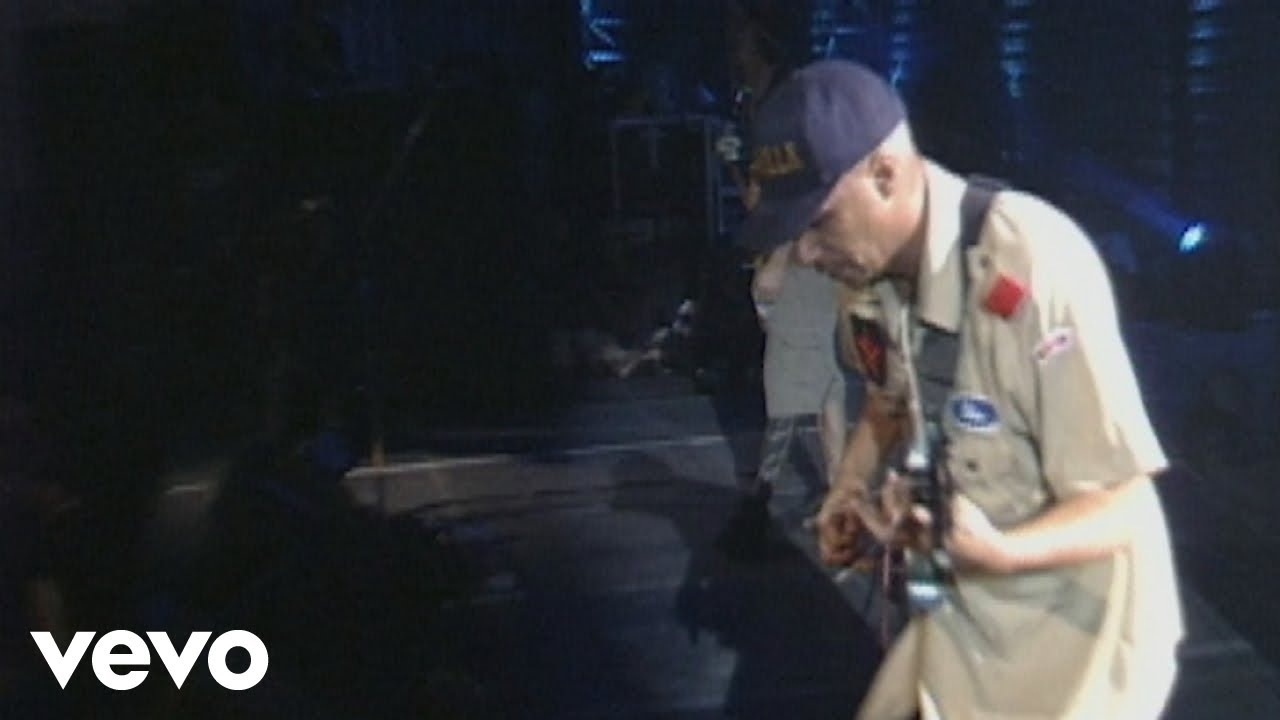
The final prototype that I approved I've been using in concert on the last tour this year. So I feel great about it. It's interchangeable down to the aesthetics of the guitar.
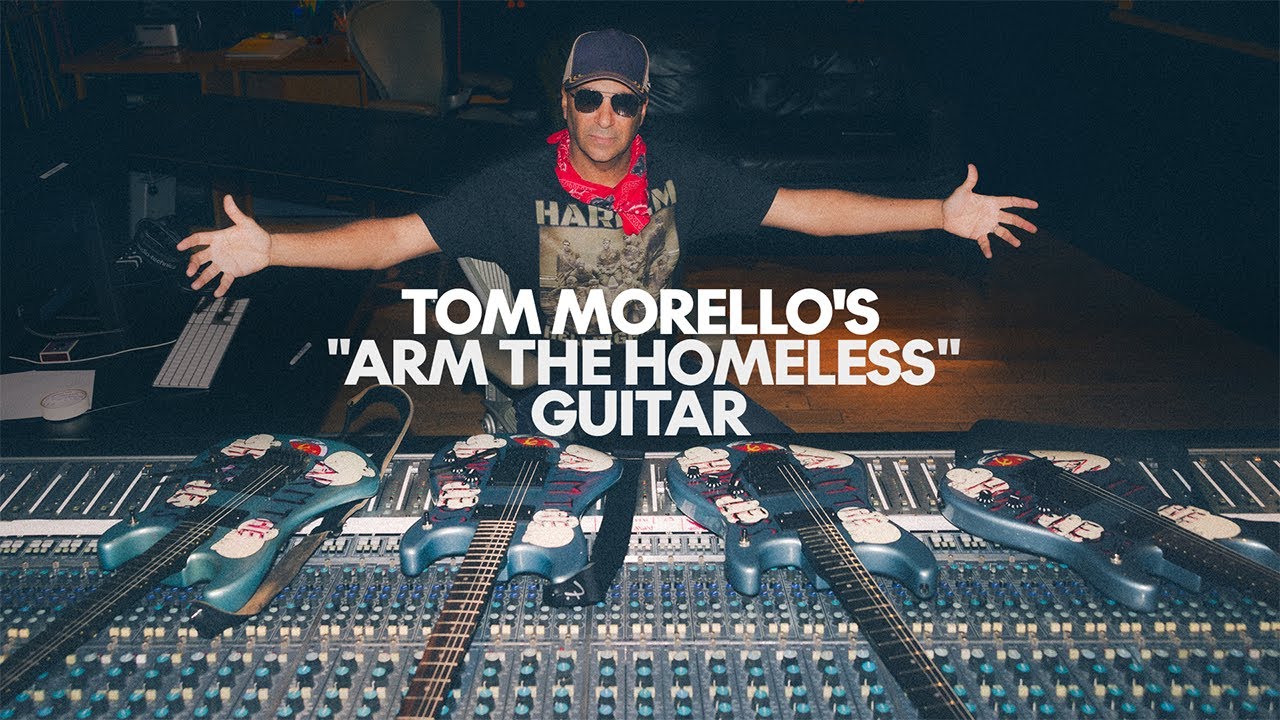
The other day, we were shooting some promos, and I was at Cello Studios where we made a number of Audioslave and Rage Against the Machine records. I put three of the Fender Arm the Homeless guitars and the real one down on the mixing board. And I brought people, and I was like, “Pick the real one.”
And I'll tell you, here's the clue: the only distinguishing characteristic sonically or visually, is that on the real Arm the Homeless guitar, couple decades ago, a dog chewed the headstock. So there are teeth marks on the headstock. I think it was a dog. It's hard to say whether it was a fan or whether it was a badger, but there's teeth marks on the headstock of that one. But other than that, they're absolutely identical.
You say you've been stealth-playing the replica on tour – did anyone notice?
Zero. Zero percent. You'd never know. I mean, I don't know! And as far as feel and tone and whatnot, we got that right a while ago, getting the neck good. That took the longest, because that's a really unique part of it. It's tapered in a way that had allowed me, when I was practicing eight hours a day shredding scales, to be able to do that.
But also, the feel of a guitar ends up suggesting riffs. It ends up suggesting ideas. And if it were more of a thicker neck, it was more of a baseball neck, or wider in the wrong places, it never would have suggested Bulls on Parade. It never would have suggested People of the Sun.

What do you remember about the moment you first wrote ‘Arm the Homeless’ on the guitar?
I scrawled the words on it at a Rage show. It was the afternoon. We were playing at the Whisky that night. We were opening for two other bands at the Whisky that night, and that would have been in probably early ’92.
I was sitting on the dirty carpet in my little apartment in West Hollywood, and there were a couple markers around. They happened to be black and red, or it would have been something else at the time. I like slogans that are provocative.
And I love the juxtaposition of something that says “Arm the Homeless” with these cute, smiling hippopotamuses. That feels like multiple facets of my personality – those boxes are checked.


As you say, the Fender recreation looks remarkably faithful. There are a couple of very small changes, though: the Fathead Sustainer on the back of the headstock and the big hippo on the back of the guitar are both absent. What prompted those tweaks?
Well, the Sustainer on the back of the headstock of the real one never did anything. It was a pain in the ass to put that thing on. It was a pain in the ass to take it off. So I just literally never took it off. It literally did nothing. Literally nothing. So we're like, “Oh, like, I'll spare people having that.”
And then the hippo on the back. One of the reasons why I didn't put that on is because one of the features of this guitar through the last 10-15 years is when I'm showboating and playing with my teeth, I will write some sort of city-appropriate or political news cycle-appropriate thing on the back of it, and flip it over and read that so that, to me, didn't feel like it was any important part of the guitar at all.
I should say, another one of the motivations, not the principal motivation, but on the page of motivations, was all of the horrible knock-off Arm the Homeless guitars that exist in the world. There's a bunch of them out there.
People think they're getting my guitar because they're able to get the artwork sort of right, and I just think it's awful to have fans ripped off like that, to think that they're getting something that really is the Arm the Homeless guitar. It's not this one. I am the guy who made the Arm the Homeless guitar. This one is it.

You resisted signature gear for decades. What prompted that shift? Because now you've got pedals and plugins as well.
Because the stuff is exact. Here's the thing that I was always happy to put out and promote in the world: my music, because it's mine. My videos, because they're mine, or my bands, right? My ideas, because they're mine.
I was approached countless times: “Will you endorse this amp or this guitar or this pedal?” And I didn't want to do it because I didn't play it. I'm very conservative with my gear. It's the same guitar from ’87 till now. It's the same amp from ’88 till now. It's the same pedals from ’91 till now. So the only time when I've put stuff out is when it is exactly my gear.
The guitar is built in Mexico. Did you ever consider a high-end Fender Custom Shop version with all the relic’ing and road wear?
No, I didn't. Let the relic’ing and road wear be your own. Here it is. Now it's up to you to let your dog bite it.

The guitar must have been through its fair share of scrapes over the years. Dog bites aside, do any others stand out?
Oh, I mean this guitar has been at every show that I have ever played, outside of maybe a handful of Nightwatchman protest solo acoustic shows. So it’s seen it all. Some people get very emotional about their guitars, like, “Oh, this is my baby.” And I was always like, “This is a tool. This is an instrument. This is a battering ram for justice and big riffs.”
Over time, I gotta admit, I've become somewhat emotional about it
And over time, I gotta admit, I've become somewhat emotional about it. I play at night [at home], and I'm like, “We've been through a lot.” It is a long, long relationship that I have with this guitar, and it really is a relationship.
It's not just a thing; the way that it is, and the unique journey of how it arrived, is what helped me find my sound in the world, is what helped me become the artist that I am. And everything that's flowed from that, from the bands that I've been in to the ideas that I've been able to get out in the world, from the solos I've been able to shred standing next to Bruce Springsteen. You know, it's not just, “Hey, I'm doing this.” We are collaborative partners.
Does that mean you'll be retiring the original Arm the Homeless?
Well, it's taking a step back. Like the Jerry Garcia guitar or Prince’s guitar or Bruce Springsteen’s, the Arm the Homeless guitar is a working guitar in a real punk-rock context.
I play a lot of shows. Yes, there are festival headlining shows. Yes, there are shows with crews and whatnot. But I play a lot of shows for the people. And we were doing something in New Jersey within the last year, where I was walking backstage, a bunch of people walking around, I just saw the Arm the Homeless guitar, like, in a hallway, and I just went “Ah!” If I had wanted to steal it, I could have walked right out the door with it right then.
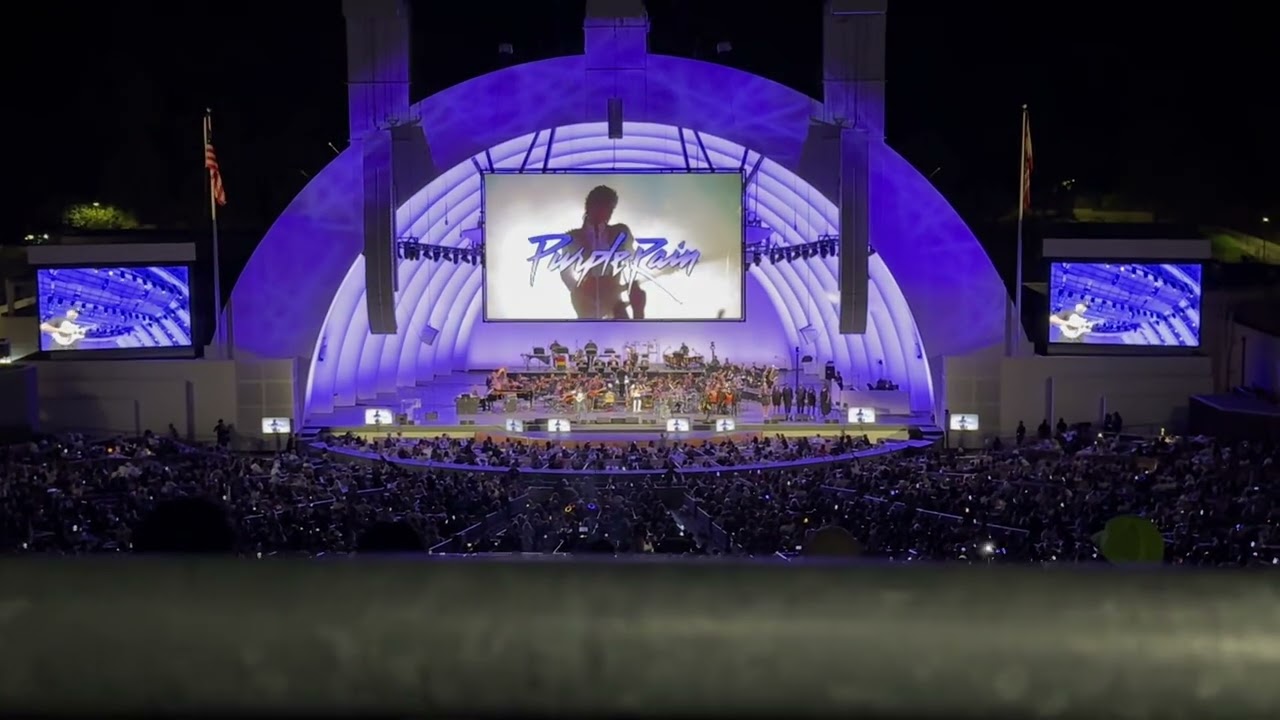
So I thought that the [original] Arm the Homeless guitar needs to maybe come out for special occasions. I used it the other day. I played Purple Rain at the Hollywood Bowl with a celebration of Black music and film. And it came out for that one, but now it's gonna come out for special occasions.
Musically speaking, what can we expect next from you? Can we ever expect to see you in a full-band context again, like Rage and Audioslave?
I'm in the midst of working on my first solo rock album, poaching riffs from my son, Roman, who's got the hot hand these days. And over the course of the next couple of months, releasing some more singles from that upcoming record. There's a full fall of acoustic, electric shows in Canada, East Coast, North American Tom Morello and friends tour playing in India at the end of the year.
I wrote a musical that's opening in Chicago called Revolutions, which has some songs from my career that Arm the Homeless guitar has created. And so it's a very, very busy time. I feel very, very comfortable in not being in a band. You know, if something comes up, I'm always willing to look at it, but I've got a lot of stuff on the docket as it is.
- The Fender Tom Morello “Arm The Homeless” Guitar is available now. See Fender.com for more.

