

Fifty years. The timeline does not lie – even if 73-year-old Martin Simpson is liable to disagree (“That’s obviously impossible because I’m only 28!”). Fortunately, the Scunthorpe-born folk hero has wasted not a beat of his half-century since 1976’s debut, Golden Vanity, planting his flag as a songwriter, performer, collaborator, author and teacher.
Simpson’s new album, Some Kind Of Jubilee, cannot hope to entirely distil that fascinating career. Yet it comes closer than you might think, nodding to his back pages on formative standards and fan-favorites reimagined with cello and pedal steel, while airing bold new songs that announce he’s far from done.
Over a summer’s afternoon at his home in Sheffield, the affable maestro held court, spinning war stories, airing his formidable fingerstyle and nudging Guitarist to pass over so many of his favorite instruments that we started to feel like a golf caddy.
How does it feel to reach that 50-year milestone?
It’s beautifully shocking. Without being sentimental, it’s allowed me to really look at my 50 years of recording. And the thing I like is that I feel like I’m actually at my best now. I also think I’ve grown to love what I do more and more as time passes.
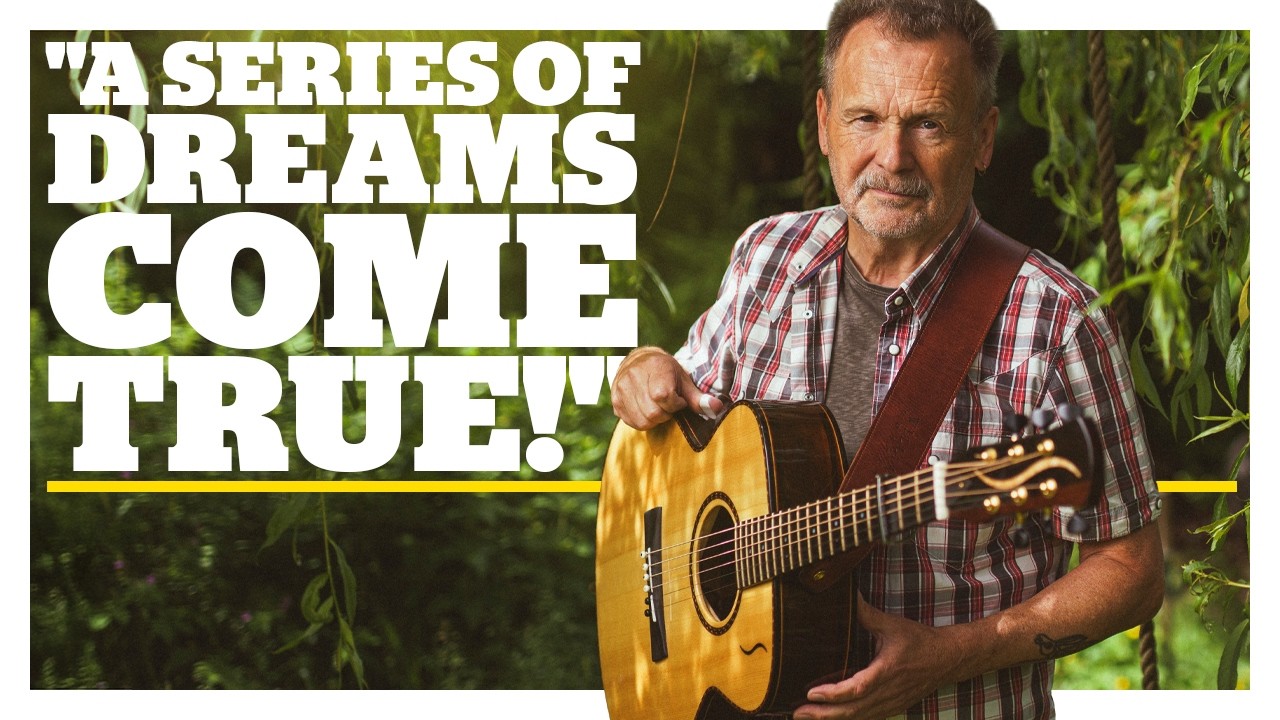
Making this latest record was like a series of dreams come true. I recorded with Louis Campbell – he’s 25 now and a monster guitar player – Liz Hanks [cello] and Ben Nicholls [bass]. We started in a place out on the North Yorkshire moors.
Then we went to Jackson Browne’s studio in Santa Monica [Groove Masters] because I really wanted to work with Greg Leisz. He’s my favourite pedal steel player. There are so many recordings where I’ve gone, ‘Who the hell is playing that?’ And it’s always Greg, y’know?
We sat down – very close, as far away as we are now – and he would be playing a Weissenborn or a National Tri-Plate and overdubbing pedal steel.
The record sounds huge. It’s really orchestral-sounding, which is funny because it’s all guitars, except for the cello
Back in England, I got Zak Hobbs to come in and do overdubs on three tracks. He’s Richard Thompson’s grandson and just a great player. The record sounds huge. It’s really orchestral-sounding, which is funny because it’s all guitars, except for the cello.
What’s the vintage of the material on this record?
I’ve allowed myself to be retrospective. When I lived in the States, I wrote a song called Love Never Dies about a road trip from Memphis to Little Rock, Arkansas. I never felt I’d recorded it right. So we did that live, with Greg playing National on his lap, then overdubbing pedal steel.
It’s a body of work that goes back a long way. When I was four, my mother had a 78 of spirituals. I heard Paul Robeson sing Sometimes I Feel Like A Motherless Child and that was it for me. I could not understand how a piece of music could make me feel so much. And the feeling was of extraordinary melancholy, which I totally adored [laughs].
I joke about it, but I decided that when I grew up, I was going to make people cry for a living. Which I think is a noble ambition, and it seems to have worked. So each of the vinyl editions of this new album finishes with a different version of Sometimes I Feel Like A Motherless Child.

How about the new songs you wrote for the album?
One is called Ruby Bridges, which I wrote on that banjo that’s currently being photographed. She was the first black child to break segregation in New Orleans schools. There’s another called Survivor that I wrote about an elm tree in the valley down there, and it just moves me every time I walk past it.
What tunings are you working in?
CGCFCD is the tuning that comes up the most at the moment, like on the tune called The Recruited Collier. One of the things about open tunings – and I always say this in my workshops – is that they dictate, and it’s up to you to go, “Don’t tell me what to do.”
Let’s look at the guitars you’ve picked out for us…
They’re utterly remarkable for how dissimilar they are, and each one has an incredible backstory. We recorded a track for the record with Paul Reed Smith at his studio in Maryland.
He’s mad as a box of frogs, in the best possible way. This is an Angelus Cutaway. Cocobolo, curly mahogany neck… It’s so beautiful. The guitar itself had been shipped to Japan in 2012 with some of the first acoustics that Paul made.
Unbeknownst to him, they had decided there was no market for PRS acoustics. So they put ’em in a warehouse. And they didn’t tell him. So this guitar sat in a warehouse for 13 years. You might think that when it came out of the case, it might sound a bit closed down. But I cannot believe this guitar. It’s insane.
And the next is a Stefan Sobell creation, right?
Yeah. This is the guitar that gets used the most at the moment. Doesn’t sound like anything else. Stefan is so influential. Completely different sound. And, for me, the separation, the piano element of it, is one of the reasons that I play the way that I play.
They’re all wide fingerboards. Stefan made this guitar in 2022, and it’s one of his 40th anniversary models. The woods are stupid. I’ve never seen German spruce that looks like that before: gorgeous. And the Brazilian rosewood: that insane green thing happens.
Stefan has been putting Highlander pickups into guitars for me since I met him. I first came across Highlanders when I was living in California. Most guitar makers just say, “I’m not going to put a Highlander in a guitar. I don’t want to do it. It’s too difficult. It’s just a nightmare. It’s arcane.” And, in fact, Highlander is no longer in business.

But Stefan bought 12 of them from Japan, and one of the things that he’s utterly brilliant at is the installation of these pickups. He said to me, “If you tell anybody how, I’ll have to kill them.” It’s got a Highlander and a K&K, so it’s the two signals.
I use them both at the same time – two DI boxes – and every soundman I’ve worked with since I had this installation has gone, “That’s the best acoustic sound I’ve ever heard.”
And this next model is a Turnstone build by Rosie Heydenrych, isn’t it?
I’m sure she wouldn’t mind me telling this story. Rosie had built a guitar for me, which I loved, but at the end of a couple of hours, my right hand was going, “I don’t like this.” So I called her up and said, “Rosie, I hate to say this. This guitar is absolutely fucking brilliant, but…” And she said, “Hooray! I’ve been listening to you play and thinking about your tone production, and I really wanted an excuse to make you another guitar because I think I can do it better.”

So we ended up making this. This is Mexican royal ebony, which is called Katalox as well. It’s an Adirondack top; I like European and Adirondack. I just think they do the business. And it has an English sycamore neck, which I just think is absolutely incredible. Her work is insanely beautiful.
What can you tell us about this Fylde?
I had a 1931 Martin 000-18 12-fret, which was just revelatory. Everybody that played it went, “For fuck’s sake! Oh my God!” But I didn’t keep it because it was such an iconic instrument. I couldn’t put pickups in it. I couldn’t take it out. I’d play it in the studio and wrote a bunch of stuff on it. Then I went, ‘Let’s see what other people do with this idea.’
Roger [Bucknall] makes my 12-fret guitars, and this was the second one that he made. Sonically, it’s always been just absolutely ridiculous. But it had some intonation issues. Roger, fortunately, is a very flexible human being. So he said, “Well, why don’t I put a new neck on it?” And I said, “Yeah, great. Why don’t you model it on my old Martin?” The neck is ebony, dyed maple, and mahogany. It’s got a huge voice.

Let’s take a closer look at the Taran.
If you were to talk to the absolute woodworking kings, like Ralph Bown, their opinion is that the guy actually pushing the envelope the most is Rory [Dowling]. This has done at least 250 gigs. It’s the most in-tune guitar. Before he built it, Rory asked me, “What’s your favourite colour?” I said, “What is this, Smash Hits?”
He said, “Just wait.” So if you look at the interior walls, they’re Kingfisher Blue. When I got this guitar, I went, “Oh fucking hell!” I called Rory and said, “Right, my first question is, where did you get that burl?” I could hear him grinning down the phone. He said, “From a Bentley.”
On the electric side, tell us about this Galanti?
I saw this at Rich Tone. It belonged to one of the guys that worked there. I went, “What the fuck is that?” And they said, “It’s a ’65, Italian.” It’s clearly Italian. You know, this is one of the best electric guitars I’ve ever played in my life. Look at the quality of that piece of construction.
This whammy bar is so beautifully made. Stays completely in tune. They should have licensed it to everybody because it’s way better than [better-known vibrato formats]. And, of course, Galanti is an accordion maker, so it’s got the mute button.
The interesting thing about this, for me, is that everything about it, spacing-wise, is friendly to an acoustic player. I think it’s cool as fuck. I’ve just been getting further and further away from what most people think are great electric guitars. That [Jazzmaster] completely changed my life, too. It sits right. It feels like a proper guitar.

We’re celebrating your half-century of music-making. Where did it all start?
I got my first guitar when I was 12, and I was very fortunate that literally 400 yards around the corner from where I lived was the home of the Scunthorpe Folk Club. It kicked off around about the same time as I got my guitar, so that’d be 1965.
At that point, the folk scene was absolutely on fire, and it was very eclectic. So there was the chance you might go and see somebody playing blues, like Mike Cooper, who was a phenomenal technician, used to play country-blues stuff really, really well on a National Tri-Plate. The next week it might be The Watersons, which was equally avant-garde, when you think about it – this family of travelers singing wild harmonies.
Stefan Grossman. Martin Carthy. Mike Chapman. Nic Jones. Everybody would come through the folk club. These people who were incredible, pushing the envelope.

It must have been amazing to be at that flashpoint.
Meanwhile, I had two teachers at my school who formed the John Leggott College Folk Song Society, and they’d take us on school trips to see Pentangle. Obviously, there was Bert [Jansch] and John [Renbourn], but what blew me away was Danny Thompson doing a solo on Blue Monk.
I could not comprehend this guy with this unbelievably huge instrument playing a solo Thelonious Monk piece. I will never forget that
That was beyond belief to me. I could kind of comprehend the role of the guitar in this. I could not comprehend this guy with this unbelievably huge instrument playing a solo Thelonious Monk piece. I will never forget that.
All these years later, what’s your next move?
I absolutely love what I do. I absolutely love playing the guitar. I love the mechanics. I love when you find the right way to play a phrase. I spend hours sometimes just figuring out where to put my fingers. I never tire of it. In fact, rather than tiring of it, it just elevates me even more, I think. This album is a big piece of work. It’s finished. It’s mastered. And I find myself thinking, “Right, what are we going to do now…?”
- Some Kind of Jubilee is out now via Topic Records
- This article first appeared in Guitarist. Subscribe and save.

