


Ned Steinberger did not invent the minimalist guitar – the ’60s La Baye 2x4 and the skeletal Gittler introduced during the ’70s both precede his design.
Nor was Steinberger the first to make a headless instrument – Les Paul invented a headless guitar with an aluminum body in the ’40s, Dave Bunker patented his headless “touch guitar” in the mid-’60s, and numerous Northern California luthiers built custom headless instruments during the late ’60s and ’70s. This writer vividly recalls seeing a few headless guitars and basses at Stars Guitars in San Francisco during the mid-’70s.
However, Steinberger was the first company to successfully mass produce minimalist, headless instruments.
Built from non-traditional composite materials – a graphite/carbon fiber blend neck and body and phenolic fretboard – the original Steinberger guitar design is noteworthy for its appealing combination of radical elements, familiar features, brilliantly engineered innovations, and comfortable ergonomics.
The first Steinberger GL Series guitars appeared on the market in May 1984, starting with the GL2 model featuring EMG 81 and 60 active humbuckers and a stop tailpiece. At 29 ¾ inches long, it was only a few inches longer than its 25 ½-inch scale length.
Standard features included 24 frets and master volume and tone controls. By 1985, the lineup expanded considerably, consisting of the dual humbucker GL2 and GL3 with three single-coil EMG SA pickups, both offered with either the standard S-Trem (GL2S/GL3S) or revolutionary TransTrem (GL2T/GL3T) vibrato systems. The popular GL4 model with an HSS pickup configuration then followed in 1986.
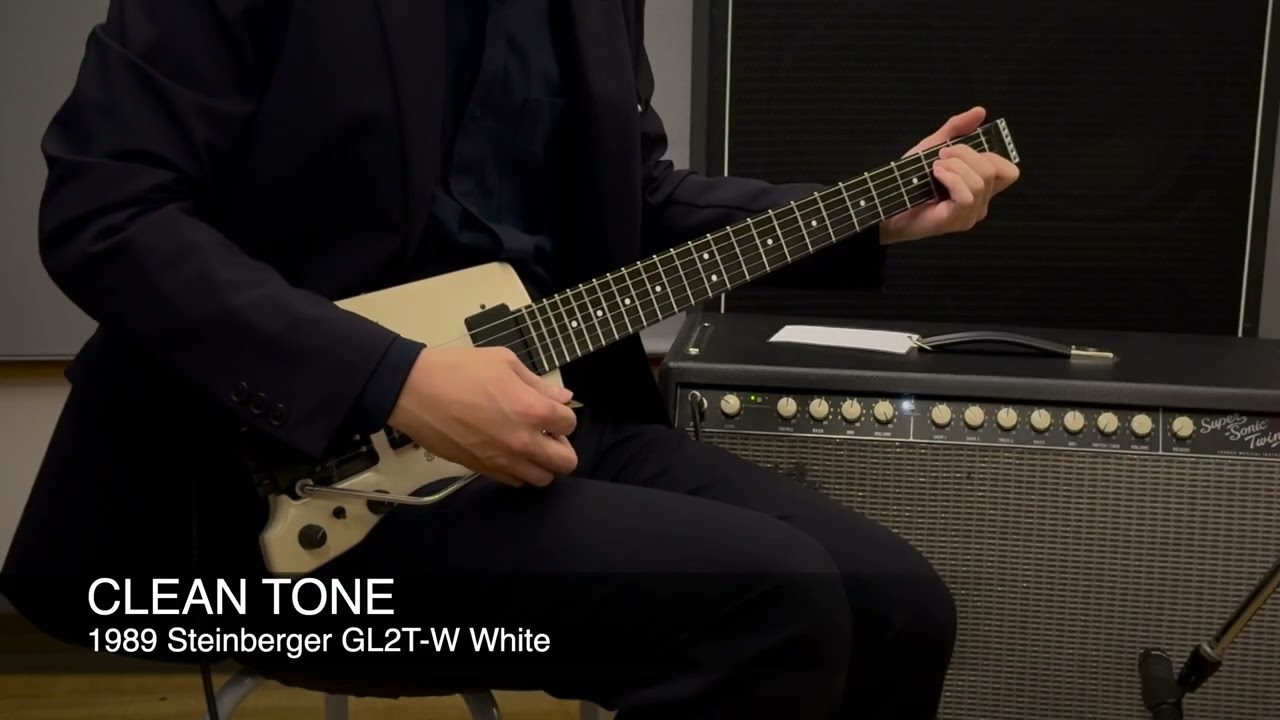
An instrument unto itself, the TransTrem is an engineering marvel that allows users to lower or raise pitch while keeping chords in tune. A metal stop piece can lock the strings in six positions that transpose the key to B, C, D, E, F#, and G. Both the TransTrem and standard floating S-Trem provide a lever that locks the tremolo arm for non-tremolo performance, which also maintains tuning when a string is broken.
One rarely mentioned feature of Steinberger GL guitars is the Co-x connector system that allows users to quickly swap EMG pickups using snap on-off connectors. The body's removable rear-mounted faceplate also made it easy to access the electronics and install other non-EMG pickups with minimal hassle.
Initially, the GL guitars came with a plug-in leg rest for comfortable playing in a sitting position, but later a simpler, improved fold-out leg rest was adopted. The double ball end string design radically simplified the process of changing strings, although the non-standard strings were not always easy to find.

Although Steinberger stopped offering composite versions of their GL models by the late ’90s, the timeless minimal design has become a classic that still lives on today via Steinberger's budget Spirit line.
Thanks to its prominent use by a wide variety of guitarists like Elliot Easton, Reeves Gabrels, Jerry Garcia, David Gilmour, Steve Hillage, Allan Holdsworth, Steve Howe, Mark Knopfler, Mike Score of A Flock of Seagulls, Andy Summers, David Torn, and Eddie Van Halen – the latter two being among the few who truly mastered the TransTrem – the Steinberger GL model has become a desirable icon of both ’80s/’90s nostalgia and futuristic innovation.

