

In the influencer age, it’s not uncommon for guitarists to run their own companies. More unusual, however, is for a superstar guitarist to buy the company that has been building his instruments for decades.
In 2019, Muse frontman Matt Bellamy became owner of Manson Guitar Works after 20 years of collaboration with the firm, which operated out of his local guitar shop in Devon, UK.
“I first went into the shop in 1999,” he reflects now. “The first thing I bought was the seven-string that I used for the song Citizen Erased. Then I started designing with them. It feels like forever.”
The British guitar hero is speaking to Guitar World 15 minutes before Manson opens the doors to its new showroom for the first time. The walls are lined with the firm’s modernistic guitars, interspersed with Muse memorabilia and Bellamy’s own stage-ravaged instruments. Industry veterans, influencers and Manson’s most loyal customers are arriving, and shortly, the frontman will join them to sign pictures and pose for photos.
Bellamy, who splits his time between the US and Devon, remains the brand’s most high-profile ambassador. In his hands, Manson guitars are played on the biggest stages in the world. Yet the firm remains a relatively small operation by design.

“I love the guys and girls who work here. It’s an amazing team,” Bellamy says. “As a small business, you have to grow it very carefully. You could easily overblow it, but we’re staying in this wonderful niche that we’re in.”
Manson’s hottest sellers are replicas of Bellamy’s tech-loaded stage guitars, all with outlandish names like 007 and the Delorean, which sell for thousands of pounds. But its larger-scale ambitions are slowly revealing themselves.
Cort manufactures the Meta series in Indonesia, bringing Bellamy’s signature look down to a sub-$900 price point. Tech metal production mainstay Adam ‘Nolly’ Getgood lent his tonal knowhow to the Oryx line: his vision of the ultimate high-gain guitar. Masked metallers President have their own customized Mansons.
Bellamy’s vision for the brand right now is straightforward: keep making high-quality guitars, get them in the right artists’ hands and stay ahead of the curve. Crucially, his passion for guitars shines through.
At 48, Bellamy still has a teenage giddiness when he talks about guitar playing. He lights up when gear or playing philosophies are on the table. And that’s reflected in Muse’s latest album, The Wow! Signal, whose back-to-basics approach has been hailed by fans as their best effort since 2006’s Black Holes and Revelations.
In a rapid-fire conversation, Bellamy let us in on Manson’s plans for a Graham Coxon signature model, the pressure he feels to update his guitar playing with each album, and why Muse can’t stop sneaking Rage Against the Machine riffs into their sets.
Congratulations on seven years at the helm of Manson. What are the trends you’ve observed over that time?
We’ve been lucky that we’ve had an association with the metal scene thanks to people like Nolly. There’s something about that audience that is really solid and stays with you longterm. If we were leaning more on the pop side, it’d be a bit more up and down.
Metal is the real solid audience customer base, but then we started mixing it up with people like Graham Coxon. That was a really nice surprise. That was totally organic. I was in a ’60s covers band with him just for fun [The Jaded Hearts Club Band]. And he saw me playing this thing that looked a little bit like a Telecaster, but he knew it wasn’t. He was like, “What is that? Can I try it out?… This is fucking amazing.” So I got him one as a gift. Then he came down here, and the next thing he’s going to do a signature, which is great.

And then also up-and-coming guitarists like Emi Grace. I reached out to her on Instagram because she kept coming up on my feed, and I thought she was amazing. And I just said, “Do you have a deal with anyone? Would you like to try one of our guitars out?”
I see that as being an expansion for us, getting into some of these Instagram-type influencer guitarists and bass players eventually. Instrumentalists now can create an entire career for themselves without having to be in a band, which is exciting.
Who else have you been checking out on socials?
Ariel Posen. I saw him on Instagram. It’s like slow, deep, dark blues pitched way down with a slide – really, really fucking cool. He’s impressed me.
What gear have you got in the works at the moment?
I’m trying to come up with some new tech to put in the guitars. I’m looking at these AI prompt pedals. I know AI is a bit risky, but we always like to try and be a couple steps ahead. I like the idea of a guitar that you can AI-prompt to sound any way you want, whether it be effects or tone. I don’t know how we’re going to do that yet, but that’s what I’m trying to think about next.

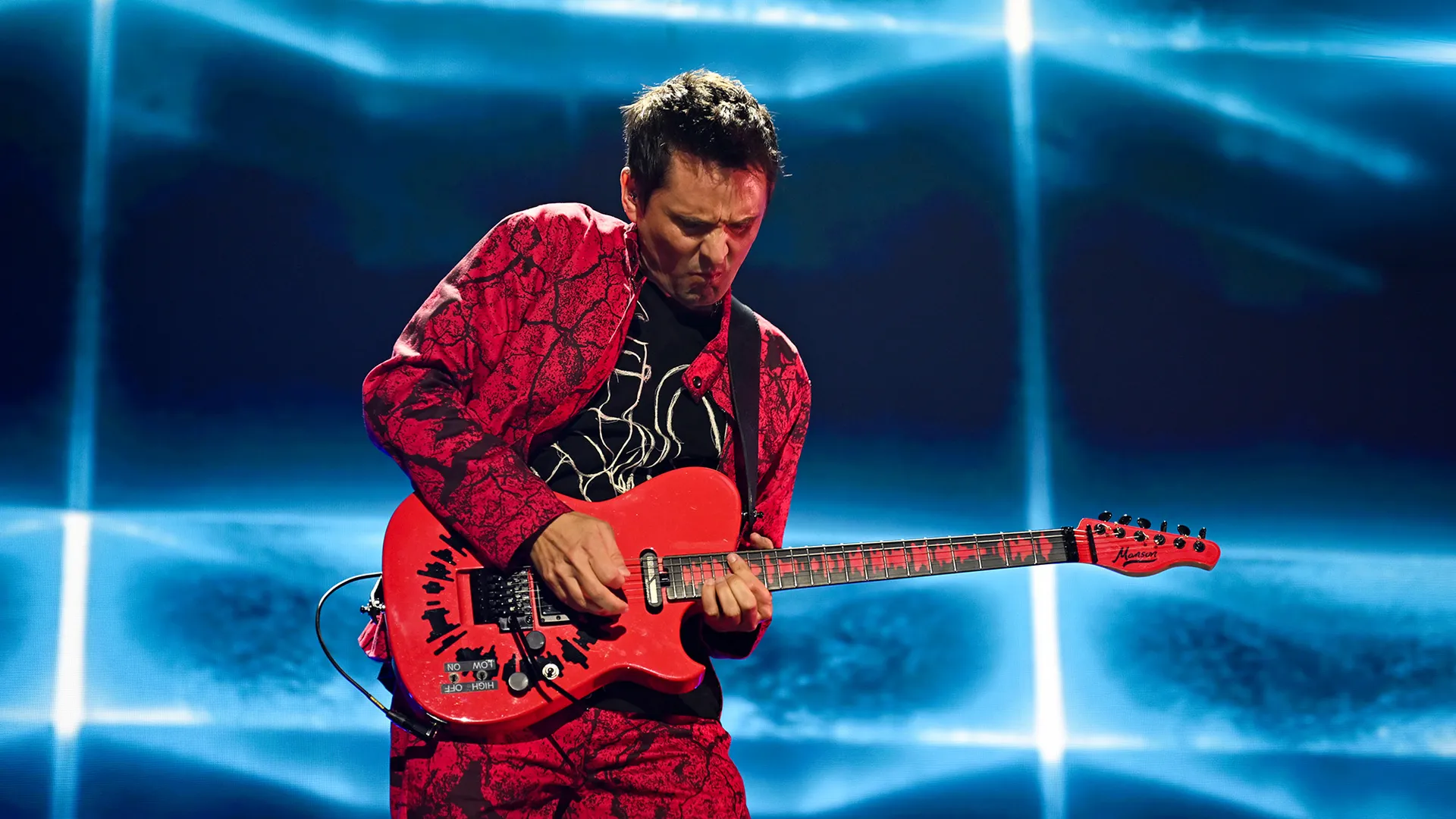
In terms of what we’re working on now, we have the Origin of Symmetry guitar. And then we’ve got the new eight-string Oryx that’s being launched at the moment, and the eight-string I’m using on stage. And then my Wow! Signal guitar, the new red one. It’s got a really nice design and a really nice fretboard. We’re going to launch a [production] version at some point.
How did you find the jump to eight-strings?
I realized how small my hands are! But I really enjoyed it. As soon as you pick it up, you just start playing these riffs that you just never would have thought of before. On the new Muse album, I used it mainly on Unravelling and Shimmering Scars. Those unison riffs with a regular-tuned bass, they just sound massive. It just unlocked a little extra something for Muse.
Let’s talk about The Wow! Signal. One thing that struck me was how it touches on influences from the wider rock world. It references Turnstile, Ghost, even Sleep Token – do you feel pressure to update Muse’s sound with each album?
Yeah, I think you have to. You have to work out what’s going on now and combine that with your sound. You don’t want to just do the new. You want to incorporate that to make it sound like you. Otherwise you’re just going to say the same thing over and over again.

This album was more in tune with earlier Muse than anything else. But it sounds like what we would sound like if we came out today – like, if Muse’s debut album was right now, but we had the emotions and the vibes and everything we were going for in the early three or four albums.
Guitar-wise, when you’ve done 10 albums, it can be tricky to find, “OK, what’s new; what do I do now?” You look at tech, you look at pedals, you look at different guitar tunings or baritone guitars, and sometimes those things can unlock different ideas.
You emerged pretty much fully formed as a guitar player, right from the very first Muse EP. Who was inspiring you?
At the very beginning, it was Jimi Hendrix and Eric Clapton in Cream. Obviously, Kurt Cobain. But really where I was heading, I think, is Tom Morello and the Edge from U2: I was going for somewhere between those two. I wanted to do weird sounds like Tom Morello but I also liked the Edge’s shimmering atmospherics. And both were Whammy users, and I did a lot of Whammy work in the early years.
Manson has issued a run of Origin of Symmetry guitars and Fuzz Factory pedals with Z.Vex. How did you first discover that pedal?
I was in a shop in Tokyo. It must have been in ’99/2000. I can’t remember the name of it, but it had racks of pedals. I was looking at all the weird ones, and that one sounded amazing. I had to have it.
I literally used it that night in the show. At the end of every song, I would just get down there [on my pedalboard] and make noises, and I was like, “I need this on the guitar.” [Bellamy has since incorporated the circuit into many of his onstage guitars – Ed.]

The last time we spoke, you’d just bought Jeff Buckley’s Telecaster. How has your relationship with that guitar evolved since then?
It might be a crime against humanity, but I have used it a fair bit on these albums. I have secretly slipped it in in a few unusual places: a couple of heavy riffs, a couple of pokey parts. It was on Shimmering Scars, and I used it on Reach Out [I’ll Be There], which is the main song that streams for Jaded Hearts Club.
It’s a frightening guitar. It’s got such a history to it. But the tone is genuinely unique. The pickups, for some reason, were slightly out of phase, and it makes it sound super-glassy, like a piano. It’s got such clarity of definition between the notes, which you can hear on the [Buckley] album Grace.
I had these guys [at Manson] doing an analysis, and they did a whole report on it. I think it would be a nice idea to do something based on that at some point. We obviously couldn’t do the shape, but we could do something that’s inspired by the tone of it. Trying to work out the exact science of how to recreate that would be interesting.

Muse are well-known for sneaking riffs by other bands into your set – from Deftones to Rage Against the Machine. How did that first come about?
It started because we love those riffs. And I wished I could have been a metal singer – a harder singer. My voice is just a bit soft, so it was always going to push us towards alt-rock rather than hard rock. If I could have done Zack de la Rocha, I would. If I could have done Nirvana, I would. But I didn’t have that voice.
You have to have a certain voice for certain types of riffs and certain types of songs, I think. And so sometimes, just out of sheer frustration with my own ability to sing over that music, I’d finish a song and go, “I wish I was in Rage Against the Machine!” It really was just an homage to our influences, but also a chance for me to just pretend I was in that band for a minute while I was on stage when actually I’m in Muse.
There are some blistering runs and two-hand tapping moments on the new album – do you still sit down and practice?
When I’m making a record, I do. I’m always trying to find something to do that’s pushing me a little bit. But having said that, I’m not the most technical player. I never spent years doing scales and runs, and I never studied the intricacies of sweep picking like Yngwie Malmsteen. I saw Yngwie, and I was like, “I’m never gonna get there.”
I have huge admiration for technical players, but I don’t personally have the patience to get to that level. I like having a bit of it, but not quite enough of it. I like some of the struggle that comes out in my playing. I think there’s some humanity in it, and I also like the fuck-offness of making mistakes and running out of steam sometimes. That doesn’t bother me.

I like the rawness, like Kurt Cobain: the struggle, the pain, but also the imperfection of it. Jimi Hendrix had elements of that – the chaos was allowed to happen. If you embrace that, you’re deliberately letting go of the technical precision. I try and balance both.
Who is your dream Manson endorsee?
I would have loved to get Turnstile, but that might be too late. Tom Morello would have been number one, but that was before our time. But someone like him.
For bass players, Charles Berthoud and Danny Sapko. I’m sure Charles has deals coming out of his ears coming from every bass company in the world. But if I could convince him to come here and just do whatever it takes to make him the best bass ever, I know it would be the best bass ever because I think he’s the best bass player ever.
Don’t let Chris Wolstenholme hear you say that.
Apart from Chris, obviously. Chris is the best bass player – for Muse!
- For more information, head to Manson Guitar Works.

