


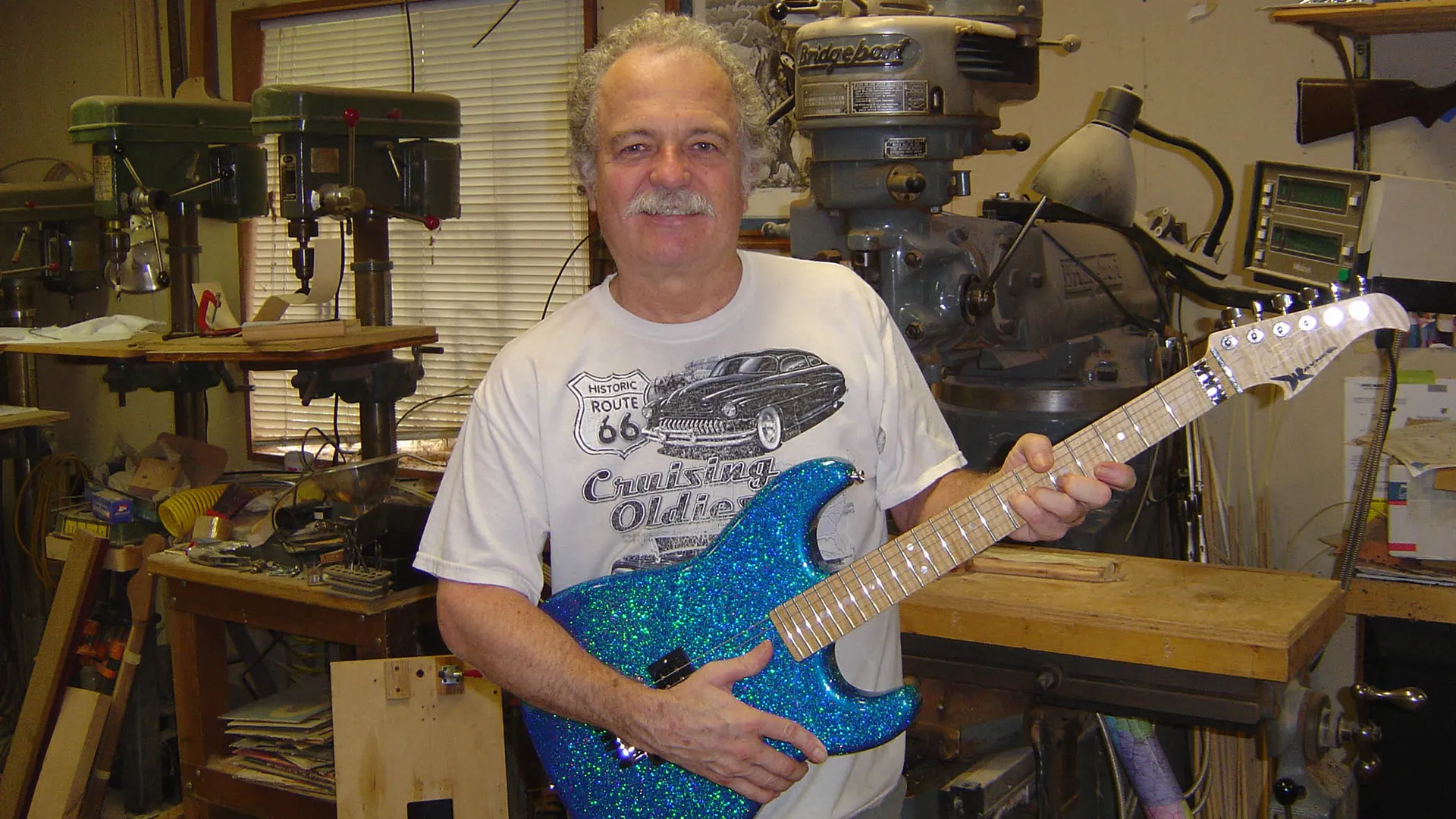
Most guitarists today are aware of Charvel the brand, but, unfortunately, fewer are familiar with Charvel the man.
Like Leo Fender and Orville Gibson, Wayne Charvel created a namesake company that lived on long after he was directly involved, thanks to his visionary spirit and distinct style, which still endures despite numerous changes of ownership.
But unlike Leo Fender and Orville Gibson, Wayne Charvel has rarely received proper credit for the magnitude of his contributions to guitar history. With his passing on July 12, at the age of 85, it is time to pay the man his long-overdue respects.
Wayne Charvel’s achievements were numerous and included his highly influential roles in innovating hot-rodded guitar modifications and the guitar custom shop, sort of the guitar industry equivalent of Alex Xydias’s So-Cal Speed Shop, which popularized hot rod and kustom car culture during the late ’40s and ’50s.
By offering a wide variety of aftermarket guitar parts with improved quality and performance, including bodies and necks in addition to hardware, his company kicked off the DIY kit guitar phenomenon. Perhaps most importantly of all, Charvel played a crucial role in the development and popularity of the Superstrat design.
Wayne Charvel was born July 1, 1941. As a teenager during the ’50s, he became attracted to the sounds of country and rockabilly music and eventually learned to play guitar. Shortly after Charvel turned 18 in 1959, he bought his first electric – a brand-new Fender Stratocaster. By the early ’60s, Charvel played in surf bands in Southern California.
“Dick Dale was my hero,” Charvel recalled. “He was left-handed and played a right-handed Strat flipped over. He also had these Fender Showman and Dual Showman amps that were really loud. In my opinion, Dick Dale invented heavy metal.”
At the time, Charvel was working as a spray painter in a sign shop in Southern California. Back in the early ’60s, many guitarists copied Dale’s style and appearance down to the finish on his guitar.
To stay one step ahead of his imitators, Dale frequently had his Strat refinished in bold, bright pearl and metallic colors. Dale’s striking Strat probably inspired Charvel to use his sign-shop skills to refinish his own Strat with a dazzling candy apple blue finish.
Soon, other guitarists asked Wayne if he could refinish their guitars, and he started painting and repairing guitars on the side. “After I got married, I quit playing in bands,” Charvel said. “This was sometime in the late ’60s or early ’70s. A couple of my good friends who worked at Fender knew that I painted guitars, so Fender hired me to do all of their out-of-warranty repairs.
“They didn’t want to take guys off of the production line whenever a scratched-up guitar came in. They wanted them to keep making new guitars instead of fixing old ones, because that’s not profitable.”
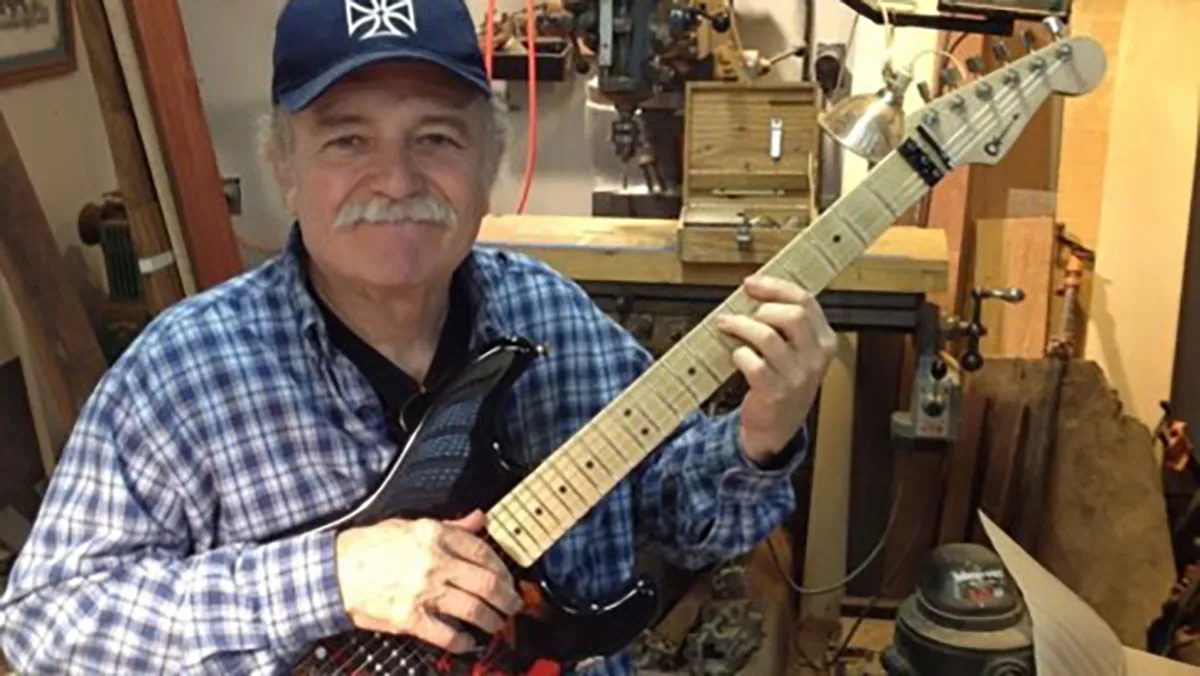
Charvel set up a workshop in the garage of his house in West Covina, California, about 16 miles from the Fender factory in Fullerton.
“I was painting guitars, refinishing and refretting necks and replacing Tolex covering on amplifiers and Rhodes pianos for Fender,” Charvel continued. “It was great for me. I was swamped. I would go to the Fender factory twice a week to pick things up, and I got to see how they made and finished Fender guitars.
“I was using nitrocellulose lacquer and they were using polyester from Dunn-Edwards. The bodies were shaped using overhead pin routers, and everything was made by hand. They didn’t have CNC machines back then.”
Fender’s transition to more durable polyurethane and polyester finishes eventually led to fewer guitarists bringing in instruments for touchups, and Charvel’s workload for Fender eventually started to decline.
Bob said I’d do better if I had a shop. People respect it more if you’re doing repairs in a shop as opposed to your garage
In early 1974, Wayne Charvel decided to become his own boss and opened his own independent business, Charvel’s Guitar Repair, in a small storefront on Arrow Highway in Azusa, California.
Initially, Charvel planned to continue working in his garage, but his good friend Bob Luly, who designed amps for Leo Fender’s Music Man company, had a better recommendation. “Bob said I’d do better if I had a shop,” Wayne told guitar historian Tony Bacon. “People respect it more if you’re doing repairs in a shop as opposed to your garage.”
Over the next year, the shop quickly built a steady clientele from word-of-mouth and business that Fender and local retail shops like Hanich Music directed Charvel’s way.
One of those retailers – possibly Hanich – asked Charvel if he could make an unbreakable jack plate for Gibson Les Pauls as the store was getting a lot of complaints about the fragile plastic version on new models. Wayne had a friend who owned a metal press, so he had a small run made that promptly sold out.

Wisely, Charvel realized that this simple guitar part potentially had national appeal, so he placed a tiny ad in Guitar Player that first appeared on page 49 of the February 1975 issue with John McLaughlin on the cover.
People started seeing my shop’s name in Guitar Player every month. Placing repeat ads helped me build name recognition and convinced players that I was legit
Wayne Charvel
“People started seeing my shop’s name in Guitar Player every month,” Charvel said. “Placing repeat ads helped me build name recognition and convinced players that I was legit. Eventually I started selling more parts, like a stainless steel tremolo arm for a Strat that was four times stronger than the stock arm and chrome-plated and vintage-style Strat replacement pickguards.
“I had a big advantage over other mail-order businesses that were also starting to sell guitar parts because I had a repair shop, too,” he continued.
“That’s because guitarists would come into the shop and tell me what they wanted. That’s how I got new ideas and why Charvel expanded into other things like bodies and necks. Players wanted to build or modify their own guitars, and we provided them a way to do that.”

Selling guitar parts might seem like a no-brainer today, but in the mid-’70s it was a revolutionary concept. At the time, replacement parts were pretty hard to come by and usually had to be salvaged from older, damaged instruments.
For example, Gibson sold only a very limited selection of parts – pickups, control knobs and a replacement Tune-O-Matic bridge and stop tailpiece. Charvel made it easier for guitarists to restore their vintage instruments, but even more importantly it became the first custom shop for players who wanted to hot rod their guitars for maximum performance.
Soon, Charvel’s Guitar Repair became a hangout for pros and aspiring players. Clients included Doctor Mike “Boffin” Phillips, a road crew member for Deep Purple, and Alan Rogan, who had recently become Pete Townshend’s guitar tech.
Charvel customized guitars for several notable rock stars and even built a few custom instruments, like a quilted maple Strat that Tommy Bolin used on stage during the mid-’70s.
Back in those days, nobody was flattening the fingerboard and installing jumbo frets like we were doing
“I was taking Fender guitars and hot-rodding them,” Charvel said. “Back in those days, nobody was flattening the fingerboard and installing jumbo frets like we were doing. We also did things like putting humbucking pickups in Strats and Teles. We were ahead of everybody. I did it because I worked in nightclubs for so long and realized that Fender single-coil pickups didn’t have the sustain players wanted.
“I started doing that, and players loved it. Then I started making bodies. I hooked up with Dave Schecter, who taught me a lot of things, and Dave and I made 100 bodies in one weekend at his shop in Reseda.
“Later, I taught my junior high school buddy Lynn Ellsworth how to make guitar bodies and necks, which he started building for me. He called his company Boogie Bodies and did all the tooling. He even started to make a few of his own guitars.”
The first ads featuring Charvel bodies appeared in October 1976, and replacement necks were first offered a few months later in March 1977. Meanwhile, Charvel built a coalition partnership with associates that included Boogie Bodies, Schecter and Seymour Duncan, and his shop stocked high-output pickups from companies like DiMarzio and Mighty Mite.
During the fall of 1977, the Charvel shop relocated to a larger facility in San Dimas that was better equipped for building guitars and manufacturing parts in house. Many other companies also produced guitar parts, but Charvel stood out by providing everything guitarists needed to build entire instruments from scratch. From this moment onwards, the DIY guitar phenomenon was off and running, thanks to Charvel.

Around late 1975 or early 1976, a young, unknown player named Edward Van Halen started dropping by the shop and hanging out.
According to Charvel’s recollections, Van Halen first came to the shop to see if they could fix a pickup in one of his guitars that was squealing and feeding back excessively (probably Ed’s 1975 Ibanez Destroyer, as the model’s Super 70 pickups were notoriously microphonic). Charvel suggested dipping the pickup in wax, a process known as “potting,” which he had learned about from the Fender factory.
Considering that Charvel was already installing humbucking pickups in Strats for clients at the time, it’s highly likely that Eddie bought the 1961 Strat that he was photographed playing in clubs in 1976 from Charvel with its bridge humbucker already installed.
The earliest shots of Van Halen playing this guitar taken in mid-1976 show that the pickguard mounting hole for the humbucker is perfectly and professionally cut. A few months later, when Ed realized the pickup was placed further away from the bridge than he preferred, he crudely cut the pickguard and hacked out a larger cavity with rough edges, typical of Ed’s early “by any means necessary” approach to guitar modification.

Although Eddie Van Halen certainly deserves credit for inventing his iconic Frankenstein guitar with a single humbucker, single volume knob and distinctively striped finish, it appears that the guitarist got much of the inspiration for his early gear innovations from Charvel (including the Variac, which is a fascinating subject for another story).
Ed rescued the Frankenstein’s ash body, which was a flawed second with a knot in the treble cutaway and an angled center seam, from the scrap heap, buying it for the discounted price of $50. A few months later, he returned to Charvel and bought a neck with a wide, flat maple fretboard for $80.
For decades, Van Halen fans assumed that the body of Ed’s iconic Frankenstein guitar (first seen in February 1977 in a raw, unfinished state) was made by Boogie Bodies, but strong evidence suggests that it was actually made as part of the batch of 100 bodies constructed by Wayne and Dave Schecter.
Luthier Donnie Ward, who has seen and collected dozens of examples of early Charvel/Schecter and Boogie Bodies parts, has identified numerous characteristics seen on the Frankenstein body, such as the neck pocket shape, truss rod adjustment cutout and forearm and belly contour shapes, that perfectly match those of the Charvel/Schecter bodies.

Charvel himself supported this in an interview in 1985, long before the body’s origins were questioned. “To the best of my recollection,” he said, “the neck was probably an Ellsworth neck (Boogie Bodies, first seen on Ed’s Frankenstein in July 1977) and the body was ours. That first white (striped) one, I’m pretty sure that was our body.”
Van Halen loved the Frankenstein guitar he built from Charvel parts, and he repaid their help by mentioning “Charvel’s Mfg.” in the special-thanks section on the back cover of Van Halen’s debut album. During early 1978 he asked Charvel to build him a new guitar based on his Frankenstein but with a rear-loaded humbucker.
Charvel delivered the finished guitar to Ed in the late summer/early fall of 1978, and the guitarist was first photographed playing it in October 1978 during a handful of shows in Europe.
Featuring an eye-catching black finish with yellow stripes painted by Wayne Charvel that inspired the guitar’s “bumblebee” nickname, the guitar became iconic when it appeared on the back cover of the Van Halen II album, released in March 1979.

Unfortunately, Charvel’s partnerships and reliance on outside manufacturers to build parts led to cash flow and debt problems for the burgeoning business, which was still building its customer base. Stressed by the challenges of operating the business, Charvel sold his company, including rights to use his last name, to employee Grover Jackson.
In a cruel twist of fate, the change of ownership took place in November 1978, which was the same month that Guitar Player’s first interview with Eddie Van Halen was published.
Whereas the “Charvel’s Mfg.” credit only hinted that Ed’s Frankenstein may have come from Charvel, suddenly the entire guitar community knew when he told the guitar’s origin story and generously mentioned Charvel three times in the article.

Wayne Charvel was never bitter that Charvel’s surge in success happened after he left the company. A dedicated family man, he was relieved that he could focus on raising his children rather than toiling to pay vendors.
Wayne’s post-Charvel life wasn’t quite as groundbreaking, but it still was creatively fulfilling. For a while in the late ’70s and early ’80s, he worked for B.C. Rich handling artist relations, designing a few models and setting up the factory so its manufacturing was more automated and efficient.
He also built custom guitars for numerous artists who still commissioned his talents. Notable examples include Michael Angelo Batio’s original four-neck Quad guitar and a matching guitar and bass built for ZZ Top’s Billy Gibbons and Dusty Hill with bodies shaped like the famous 1933 Ford “Eliminator” coupe and featuring a pyro charge and motor that blew smoke out of the instruments’ tail pipes.
For a brief period between 1987 and 1989, Wayne worked for Gibson and designed the Wayne R. Charvel WRC signature, US-1 and U-2 Superstrat models. Charvel’s association with Gibson was short-lived due to a trademark infringement lawsuit that Jackson/Charvel filed that severely restricted how the guitars could be marketed and how Charvel’s name could be used.

Charvel left Gibson in 1989 to start producing guitars with the Ritz brand name for about a year until he changed the name to WRC. Finally, in 1998, Charvel and his son Michael started the Wayne Guitars company, which produces instruments with the same standards of quality and spirit of the original Charvel shop in San Dimas. Wayne Guitars continues on today under Michael Charvel’s leadership.
Numerous guitarists paid tribute to Wayne Charvel when news of his passing became public in late July. His son Michael’s tribute was the most eloquent, as he knew Wayne better than anyone during his father’s years spent living, building guitars and running a retail music shop in Paradise, California, and relocating to Arizona after Wayne’s home, workshop and business burned down in the devastating Camp Fire in 2018.
“Many of you knew him as a legendary guitar builder, craftsman and musician,” Michael wrote. “I was blessed to simply call him Dad. Of everything he accomplished in his life, what meant the most to me was that he was a loving father. Rest in peace, Dad. I will miss you every day.”
- This article first appeared in Guitar World. Subscribe and save.

