

Malina Moye has always done things her own way. She plays left-handed with the strings in right-handed order and blends rock, blues, funk, soul and pop into her own language. So when the time came to create the Kramer Malina Moye Pacer Deluxe, an existing guitar with her name on it was never enough.
The process unfolded over four years and as many prototypes, with Moye fully involved at every turn. She stayed closely engaged throughout the process and was not prepared to settle for anything less: the finished guitar had to carry her personality as clearly as her name.
But there was more behind that determination than simply getting the guitar right. Moye had watched male players receive signature guitars and questioned when her own work would receive that recognition.
Becoming the first woman of colour to receive a Kramer signature model gives the moment genuine historic weight. But above all, this is a guitar that reflects her personal vision, her standards and her refusal to compromise. We sit down with Moye to discuss how it all came about.
You described this guitar as being bigger than you. What does this moment mean?
Man, this is everything. There are so many layers, as a woman, as a Black woman and as a guitar player. I’ve said for years that manufacturers need to look at who’s actually picking up instruments.

A lot of those people are women, and they deserve the opportunity to have signature guitars. So when this came along, I wanted it, but not only for me. I wanted other people to see what’s possible.
This was never, “Here is a guitar, let us put your name on it.” Kramer listened when I said, “This is how I see the guitar, this is what I need as a player, and this is how we can include more people.” I wanted to make us proud.
How did you and Kramer first find each other?
It started during the pandemic. Janie Hendrix recommended me for a voiceover connected for a Jimi Hendrix project, and that introduced me to the Gibson family. I met so many great people there, and what really struck me was how many women were in the room.
Everybody was forward-thinking and sharp. I said I would love to do something together, and the conversation opened from there. Kramer respected my vision and understood that I play differently. That made it feel like the right home.
Why did the Pacer feel like the right place to begin?
To me, the Pacer is already a ‘SuperStrat’, so it was in the right ballpark. During the pandemic, Kramer sent me several guitars, including a Baretta and a NightSwan. I spent time playing them and thinking about what I would change.
I wanted to pull together elements from guitars I had used throughout my career but make them more comfortable and more ‘Malina’. The goal was to have the kind of guitar you pick up in front of the TV and then suddenly realise four hours have gone by because it feels so comfortable.
What did the development process actually look like from your side?
I was ready because I had spent decades performing and making mental notes. Every player has those thoughts: ‘If I could change this, or move that, the guitar would work better for me’. Kramer gave me guitars to try and I would send very specific feedback.
Sometimes I could feel something that I couldn’t give them measurements on, so I sent reference guitars and said, ‘This is where we need to be. Please look at this neck and see how we can move in this direction.’ We went through four main prototypes over roughly four years. I was never in a rush. My name was going on it, and I wanted to be proud of every decision.
What was most important to you when you played the prototypes?
Comfort, first of all. I have small hands, and the traditional heel felt so bulky that after 20 minutes I wanted to put the guitar down. I told them we had to look toward the future and make it easier to reach the upper frets. They would reshape it and I would say, ‘More. Take off more.’ When we finally got there, I knew immediately. It felt beautiful.
How detailed did you get when it came to the neck specs?
Very detailed, right down to the 10-inch fingerboard radius. I knew how I wanted the neck and I could feel when it wasn’t right. I was thinking about whether I could play a 90-minute or two-hour show without my hand getting tired.
That was the level of detail I wanted in a real signature guitar. I also use 0.008-gauge strings, which surprises a lot of people because they’re very light. I like the freedom they give me. Everything had to work together so that the guitar felt easy but still responded when I really dug in.

A Floyd Rose might seem like the obvious Kramer choice. Why did you go with a non-locking tremolo?
I wanted the standard two-point tremolo because you can put on another string and keep moving. I don’t switch guitars much during a show
I love a Floyd Rose, and I own guitars with them, but I’m looking at this guitar as a working player. With a Floyd Rose, if you break a string on stage, that can be the end of that guitar for the moment. You hand it off and grab another one. I wanted the standard two-point tremolo because you can put on another string and keep moving. I don’t switch guitars much during a show.
The pickups cover a lot of ground. How did you arrive at that HSS set?
The Virtual Vintage Blues in the neck and the Area 67 in the middle have been part of my sound for years. The neck pickup is thick, beautiful, clean and clear. That’s where I often go for solos. For rhythm I move to the middle because I wanted that really clean funk sound. Lead playing is great, but you can’t lead without rhythm. The Super Distortion was the new ingredient.
I asked Larry DiMarzio for something with more punch, and he suggested it after listening to what I was describing. I tried it and loved it. It brings the hard-rocking Kramer side, while the two single coils keep all the other colours available. That combination lets one guitar speak several musical languages.

How much did your own upside-down stringing shape the design?
People sometimes assume the way I play is just a visual thing, but it’s real. I play left-handed and string the guitar in the opposite order from a conventional left-handed player. For my own guitar, that’s how it has to work. But I also wanted a proper left-handed production version for players who string normally. So it’s available left-handed and right-handed; I fought hard for that.
Left-handed players are usually ignored, or they have to wait months for something that doesn’t look exciting. I told Kramer, “You can’t release only a right-handed version when your signature artist is left-handed.” The first left-handed guitars went quickly, and people started sending me order screenshots from Japan and Australia. That showed there was a real audience waiting to be served.

What inspired the blue finish?
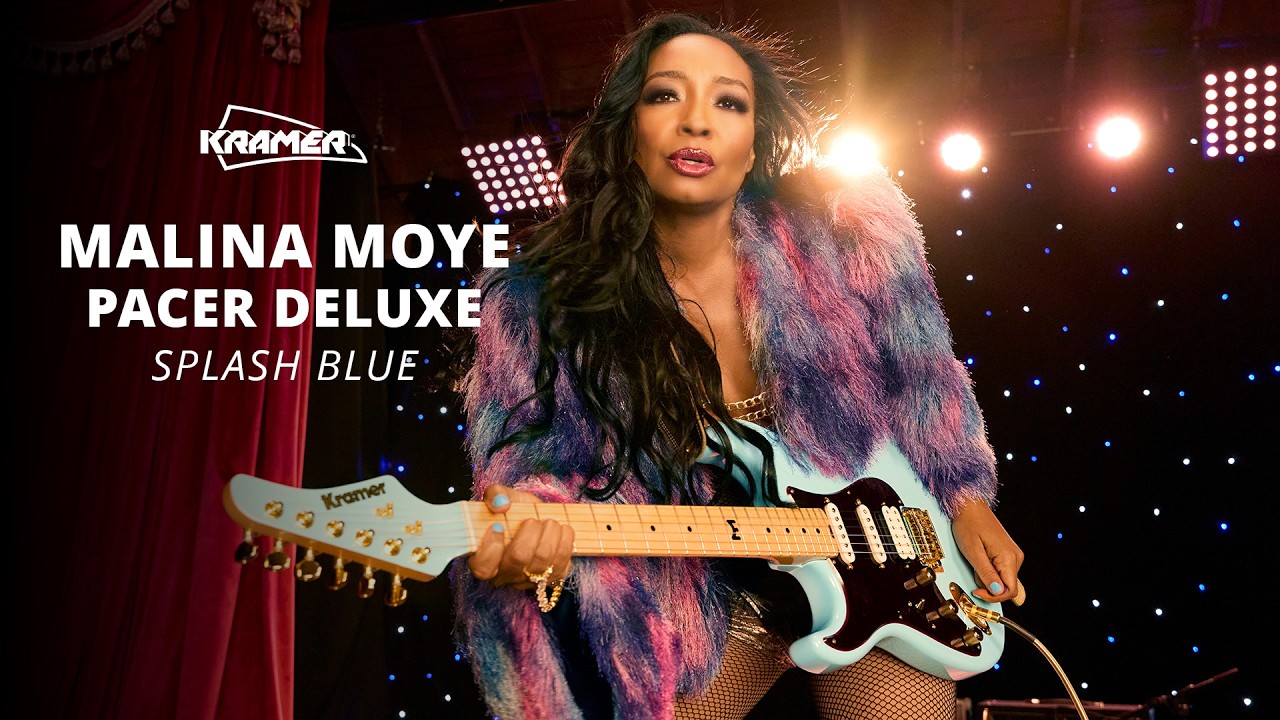
The Splash Blue finish started with a pair of blue Christian Louboutin shoes that I got for my birthday. You can see me wearing them in my little promo videos. The colour also made me think about the blue outfit that Prince wore at the 2007 Super Bowl. I grew up in Minnesota, and I like to pay tribute to Prince and Michael Jackson in subtle ways. The tortoiseshell [coloured] pickguard became another little nod to Prince, while the gold hardware is very much me.
I wanted the guitar to make a statement before you play a note. The reverse headstock, my logo at the 12th fret and my red signature on the back of the headstock all help it feel custom, but I kept my name off the front because the guitar is not only about me. The player should be able to make it their own.

Did you ever worry that making it so personal might narrow its appeal?
No, because I believe this guitar does appeal to everybody. The familiar choices are already out there. You can buy a traditional Kramer or a traditional Strat. I wanted to bring something new into the space without losing what makes a Kramer rock hard.
The guitar still has the punch people expect, but you can create more colours. That’s where players are going. People want to keep discovering, writing and crossing between styles. I’m a woman, a left-handed player and a musician with my feet on the ground. I listen to what people tell me is missing – and I wanted to answer that.
How important was the price of the guitar to you?
Very important. You want people to pick the guitar up. I wanted it to feel like a custom piece and give you a lot of guitar, but what’s the point if somebody has to give an arm and a leg to own it?
When I saw the price at $1,299, I thought it was perfect. I believe everybody deserves a shot at choosing what they want to do. This instrument carries all the energy and lessons I grew up with, but it is there for somebody else to pick up and create with.

Have you had a chance to hear what other players are doing with the guitar yet?
Yeah, I heard Gretchen Menn play a Jeff Beck piece and I loved it. Then she started playing slide. It was beautiful hearing her bring out all these different colours.
What do you hope this instrument will say to women and young players of colour who might not always see themselves represented?
My family always told me, ‘When you don’t see yourself represented, show up. When you think you can’t, show up anyway, and know that you matter when you arrive.’ I kept showing up because other people showed up for me. I hope I made people proud. I think about all the incredible players who laid the foundation but never received this kind of opportunity.
Some of them may have wondered whether anyone saw their work. I saw it. This guitar is for them, too. Now somebody else will come after me and push the door even further. That’s what makes this so powerful. I don’t want to tell somebody how to use it. I want to hand them the guitar and say, ‘Okay, play me your story.’ That’s what it is all about.
- This article first appeared in Guitarist. Subscribe and save.

