


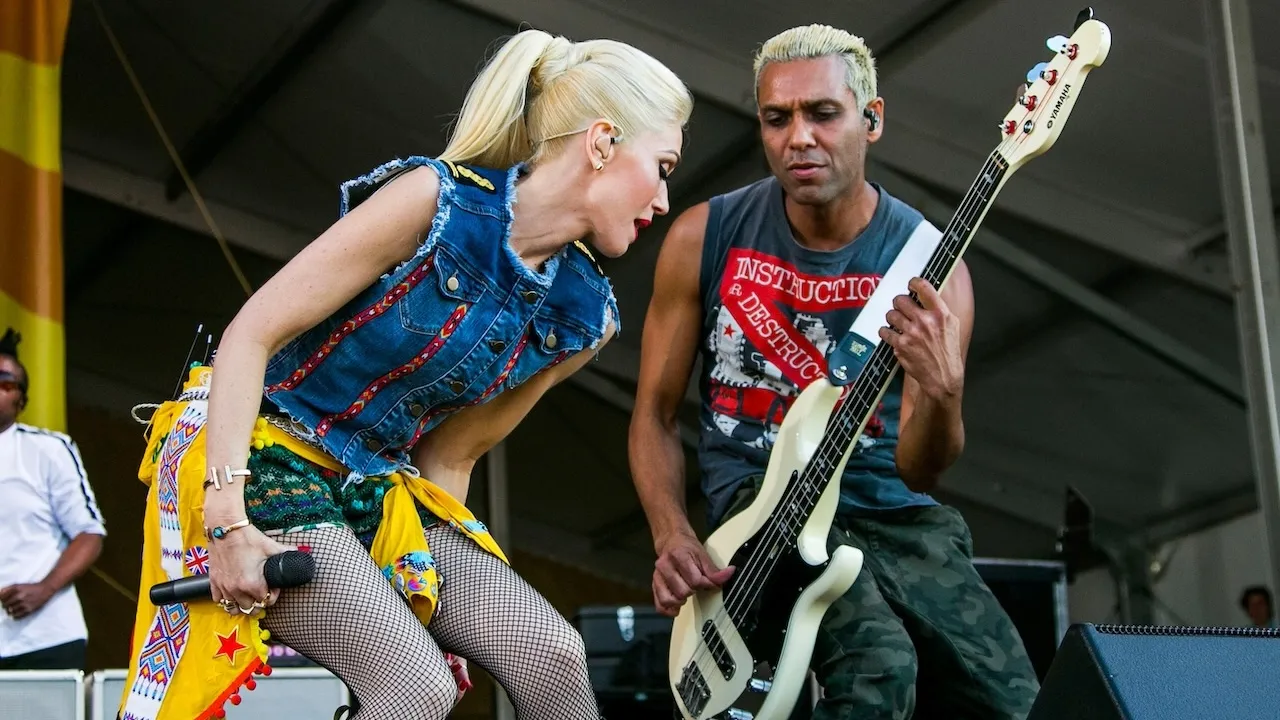
Holding down the low-end for No Doubt, Tony Kanal helped turn the band’s punk-inflected pop into a global phenomenon.
Born in London to Indian parents, Kanal moved between the UK, Canada and the US before settling in Anaheim, California, where his musical journey began on saxophone.
But it was as a bassist that he joined No Doubt at 16, going on to co-write global hits including Just a Girl and Don’t Speak – the latter reflecting on the end of his seven-year relationship with singer Gwen Stefani.
But long before Kanal was filling arenas with No Doubt, he was simply trying to get his hands on a bass guitar he could call his own. A family connection to Yamaha gave him a way in.
“When I first started playing bass I was using the school Rickenbacker, and I would take it over the weekend to play shows,” Kanal told Bass Player in July 2017. “And as cool as my high school bass teacher was, when he found out about that, he told me I had to stop taking it or he’d get in trouble.”

“At the time I didn't have a lot of money, but Gwen’s dad worked at Yamaha in the WaveRunner division, so he got me an employee discount. I borrowed $350 from my dad and bought a BB1600.
“That was my bass from 1987 until we went to Japan in 1995, and I found a BB3000 in a store. I bought that bass and started playing it. Right about then Yamaha got in touch with me, and I've been working with them ever since.
“For years they’ve been finding vintage models from the ’80s, and they totally strip them and put in new electronics and re-paint them so I can style them how I want. I just love how the collaboration with Yamaha turned out.”
“I’ve also been using Gallien Krueger heads since the beginning. I still have the first one I bought at Guitar Center in 1988. They even rebuilt it for me a couple of times, because I blew it out over the years.”
What goes through your head when you’re onstage?
When everything is firing on all cylinders, I usually go to another place entirely. That's where the muscle memory kicks in – you just go with it.
Tom and I were writing the early No Doubt stuff when we were teens, so that's real muscle memory; when you're still forming physically and mentally, it’s part of your fiber. Whenever we play, it’s just there.
Who has been your biggest influence?
My go-to is always Prince. I listen to Prince every day, and I play his music for my daughters constantly. Talk about a monster bass player. That guy made every bass player look like a joke, and that wasn't even his main instrument.

Which other bass players influenced you?
Simon Gallup, Peter Hook, Horace Panter from the Specials, and my bass teacher from high school, Michael Stopher. I had only been playing for a year when we started No Doubt, but that guy introduced me to so much great music and so many great bass players.
What was it like going to Jamaica to work with Sly and Robbie on the Rock Steady album?
It was amazing. I learned so much from those guys, especially from Robbie on the bass side. He would tell me that I didn’t have to play as many notes to get my point across.
My early basslines with No Doubt were so busy, because as a kid you always have something to prove, so I was playing a ton, but space is so important, and that’s probably the biggest thing I learned from working with Robbie.
On our song Underneath It All, I play the low bassline and Robbie is playing a strumming bassline on top. He didn’t let me cut and paste any of my parts, so that song was all in one take. No matter if I got off or not, it was real.
You also played key bass for the first time on that album.
I had no idea what I was doing when I started playing keyboard basslines, but that was the cool thing about the way we recorded Rock Steady: We just let go of everything we had done in the past. It was just about trying something new.
In our case it worked really well, and I’m glad I didn’t get discouraged by the fact that I’m not a keyboardist. It wasn’t about skill it was all about getting something that just felt great.
I tend to overcomplicate things on bass, and this was a way to prevent that from happening. It forced me to play simply – but simple in a way that left me happy with the part. I think that changed my mindset overall, to the point where now I’m okay with playing a very simple part on the electric bass as well.

What advice would you give to an up-and-coming bass player?
You have to be hungry and work hard at what you do. We were just tenacious when we started out. People don’t realize this about us, but we didn’t get on the radio until we had been together for nine years. That’s a long time to be doing something, but we loved what we were doing.
I went to college for a little while and I was in psych classes and I was just working on the next No Doubt flyer. It was where my heart was. Love what you do, and don’t stop putting in the work.