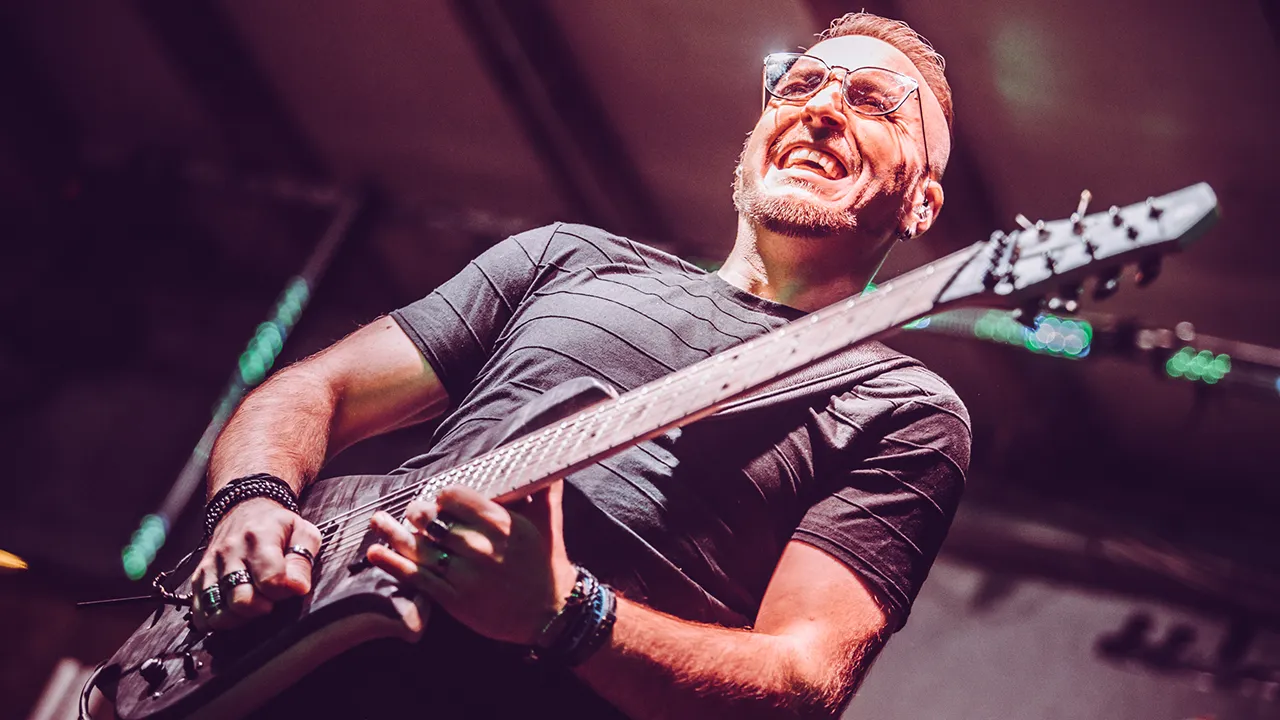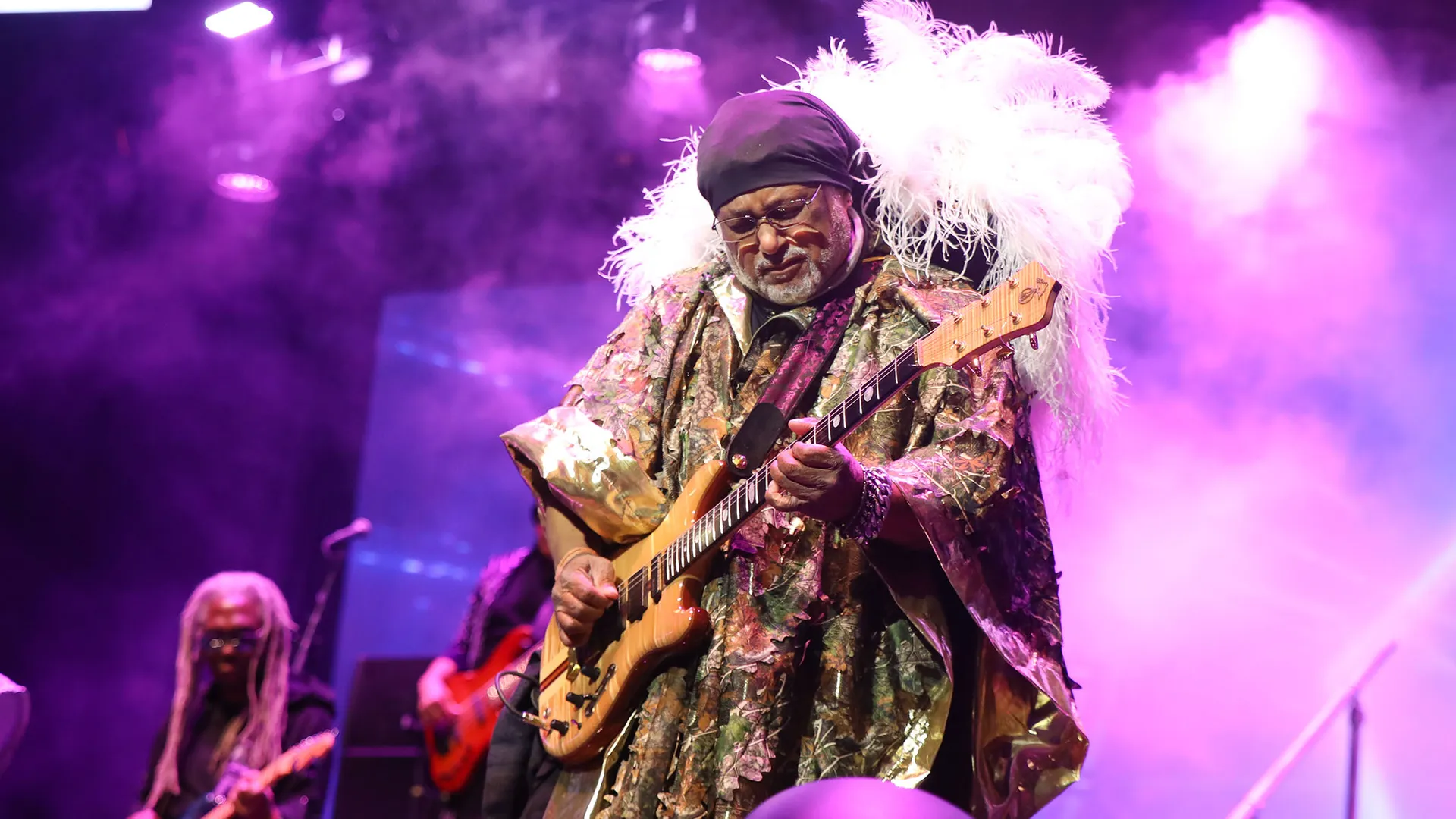
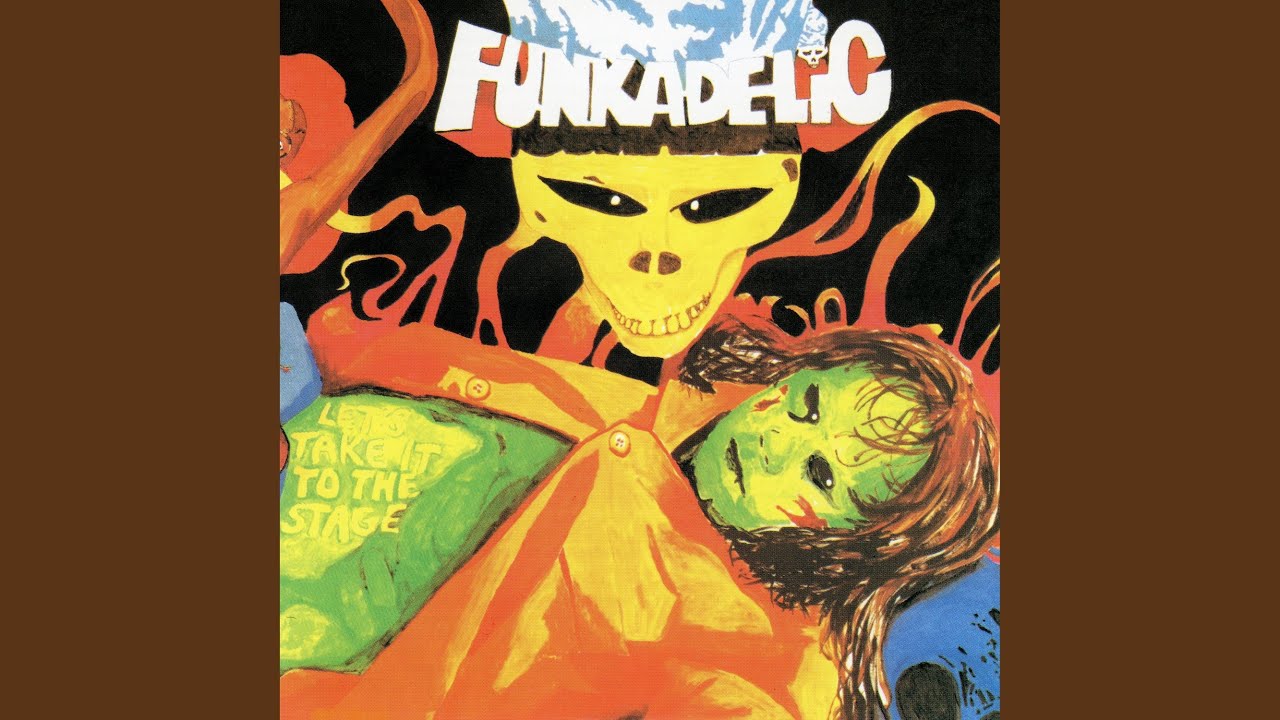
Michael Hampton was barely 20 when he recorded Funkadelic’s 1975 record Let’s Take It to the Stage. He was young compared with his P-Funk bandmates, earning him the nickname Kidd Funkadelic – but he quickly settled into the funk collective, and the good times soon rolled.
“Once I got in the band and out on the road, I just practiced and played,” Hampton says. “When we got into the studio, maybe I’d bump into a few beers and just kick it and have a good time.”
With this, Hampton admits he “couldn’t tell you the actual process,” mainly because Funkadelic was a collective of free-spirited, drug-using, hard-partying musicians looking for nothing more than a groove to accent their good times.
“Those guys were older than me,” Hampton says. “They were putting it together. There was probably a lot of ‘paperwork’ I missed out on. [Laughs] But, hey, I’d rather have the few brain cells that I’ve got left than worry about any of that!”
Like most of Funkadelic’s ’70s output, Let’s Take It to the Stage is a banger with lots of guitar heroics to spare.
“We saw it as like a battle of the bands, you know, that type of relationship,” Hampton says. “We always tried to do our best on tour. That’s where ‘Let’s take it to the stage!’ came from. We’d be like, ‘Let’s do this sucker!’ We were like a funk mob, just doing our best to smoke the stage and outdo whatever other band was coming.”
Now 69, Hampton isn’t a “Kidd” anymore, but he fills up with youthful energy when he looks back on Funkadelic’s halcyon era.
“It means something to me on the groove trip,” he says. “If you don’t like it, take your dead ass home, you know? [Laughs] Shit, I still love that stuff. I love playing it. When I do, I pull out the best equipment, so that whatever I use will be louder and funkier. We still say, ‘Let’s take it to the stage,’ you know? It still represents us. It’s about having fun and that competition, which is alright by me.”
How did the sessions for Stage kick off?
We went up to Michigan United Sound, which was near Wayne State University’s campus in Detroit. We stayed across the street at a little motel, and that was where we came up with a lot of stuff. I’d have to listen to the album to remember exactly what happened and where, but I do remember that.
Can you remember the first song that you recorded?
That woulda been Be My Beach. I actually did the sessions for Let’s Take It to the Stage the same day I did the first sessions for Bootsy Collins’ first album, Stretchin’ Out [1976].
Given the free-spirited nature of Funkadelic – and your playing – what was your general approach?
I had no idea where we were going. [Laughs] I don’t know what the process was because there wasn’t one! We went in there, said, “We’re gonna record this song,” and we just did it. No-one ever approached me formally and was like, “This song is gonna be on this album, and we’re gonna do it this way…” We just did a lot of sessions for both albums, and they picked out the best stuff that made sense for the albums.
![Parliament-Funkadelic in 1977 and in full effect, including Bootsy Collins [standing, far left] and Michael Hampton [in hat, near center right]](https://cdn.mos.cms.futurecdn.net/cgqdSDMhaJy9dBRqf7Ho7B-1200-80.jpg.webp)
So you had no idea if you were recording a track for Funkadelic or Bootsy?
It wound up as a process of elimination. Everybody was just recording all the time, 24/7. It was like one giant shift; you’d get back up, go over there, play, do it, hang out, kick it, put some parts on and then come back out. It’s hard to even know who played on what track, to be honest with you.
That checks out, as the credits on P-Funk albums are murky at best.
A lot of things went undocumented. I’d have to listen to try and figure out who played with me on this or that track. There might be a log out there somewhere that had that, but I don’t know. I’d go in there early in the morning and be on this or that song, but things changed so often, and the process was fluid.
Who plays guitar on Good to Your Earhole, which features a ton of ripping guitar?
I know that one, man. That’s Eddie Hazel! I didn’t play the foundation of that or anything. Everybody was recording, and Eddie probably went in there, did his thing and probably did some singing because he was a great singer, too. That’s the story there.
According to George Clinton, a “smack addict” wandered into the studio, laid down the solo for Get Off Your Ass and Jam and was paid $50. Is that true?
I heard a story like that, but I don’t wanna say the guy who did it was a smack addict, you know? [Laughs]
Paul Warren of Rare Earth has claimed that the solo on Get Off Your Ass and Jam was, in fact, him. Should we put the “smack addict” rumor to rest once and for all?
Yeah, I don’t know! Maybe it was a guy on smack who got paid $50. But let’s just roll with what George Clinton said. [Laughs] So, yeah, sure, the original story is probably true.
Did you play on Get Off Your Ass and Jam, too?
I did the loop when the song starts off. They looped it real fast, and then I’m in the back doing some whammy stuff later on. And it’s funny because I think Tupac Shakur sampled that in one of his tracks [1993’s Holler If Ya Hear Me]. Somebody sent it to me. They broke it down, and it’s like three notes running; he made all these beats and different time signatures. It was a cool sample.
What gear were you working with?
We had a lot of Marshall amps. And we had the old backline from Aerosmith, which were Music Man amps, and Crown power amplifiers. So, yeah, we were using Aerosmith’s old equipment.
Some people just have their favorites, but it doesn’t matter to me too much. It’s about how well you play
How did Funkadelic end up with Aerosmith’s gear?
That’s a good question! [Laughs] There was a guy called “Rabbit” who we coulda asked, but I don’t know about any of that, man. I don’t wanna drop any names, but I just heard that’s where we got the Music Man and Crown stuff.
I’m not quite sure if we borrowed them, if it was an actual purchase or a trade, but there were a lot of things going on back in the day with roadies and things like that, so who knows about the actual transaction.
Is that to say maybe a side deal took place between roadies?
Well, there were some guys that worked with Aerosmith that were actually techs, and they were working with us, too. I don’t know because I didn’t see the guys, and I didn’t talk to anybody that did the deal. I just know that we wound up with it, and that’s what was used. They worked, I plugged in, and that’s how it was!
What guitars did you use on the album?
I had an old Gibson L6-S. I kept it all original, and that’s the guitar I used a lot back then. I also had a Les Paul and an old Framus that was kind of Les Paul-shaped [probably a 10600]. I had that guitar worked on; it had these weird augmented pickups where the coil and the wire wrapped around them made crazy sounds.
I ended up having DiMarzio pickups put in there instead. And then I had an Alembic guitar that I bedazzled with rhinestones, mirrors and shit. [Laughs] Oh, and I had my B.C. Rich Bich.
How do you view the album’s legacy?
Some people just have their favorites, but it doesn’t matter to me too much. It’s about how well you play. Once somebody gets into it, that’s what matters. But it’s funny because I had no idea people would like it so much. You play the songs, rehearse them and do the shows, but you don’t know it’s gonna be something that loops on forever.
- This article first appeared in Guitar World. Subscribe and save.