


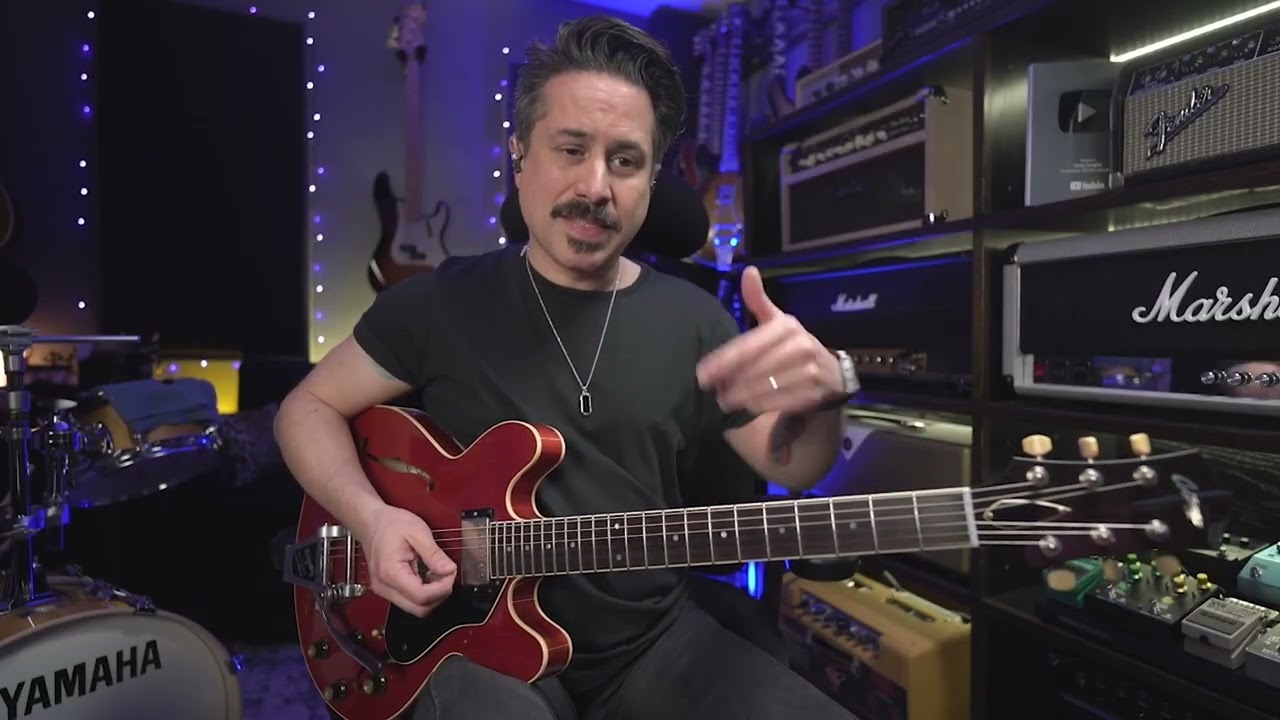
In this lesson, I’d like to share a cool way to add harmonic color to a melody played over a dominant 7 chord, and that is to play a minor 7 arpeggio that’s rooted a 5th higher. To demonstrate, I’ll use Dm7 arpeggios over a G7 chord.
D is the fifth note, or degree, of the G major scale. When playing in the key of G, a D major chord is the V (five) chord, and a D minor chord (Dm) is the Vm (five minor, alternatively indicated by a lowercase v).
Figure 1 shows a 3rd-position G7 barre chord, as well as the individual notes that make up the chord – G, B, D and F. G is the root, B is the major 3rd, D is the 5th and F is the minor, of “flatted,” 7th (m7, or b7).
Figure 2 illustrates a Dm7 arpeggio, built from the notes D, F, A and C. Relative to a D tonal center, D is the root, F is the minor, or “flatted,” 3rd (m3, or b3), A is the 5th and C is the minor, or “flatted,” 7th (m7, or b7). But when you play these four notes over a G chord or G bass note, D is heard as the 5th, F becomes the minor, or “flatted,” 7th, A is the 2nd, or 9th and C is the 4th, or 11th.
Figure 3 begins with a descending riff built from these notes that sounds great over G7. In bar 2, I initially ascend a Dm7 arpeggio and then end the phrase with a descending line that’s based on the G minor pentatonic scale (G, Bb, C, D, F) with the inclusion of the major 3rd, B.
To me, it always sounds pleasing to resolve the Vm7 (or v7) arpeggio to a bluesy line based on the tonic or home key. For example, in Figure 4, the Dm7 arpeggio is moved down to 2nd position and begins on the 5th string, and is followed by a G minor pentatonic line.

A good way to practice incorporating Dm7 arpeggios over a G7 chord is to set up a G7 vamp with a looper. Figure 5 illustrates a simple, funky vamp based on a repeating G7 voicing, with a hammer-on from Bb, the minor 3rd, to B, the major 3rd, each time.
A typical tried and true approach is to play straight blues over this vamp, like the riff in Figure 6, which is based on G minor pentatonic.

Now, let’s kick off the line with a Dm7 arpeggio and then hand off to G minor pentatonic. In Figure 7, I begin with the straight Dm7 arpeggio then end the phrase with a lick based on G minor pentatonic.

Next, we’ll try moving the concept to different areas of the fretboard. In Figure 8, I begin in bars 1 and 2 with a Dm7 arpeggio in 10th position.
In bar 3, I move down to 7th/8th position for the arpeggio and then wrap up the line with G minor pentatonic in 3rd position. Bar 5 starts with Dm7 in 2nd position then gradually shifts up to 6th position, before once again resolving the line to G minor pentatonic in 3rd position.

As you can see, starting on a Vm7 arpeggio and then resolving to the tonic with a more conventional blues phrase sounds really cool and satisfying and offers a great way to add harmonic depth to your solo improvisations. Try doing this in different keys.
- This article first appeared in Guitar World. Subscribe and save.

