




“This is Keith” is a pretty mundane phrase, but when you answer your phone and you hear those three simple words growled at you by the most distinguished rhythm guitarist of all time, they make a lasting impression.
The 30-minute interview that follows is no less impactful. Even at 82 years old, Keith Richards is in devilish form, prone to laughing hysterically at his own jokes, dropping clusters of F-bombs, mocking some of GW’s more naive questions and generally behaving like the snaggle-toothed Captain Jack Sparrow caricature that all Rolling Stones fans recognize and appreciate.
Talking to him, you don’t feel like you’re in the company of some godlike rock star; you feel like you’re backstage at a Stones show, laughing it up over life’s more surreal and stupid moments.
Still, Richards, who was infamously labeled “mad, bad and dangerous to know” more than half a century ago – and with good reason (you already know the coke, heroin and switchblade anecdotes) – is a mellower character these days than the terrifying Glimmer Twin persona of decades past.
He’s a well-spoken fellow; you can still hear traces of the suburban London accent that he shares with his fellow Stone Mick Jagger as he talks enthusiastically and at length about all things guitar.
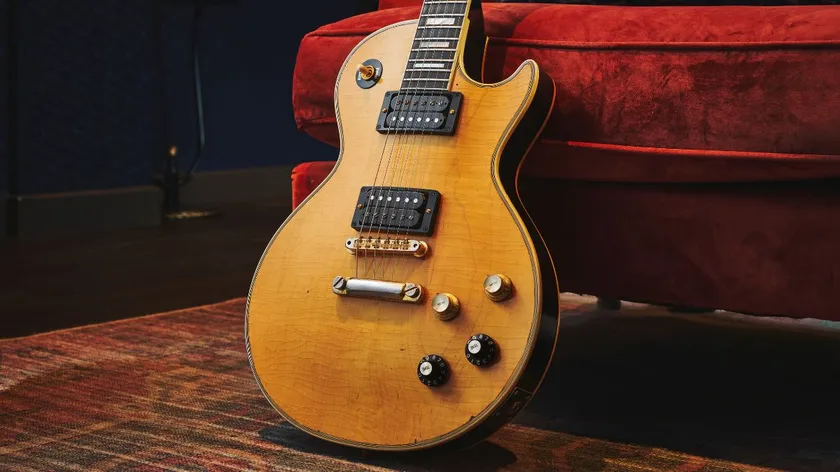
He’s a committed lover of his instrument – almost literally, by the sound of it – and is especially keen to discuss his latest signature model, the Gibson Keith Richards 1960 ES-355 Collector's Edition.
![The Rolling Stones - Sympathy For The Devil (Official Video) [4K] - YouTube](https://img.youtube.com/vi/Jwtyn-L-2gQ/maxresdefault.jpg)
Built by hand at Gibson’s custom shop in Nashville and available in a limited run of 150 units, 50 of which are signed on the F-hole label and headstock and 100 on the label only, this guitar comes in at a marriage-destroying $29,999 and $19,999 respectively, in other words too expensive for you and me; well, maybe you but definitely me.
The point of the new ES-355 model is that Richards’ original, which has been 3D-scanned by Gibson to make the new version a millimetrically identical copy, occupies a rare spot in guitar history; he used it (among other guitars) to record the Stones’ seminal Sticky Fingers and Exile On Main St. albums in 1971 and ’72, and has played it on every Stones tour since 1997. If you ever get your hands on one, count yourself lucky.

The same adjective applies to Richards himself. He’s still in pretty good shape despite an early-career adherence to the rock ’n’ roll lifestyle that few could possibly survive; he’s an acknowledged legend in his own lifetime; and he still wants to be better at what he does.
I was expecting him to be pretty jaded at the prospect of yet another guitar-related interview, but the opposite turned out to be true. You’ll enjoy the chat that follows, even if your relationship with your instrument isn’t quite as intimate as his.
Hello, Keith. Are you at home in Connecticut?
I am, yes. We’re absolutely snowed in. Nobody can get here except a man with a snowplow. He’s working away right now. I quite like it, because it means I can’t get out.

This new Gibson ES-355 of yours is pretty tasty, isn’t it?
Yeah, yeah! What a surprise, and what a fuckin’ honor. I tell you, when they came at me with this one, I was like, “How can I refuse?” It was a shock to me at first, because when I started, the idea of even owning a Gibson was pretty much out of the picture.
There are only 150 of them. How many of them are Gibson giving you?
Oh look, I have enough guitars already.
Is it true you have 3,000 guitars in your personal collection?
It’s something like that. You can call my guitar man, Pierre de Beauport, if you want the exact number, but it’s around there. But it’s not like I go around buying them or anything; a lot of these guitars have been given to me. I’ve never seen them all.
I actually only use about… well, the working number is about 15 guitars in the rack, for different sounds and whatever. But the other 2,900, I don’t know. They’re taken care of, though. I mean, this is a prime collection.
![The Rolling Stones - You Can’t Always Get What You Want (Official Video) [4K] - YouTube](https://img.youtube.com/vi/Ef9QnZVpVd8/maxresdefault.jpg)
You’re known for putting groove into your playing and hanging back behind the beat.
It’s actually nothing you can put into words, because it’s just the way I feel the rhythm. I always say that I can only do this because I’ve been blessed with the best drummers in the world. I have the luxury of knowing that the guy knows what he’s doing, you know.
Were you the first guitar player to bring that swing to rock music?
Well, if you think about it, it’s the other way around. Rock music came out of swing music. You listen to any of the old ’30s and ’40s big bands, they’re playing as much rock ’n’ roll as Bill Haley or Little Richard. The essence of a lot of it was in those big bands and their rhythm sections.

You played with Chuck Berry in the ’80s. What was he like?
Chuck, as a person, was an ornery old fucker – a lovable, ornery old fucker.
Why do you admire his guitar playing?
The same thing you’re talking about; there was something about the way he used that rhythm behind the drums that, to me, was fascinating. He said to me, “I was just playing with the right guys, [bassist] Willie Dixon and [pianist] Johnnie Johnson.” And that’s the way I feel about the way I play – lucky to play with the right guys.
We’re talking about a mysterious thing, a thing called feel, a thing called groove. Luckily you can’t put your finger on it, you know. But I try! [Laughs]

Is the way you weave lead and rhythm parts playing with Ronnie Wood an unspoken thing?
Oh, absolutely. There’s something between us. It was the same with me and with Mick Taylor, and also with Brian Jones, back at the beginning. You’d meet the right guys and automatically they knew that “You take over here, I’ll come in underneath,” and there was a beautiful little ballet going on. That’s amazing, and that’s what makes it worth doing, you know – this interconnection between musicians.
When it works, it seems almost telepathic.
Yeah, it is kinda telepathic, in a way. I suppose. You can put that word on it. [Shouts] Ronnie! [Laughs] And it’s something you don’t wanna fuck with. Once it’s there, you don’t talk about it amongst yourselves. It’s an unspoken reliance upon each other, which is a beautiful thing.
You mentioned Brian Jones, who we rarely discuss as a guitarist. What was his playing like?
Personally, he was the first steel slide player I heard. His middle name could have been Elmore, because he used to just play Elmore James stuff. He was really, really in front of that game, and that’s what I really admired about him when we first started playing together.
This band was started by a piano player, Ian Stewart, and he had Brian with him. Once I heard Brian playing Elmore James, I thought, “I’ve found a guy here who I can mess with,” and then we got into Jimmy Reed stuff and, of course, Muddy Waters, all of that… I wouldn’t call it a university education. [Laughs]
Have you ever played with a guitarist who couldn’t groove?
I very rarely play with stiffs! I’ve been lucky to play with the best. Listen, I’ve played with the guys I grew up listening to. Little Richard, Scotty Moore. Jesus Christ, should I go on? [Laughs]
Did you know John Mayall?
Wizz Jones used to come round to my house and hang out for a few free cigarettes and show you a lick or two
I had great admiration for John. He was such a scholarly guy about it. John was sort of a shadowy figure. A lot of those guys came out of the folk music scene, as it was known at the time, because for some weird reason in those early years, there were hierarchies between traditional jazz and folk music.
You know, people got fussy about shit. Anyway, it was amazing to me that these guys were dying to play music that comes from thousands of miles away and that it resonated with them. Therefore the resonation continues; music is about resonation.

Did you like the British folk guitarists?
Yeah, I did listen to them, and they were good pickers, you know. Wizz Jones used to come round to my house and hang out for a few free cigarettes and show you a lick or two. Do you remember Wizz Jones? He was an incredible guy. I really actually admired those guys. Bert Jansch was fuckin’ amazing. And unrecognized, really, for how great they were.
When you got into open-G tuning on five strings, it seemed to change your whole view of guitar playing.
It did, actually, and anybody that tries to get into it, it changes their fucking mind, too. [Laughs] Because it is a really strange setup, especially if you’re used to six-string guitars.
You have to reconfigure everything, and you realize you’ve restricted yourself to five strings and three open notes [GDGBD], you know. You have to learn to play the chords. I figured it out. It’s still fascinating. I’m still rambling around in there, looking for stuff.

Is the objective of the partial chords you often play to strip the music down?
Yeah, basically, because with five strings in open G, your bottom string is a G, so you’re immediately stripping away a whole load of possibilities of being Jimi Hendrix. [Laughs]
Also, if you get into it, you find a million other things people haven’t explored before, or at least, very few of us have. For me, it started off as an interesting sort of experiment and then I suddenly found that, hey, this is the stuff.
You mentioned Hendrix. Did you ever want to be a virtuoso soloist yourself?
No, I have never really wanted to go down that path. I mean, with solos, I admire the virtuoso and the technique and the nimbleness, but at the end of the day, what are you soloing over? You’re the icing on the cake. And I’m the cake!
![The Rolling Stones - Midnight Rambler [Live] HD Marquee Club 1971 NEW - YouTube](https://img.youtube.com/vi/t87B4frtEh8/maxresdefault.jpg)
So what did you think of the Sunset Strip shredders that got big in the ’80s?
[Laughs] I laughed my fuckin’ head off! Like, “Oh my God, what have we spawned?”
They were skilled players, though.
Yeah, they were good pickers, and they had a hit record here and there, but that’s pop music. Look, as long as you’ve got something to solo over, then go. But that never appealed to me. What appeals to me is what’s going on underneath. What I really do love is two or three guitars playing together, because that’s what fascinates me. Just one guy soloing means nothing much to me. Right?
Do you play fewer notes these days?
Yes, I do, because I’m not as fast as I used to be. [Laughs] I tell you what, at my age, what I find most interesting about the guitar is you can compensate for certain disabilities and nimbleness and find other ways of getting around the problem, and it still teaches you another thing – you never stop learning with the damn thing. I love it and it’s my friend forever. If I had to, I’d fuck it.

Noted. Are your hands holding up OK at age 82?
Well, I do have arthritis and very large knuckles. They don’t hurt, but it does get in the way sometimes. I’m going for a wider fingerboard for that reason.
I just look at my hands and my hands look at me, and we say, “Well, let’s see what we can do today.” And that’s the way I play guitar
Do you warm your hands up before a show?
I sit on ’em. No, I do have one of those hand pumps, you know. I’m really lax, quite honestly. I just look at my hands and my hands look at me, and we say, “Well, let’s see what we can do today.” And that’s the way I play guitar. I look at it and I say, “We’ve got nothing else to do. Come here. I love you!” [Laughs]
What’s your favorite song ever?
What, just one? Oh man, you’re sticking me against the wall. You’re killing me here.
It’s what we do.
Yeah! I gotta go with Robert Johnson’s Come On in My Kitchen. It’s all there – originality, everything. It’s fantastic.

And if you could only play one guitar for the rest of your life, which would it be?
Whoa… you’re a firing squad, ain’t ya? I have a little black Gibson looking at me right now, a 1936 acoustic, broken, battered. I’d keep that one with me.
You’ve often said acoustic playing is at the heart of what you do.
Well, you can’t become an electric guitar player without knowing where the damn thing comes from. If you don’t get the basics, where do you think you’re going to end up? [Laughs]
Are you still learning as a guitar player?
Who isn’t? That’s the beauty of the thing. My teacher never stops teaching. I’ve been at it for years now and he still knows more than me.
Have you got any advice for our younger readers about guitar playing?
I cannot give you any advice, kids. If you love the thing and feel like playing it, just dig in and find out yourself. It’s a great pal, and when there’s nothing else around, there’s always a guitar. It becomes a friend, a real deep friend, and also a challenge. It looks at you across the room and leers at you. [Laughs] “Come on, you ain’t got nothing out of me yet.”
It’s been 11 years since your last solo album. Will you do another one?
I’m thinking about it. I never plan these things. [Rolling Stones drummer] Steve Jordan and I were having a chat about it the other day, and usually you start by just saying, “Let’s go in and cut a track or two.” Sometimes that’s what happens, and other times you say, “Hey, here’s another one, and here’s another one.” So I’m not counting it out.
Are you still inspired to write songs?
I cannot give you any advice, kids. If you love the thing and feel like playing it, just dig in and find out yourself. It’s a great pal
Oh, God, long may they come. They come out of nowhere. They come out of babies’ mouths, they come out of a car crash; you never know. Everything’s a song.
They say the best songs come when you’re feeling anger and frustration. Is that true in your experience?
Anger and frustration help for a while, but you’ll never make a living at it.
What makes you happy these days?
Well, breathing. [Laughs] No, this winter my grandkids have been around. They’re all ones and twos and threes; it’s fascinating to watch. I’m starting to get the hang of it, you know. Over this winter, they’ve been my inspiration.
What are your goals at this point?
To make it to the next winter!
- For more information on the Keith Richards 1960 ES-355, head to Gibson.com.
- This article first appeared in Guitar World. Subscribe and save.

