


Ernie Ball Music Man is honoring the 50th anniversary of its gold-standard bass, the StingRay, with an equally golden model.
Consequently, it’s got Sterling Ball, son of Ernie, reflecting on the iconic instrument’s – and the company’s – origins.
Finished in either Molten Gold and Liquid Gold, the celebratory model is paired with an ebony fretboard, glow-in-the-dark side markers, and a gold-plated Vintage Music Man bridge with gold-plated steel saddles. Heck, even the truss rod wheel at the heel of the neck is gold.
It’s a celebratory bass fit for royalty, as Ernie Ball Music Man celebrates the big 5-0 of a game-changing active bass. But how did the company get to this position?
The StingRay, first introduced in 1976, took cues from the Fender Precision Bass, which Leo Fender had designed years prior. The StingRay was put together by Fender, as well Tom Walker and Forrest White, while Sterling Ball offered his own input on the design
It distinguished itself with a single oversized active humbucker and a three-band preamp.
The bass caught on like wildfire, and was played later played by everyone from Flea to Tool’s Justin Chancellor and Tony Levin. Queen’s John Deacon, meanwhile, recorded arguably the greatest bassline of all time with one. Half a century later, it remains embedded in low-end folklore.
“It’s so much more than an instrument,” believes Sterling Ball. “I was there when that baby was born. And when you see that 50 years later, it’s still as important, as vibrant, as valid – that’s insane.”
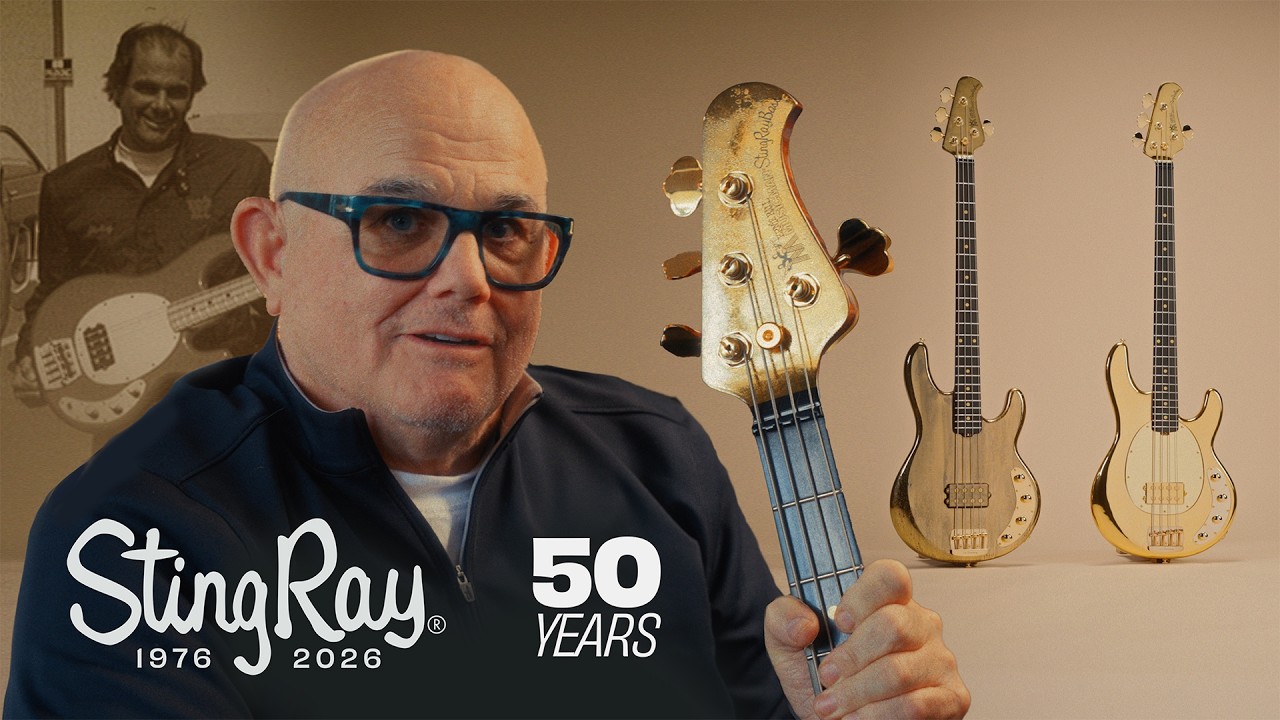
“I didn't design this bass, Leo did,” Ball adds. “But I was able to point out things that needed adjusting. The vision was to make a better bass, and the vision was to [be the first company to] use active electronics.”
Yet despite Leo Fender's crucial involvement, the bass never joined the Big F lineup. Fender had sold the company to CBS in 1965, and the StingRay instead was released by Music Man – the company founded by White and Walker, and which Fender himself joined as a silent partner.
Then, in 1984, Music Man – including its trademarks and the StingRay bass design – was bought out by Ernie Ball at Sterling's request.
“So from there it was, ‘Okay, I bought it. What do I do with it? Congratulations. You just bought Leo Fender's guitar company,’” Ball laughs. “‘Now you've got to learn how to make guitars.’
“I was so excited, so fired up to do this that I didn't stop and think, you know what, you're taking over from Leo. I think that if I had thought that, I would have been a pretty presumptuous guy with no track record, and I think I would have failed.

“You get lucky in this business sometimes,” he develops. “And Leo got really lucky because it [the bass] was super bright. There was a two-band EQ, so turn that bass up, and you had a lot of bottom. You turn the treble up, and all of a sudden, Louis Johnson and all those guys picked up on it.
“It was an accident that it came out at the same time as slapping and funk, and it became known for that initially. And then, as players like Tony Levin would use it on some of the greatest records ever, they showed how versatile it was.”
The Ernie Ball Music Man 50th Anniversary StingRay bass is available now for $3,399.
See Ernie Ball Music Man for more.

