



Guitar World Verdict
For now, I believe the MG-50Li is an extremely sensible choice, because it delivers performance and profiled tones that are highly impressive, and without a premium price tag.
Pros
- +
TS/AC-4K white-box physical modeling delivers realistic amp and FX tones.
- +
DeepImage profiling captures any amp or drive pedal.
- +
Stereo Cyber IR cab engine with adjustable microphone, position & distance.
- +
Ability to run Neural Amp Modeler profiles for even more potential.
- +
Up to 14 simultaneous FX blocks.
- +
5-inch HD color LCD for intuitive onboard editing.
- +
Built-in rechargeable battery lasts up to six hours.
Cons
- -
Internal battery lifespan will not last forever (but it’s nice and long for now).
- -
Some may wish the LCD were a touch screen (but you don’t need it).
- -
DeepImage capture profiles come real close, but not exact.
You can trust Guitar World Our expert reviewers spend hours testing and comparing guitar products so you can choose the best for you. Find out more about how we test.
What is it?
If you’re inundated by the countless choices of floor processors with amp modeling, capture technology, and multi-effects, you’re not alone. I’m overwhelmed by it too, and it's enough to give me option paralysis. As far as the big modeling guns go, Neural DSP Quad Cortex, Fractal, Line 6 Helix, Kemper, and IK Multimedia's Tonex remain at the forefront and certainly are the most cutting-edge in this space. And while each of those processors has strengths and limitations, you’ll still often hear, “Which one is the best?” Which sounds closest to a real tube amp?” “Which is easiest to use?” and so on. Loaded questions for sure, and truly subjective at best.
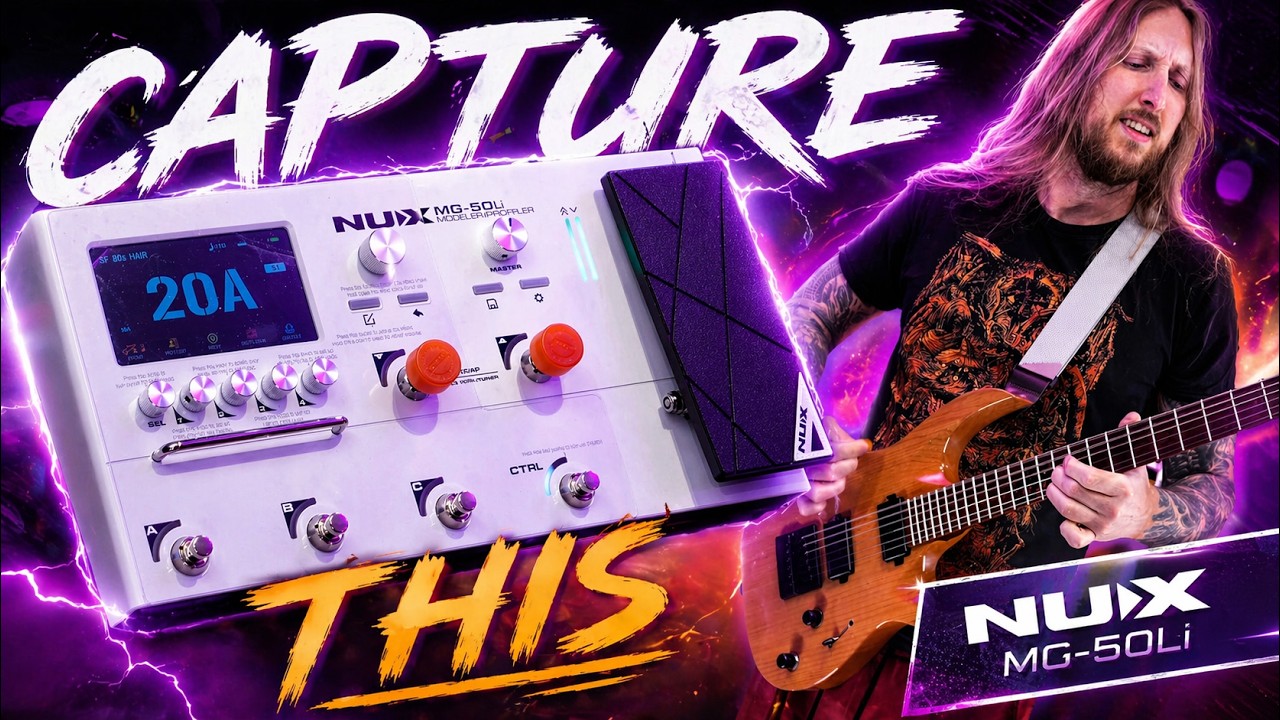
If you’re willing to dip your toes in the water, the Nux MG-50Li Modeler & Profiler is an impressive new floor processor for guitarists and bassists looking to explore amp modeling and capture without spending a fortune. As the current flagship of Nux's MG series of floor processors, the MG-50Li has the potential to stand head and shoulders above the rest by offering an extensive array of features typically absent at this price point. Not to mention, the convenience of its rechargeable, battery-powered operation, offering up to six hours of use.

As its name suggests, the MG-50Li Modeler & Profiler is a feature-rich unit that offers state-of-the-art amp and pedal profiling, including support for open-source Neural Amp Modeler (NAM) capture files, and a new hardware platform with three dedicated DSPs for effects, amp modeling, and split amp simulation, powered by Nux’s proprietary TS/AC-4K Amp Modeling (White Box Physical Modeling algorithm).
The MG-50Li boasts a large library of amps (60 split between White Box and profiling types), cabs, and effects, all accessible via a 5-inch color LCD for quick, intuitive editing, and which can also be accomplished using the free Nux Audio app. Additionally, it supports complex setups with 14 simultaneous effect blocks, flexible signal chain routing, and a UR Cyber IR cab simulator for virtual mic placement control.
Finally, the MG-50Li is equipped with a USB audio interface, dual send/return loops, loads of I/O connectivity, and Bluetooth control. Ultimately, the advanced capabilities of the Nux MG-50Li allow users to create everything from simple pedalboards to elaborate multi-amp and stereo rigs for both stage and studio, potentially making it a very impressive spec for value in the sub-$500 price range.
Specs

Build quality
- Price: $499 | £469.99 | €499
- Type: Multi-Effects processor and amp modeler with amp/pedal profile capture
- Controls: Edit, Save, Home, and Global Setting buttons, 7 encoder knobs, and 6 footswitches
- Expression/Volume Control: Built-in pedal
- Features: 5-inch LCD color display, 14 simultaneous FX blocks; 201 User and 96 Factory presets; built-in looper; TS/AC-4K white-box physical modelling; Tri-DSP architecture offers separate processing for FX, amp modeling, and split amps; Up to 80 White-Box amp models plus Deep Image profiling amp models; Nux Image & DeepImage profiling for amps and drive pedals; Compatible with 3rd-party NAM (Neural Amp Modeler) files; UR Cyber IR stereo cabinet engine; NU-X Audio app integration for on-spot editing; and 24-bit AD/DA, 32-bit floating-point processing, and 48kHz sampling rate.
Update: Since the publication of this review, Nu-X has announced compatibility for the Nux MG-50Li with NAM A2 captures. - Connectivity: 1/4" and 1/8" (aux) inputs; 2 x XLR (DI); 2 x 1/4” outputs; 1/8" headphones; In/Out MIDI; 4 x 1/4" send/return; 2 x USB-C (one for Bluetooth module)
- Dimensions: 2.83" H x 15.47" W x 8.26" D
- Weight: 6.17 lbs
- Power: 12V DC power supply; Built-in rechargeable lithium battery (up to 6 hours)
- Bypass Switching: Buffered
- Options: White (as reviewed), Dark Blue
- Contact: Nux

Build quality rating: ★★★★½
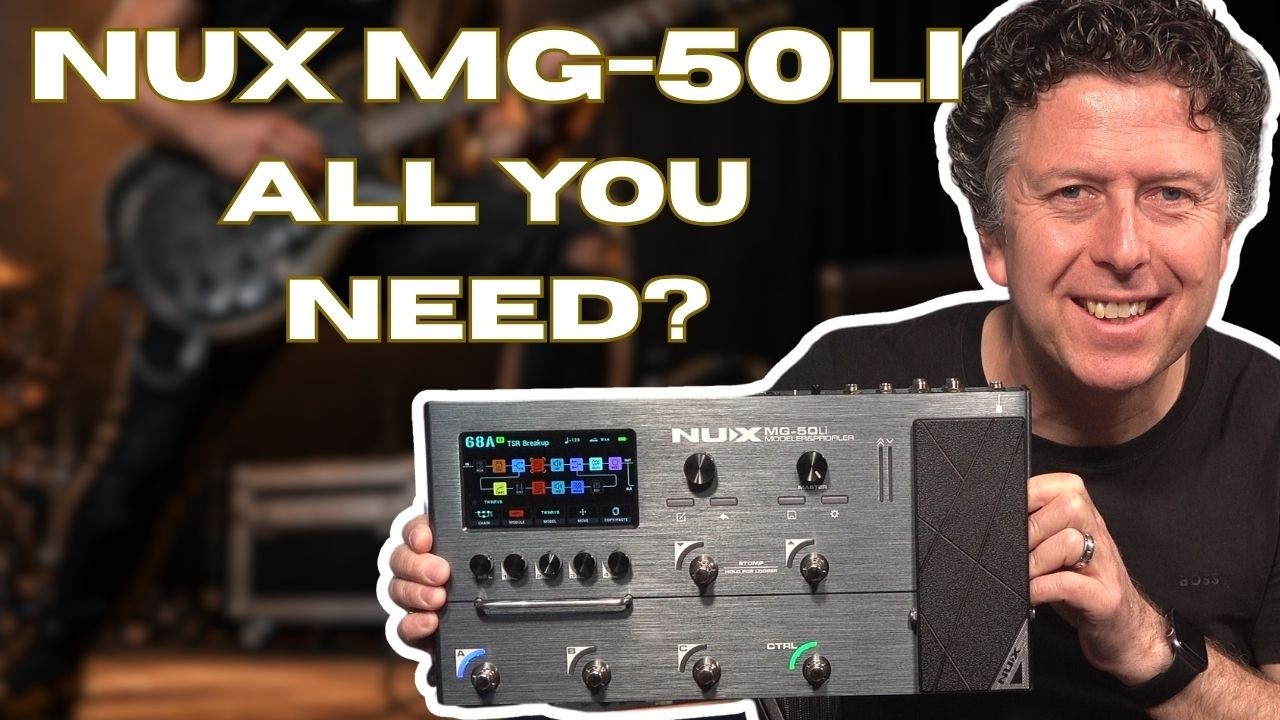
Visually, I’m pretty knocked out by the MG-50Li’s highly portable, grab-and-go form factor. In your hands, it’s lightweight and roughly the size of an elongated laptop. Also, its design is intuitive, and the unit feels built to last. The heavy-duty metal casing, durable footswitches, and sturdy, smooth-turning encoder knobs and buttons speak to its ruggedness.
Just how tough is it? Well, I accidentally knocked the MG-50Li three feet onto a cement floor from the music stand I was propping it up with. Remarkably, the unit didn't sustain a dent or any internal damage. That, I have to say, is truly impressive.

A significant advantage is the spacing of the footswitches, which are far enough apart to avoid accidental mis-hits — a common complaint I've heard from guitarists about units like the Quad Cortex with its narrow footswitch spacing. Here, the MG-50Li's well-placed switches simplify managing presets/banks, activating the looper/tuner, toggling stomps, and switching scenes.
Usability and features

Usability and features rating: ★★★★☆
Once I became familiar with the encoders and buttons, which takes all of a few minutes to grasp, I realized a touchscreen isn't necessary
As with most modelers I come in contact with, I usually find the interface confusing, because I’ve grown accustomed to the quick, efficient navigation of a modern touchscreen. However, once I became familiar with the encoders and buttons, which takes all of a few minutes to grasp, I realized a touchscreen isn't necessary. In my opinion, this hands-on format makes the unit less prone to inaccurate swipes.
The large 5-inch LCD is superb, offering a beautiful color display that makes it very easy to view parameters and presets, and to scroll between various screens. Even better, navigating the streamlined MG-50Li is incredibly intuitive.

The large Edit encoder knob is central to the interface, handling multiple functions like quickly scrolling through presets, displaying a complete signal chain view, and allowing selection or activation/deactivation of effect blocks. The Edit and Back/Home buttons, located beneath the Edit encoder, are used to access the more in-depth editing screen where the five lower knobs come into play. Pressing Back simply returns you to the preceding screen.
The five smaller encoder knobs correspond directly to the on-screen display choices. They can be used for scrolling and swapping effects, adjusting settings and parameters, fine-tuning individual effect knobs, and moving between different screen pages. Rounding out the controls are dedicated knobs for Master volume, and separate buttons for Save and Global settings.

The footswitches are self-explanatory (and the unit ships with optional orange toppers for two of them), where you have access to three preset patches per bank, plus a control footswitch where you can assign a specific function, access up to two additional scenes within a preset, or activate the tuner (which is surprisingly kick ass). The two footswitches above the main ones are down/up to select banks, and when held together, activate the onboard looper.
There are also input/output level indicators, and the built-in volume/expression pedal is rugged with a tactile throw. A wealth of I/O connectivity can be found on the MG-50Li’s rear panel, and the unit comes with a dedicated power supply, USB and MIDI cables, and a Bluetooth module.
Finally, while the MG-50Li allows for comprehensive onboard editing (except for profiling), I found the Nux Audio app (for mobile devices and computers) vital for efficiency in streamlining workflow, enabling quick, on-the-spot editing, parameter adjustments, preset organization, and file management.
Sounds

Sounds rating: ★★★★☆
As a guitarist who remains firmly in the "tube amp and pedal" camp, I must admit I haven't fully embraced the world of guitar modeling — yet. There are simply too many variables that need to align for me to make that transition. However, the Nux MG-50Li is the one processor that brings me significantly closer to joining the virtual amp modeling dark side. Is it any good? Absolutely. In fact, it's not just good; it's great.
But here’s the rub: Scrolling through the onboard presets, which are mostly influencer and artist-based, I have to admit I’m a bit underwhelmed. Some are overly saturated, modulation-drenched, and flooded in delay and reverb. I get it. Nux wants you to hear the extremes and the overarching capabilities of the onboard amps and effects. But for real-world musical applications, some are rather unusable.
I found a few of the White-Box and DeepImage amp models, like the Marshalls, Mesas, Soldano, Friedman, Vox and Fenders, all sound like approximations. Not that that is a bad thing, but I can’t declare they sound authentic. To my ears, the profiled amps on units like the Kemper, Tonex, and Quad Cortex sound remarkably closer to the actual amplifiers. But like anything you want to get good at — like having washboard abs or creating killer guitar tones — you’re going to have to invest some time with it.

One thing that Nux absolutely nails is delivering the natural response and feel of analog pedals and tube amps
Which brings me to the silver lining. Even though some of the MG-50Li's amp models and effects may not be exact reproductions, they serve as excellent foundations. In fact, many of the factory presets, particularly those in the first half, are solid starting points for crafting your own signal paths and custom presets. For instance, the Soldano capture delivers thick sustain and heavy tone, and certain DeepImage Fender models offer rich, full-bodied cleans that sound lush when combined with effects like pan delay and shimmer reverb. Speaking of which, it already offers a variety of effects, and I’m sure that will expand as the MG-50Li's ecosystem continues to grow.
Digging deep into them, you’ll find the usual, popular shades of drives along with some convincingly close DeepImage profiles of some of the more coveted, boutique styles like the Horseman OD (Klon), Full-OD (OCD), Nob ODR (Nobels), among others, and hell, even the Eat Dist (RAT) profile mimics its typical grungy saturation. Modulation-wise, it’s much of the same mixture, with great choruses, phasers, flangers, and a Harmonist that actually tracks and sounds fantastic. Delays and reverbs are of the common, garden variety, but each particular model is impressive.
One thing that Nux absolutely nails is delivering the natural response and feel of analog pedals and tube amps, thanks to its TS/AC-4K White-Box physical modelling engine and tri-DSP processing architecture. So while I’m not all that concerned whether Nux’s Diezel model sounds exact, I’m more excited that it behaves like the actual amp with its crushing saturation and distinct chug. Even better, the MG-50Li’s capture ecosystem, with its DeepImage tech and external NAM support, allows you to compensate and refine profiles with onboard EQs and power amp tube models. And to be fair, I believe future firmware updates will only enhance the power and impressiveness of the MG-50Li's modeling and captures.

The burning question is undoubtedly, "How accurate is the MG-50Li's profiling?" For starters, you'll need a computer and the free Nux IMAGE app, as profiling cannot be done by a mobile device or the unit itself. The process itself is straightforward because the NU-X app eliminates guesswork with clear instructions. For this, I chose to capture the TWA Source Code pedal I recently reviewed. Following the prompts, connection diagrams, and setting the levels on-screen, the capture was quick. Once it was done, I was able to compare the Model (the capture) to the Reference (the original sound) from my computer.
The result? The capture wasn't an exact twin. The Model had noticeably less gain than the Reference (the original pedal). However, the Model did successfully retain all the nuance and feel of the Source Code pedal, and that, to me, is crucial. After importing its capture to the MG-50Li, I was able to compensate for the difference in gain structure in post-processing, restoring the drive level and even enhancing the sound by adding a custom Impulse Response (IR) at the end of the signal chain.
Verdict

The MG-50Li is an extremely enticing and relatively affordable option in a sea of floorboard processors
In my opinion, NU-X's multi-effect processors have always been in a league of their own, mostly for their great tones, solid construction, and user-friendly interfaces. Now, it’s glaringly apparent that the new MG-50Li is a significant leap forward for NU-X. What’s interesting, though, is I think its advanced tones, modeling architecture, and feature set allow it to offer more than some competitors in a similar price range. Because of that sophistication and advancement, the MG-50Li is an extremely enticing and relatively affordable option in a sea of floorboard processors.
Still, digital floor modelers are challenging. Unlike 50-year-old tube amps, which remain relevant and will likely continue to be used by guitarists like me for the foreseeable future, modelers are doomed to have an expiration date. Floorboard processors, such as the Line 6 PODxt or BOSS GTs from the early aughts, are practically obsolete. This tells me that current premium modelers, including the Quad Cortex, Line 6 Helix, and even the Nux MG-50Li, will eventually be superseded by newer, more streamlined units. Still, there’s plenty of shelf life left for these contemporary units.
Guitar World verdict: For now, I believe the MG-50Li is an extremely sensible choice, because it delivers performance and profiled tones that are highly impressive, and without a premium price tag.
Test |
Results |
Score |
|---|---|---|
Build quality |
Highly portable, grab-and-go form factor, lightweight, and built tough. Add in a built-in rechargeable battery that lasts for over six hours, and there’s nothing to complain about here. |
★★★★½ |
Usability and features |
The 5-inch LCD color display provides fantastic visuals, and navigation is made easy by the intuitive encoder control set and dedicated buttons. Furthermore, the properly spaced footswitches eliminate any mishaps in your footwork. |
★★★★☆ |
Sounds |
Impressive captures of White-Box and DeepImage amps and effects, and while not truly exact, they serve as solid foundations for crafting and refining individual guitar tones. |
★★★★☆ |
Overall |
With advanced tones, state-of-the-art modeling architecture, profiling capability and intuitive operation, the NU-X MG-50Li is the most sensible floor processor in its price range. |
★★★★☆ |
Also try
Hands-on videos
Nux
Rob Chapman
The Studio Rats
Ola Englund