Guitar World Verdict
Line 6 was always going to have a tough job following up on the Helix. The original unit garnered many fans, meaning the sequel has a high bar to hit. With new amp models that feel lively under the fingers, increased processing power, a massive touchscreen, and a host of other features that not only modernize the Helix Stadium but also make it one of the most user-friendly pieces of modeling gear on the market, the Stadium XL Floor easily surpasses its predecessor and is a great choice for any working guitarist.
Reasons to buy
- +
Vibrant eight-inch touch screen.
- +
New and improved Agoura amp modeling.
- +
Fantastic reverbs, delays, and modulations.
- +
Integrated expression pedal.
- +
Accessible learning curve to use.
- +
Line 6 is known for consistent and meaningful firmware updates.
Reasons to avoid
- -
Bigger than some of its competition.
- -
I found myself doing more tweaking than on some other modelers.
- -
Pitch and Synth effects leave room for improvement.
You can trust Guitar World Our expert reviewers spend hours testing and comparing guitar products so you can choose the best for you. Find out more about how we test.
What is it?
For those in the amp modeling world, the Line 6 Helix needs no introduction. Released in 2015, it is arguably one of the pieces of gear that made digital amplifier modeling technology a common sight in the rigs of professional guitar players. Ten years on and now with a lot more competition, Line 6 brings out the long-awaited sequel - the Line 6 Helix Stadium XL Floor.
With a lineage in amp modelling that stretches all the way back to the ‘90s, it’s hard to exaggerate the impact Line 6 has had in this area. Starting with a couple of digital combo amplifiers - the AxSys 212 and Flextone, it is perhaps the POD - originally released in 1998 - that was the biggest indicator of what was to come.
Compact, lightweight, and kidney bean-shaped, it boasted full amp and cabinet simulations and therefore removed the need to carry around a hefty speaker. Just plug in a set of headphones or go straight to a mixing desk and play.
Line 6 developed the POD into the POD HD series, which is more reminiscent of the floorboards that we now see adorning many stages. However, the release of the Helix in 2015 stepped things considerably and put the tones on a level that more professionals were happy to use.

The biggest competition at the time was the Fractal Axe FX series and Kemper Profiler. With Fractal only selling direct and Kemper’s technology being amp capture-based (Kemper calls it Profiling) rather than amp modeling, the Helix was in a good place to have a real impact.
However, fast forward ten years, and the landscape is a bit different. Not only are Fractal and Kemper still going strong, but consumers now have a range of options, including Neural DSP’s Quad Cortex, IK Multimedia’s Tonex, and Boss’s GT-1000, just to name a few. Most of which are sporting modern features such as touch screens and wireless connectivity, which the original Helix does not have. It’s time for an update.
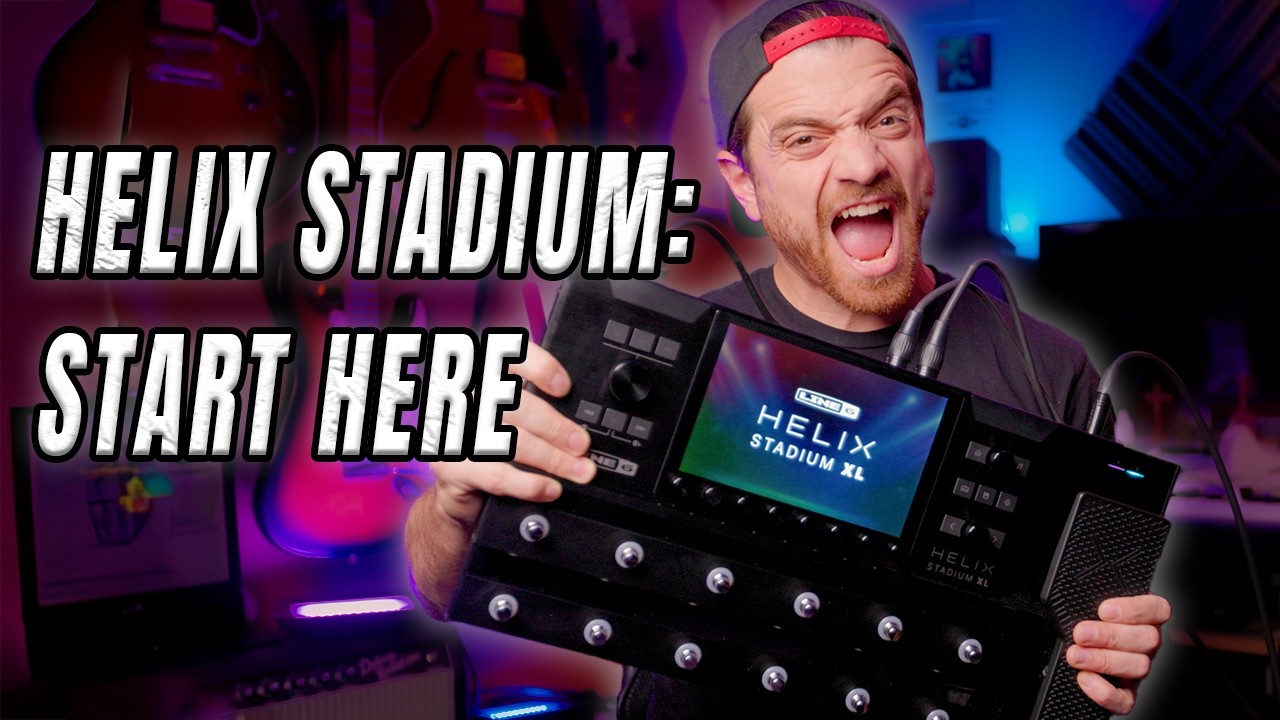
Enter the Helix Stadium XL Floor. Now with that touch screen and wireless connectivity, as well as an updated user interface, improved I/O specs, more compact dimensions, and a host of other tweaks. The headline, however, is new amp modelling technology that Line 6 has named ‘Agoura’.
Before we get stuck in, there are a few things missing from the model I have in front of me at the time of writing. Most notably ‘Proxy’, which is to be Line 6’s amp capture tech, and ‘Showcase’, which is designed to allow the user to control many parts of a live show, such as backing tracks. These were both announced earlier in 2025 but are not ready for Stadium’s initial release, meaning we will be eagerly awaiting an update to check these things out.
Update: phase 1 of Showcase is now part of software version 1.2
Guitar World video demo
Specs

- Launch price: $2199 | €2299 | £1980
- Type: Amp modeler and multi-effects
- Features: 8” high resolution touchscreen, scribble strips, capacitance sensing footswitches, Agoura amp models
- Connectivity: Bluetooth, WiFi, MIDI
- I/O: Two ¼” control outputs, two ¼” instrument inputs, XLR input, four effects loops (or two stereo effects loops), stereo XLR output, stereo ¼” output, ¼” headphone output, Nexus link, S/PDIF in and out, Micro SD slot, MIDI in and out, USB C, USB A
- Power: IEC
- Dimensions: 19.4”x10.1”x3.6”/493x257x92mm
- Weight: 11.5lbs/5.25kg
- Contact: Line 6
Build quality

Build quality rating: ★★★★★
It’s the Helix Floor that I’ve spent the most years using on stages in too many different venues to count
Having gigged the Helix LT and HX Stomp (and being a regular user of Helix Native), it’s the Helix Floor that I’ve spent the most years using on stages in too many different venues to count. From fancy theatre shows to wedding venues with hasty load-ins and the odd rowdy pub, it has seen its fair share of action. In a testament to its build, it has done so without a blink. My first impression of the Stadium is that it is cut from the same cloth.
It has a similar tank-like brushed aluminium chassis, along with footswitches that boast a reassuring clunk as well as knobs and buttons that turn and click with a resistance that inspires confidence in their longevity.
On the right of the board sits the expression pedal, with a textured finish that differs from the original, but it still feels equally as sturdy underfoot due to its chunky aluminium construction. An allen key is provided to adjust the resistance of the pedal, which is a nice touch.
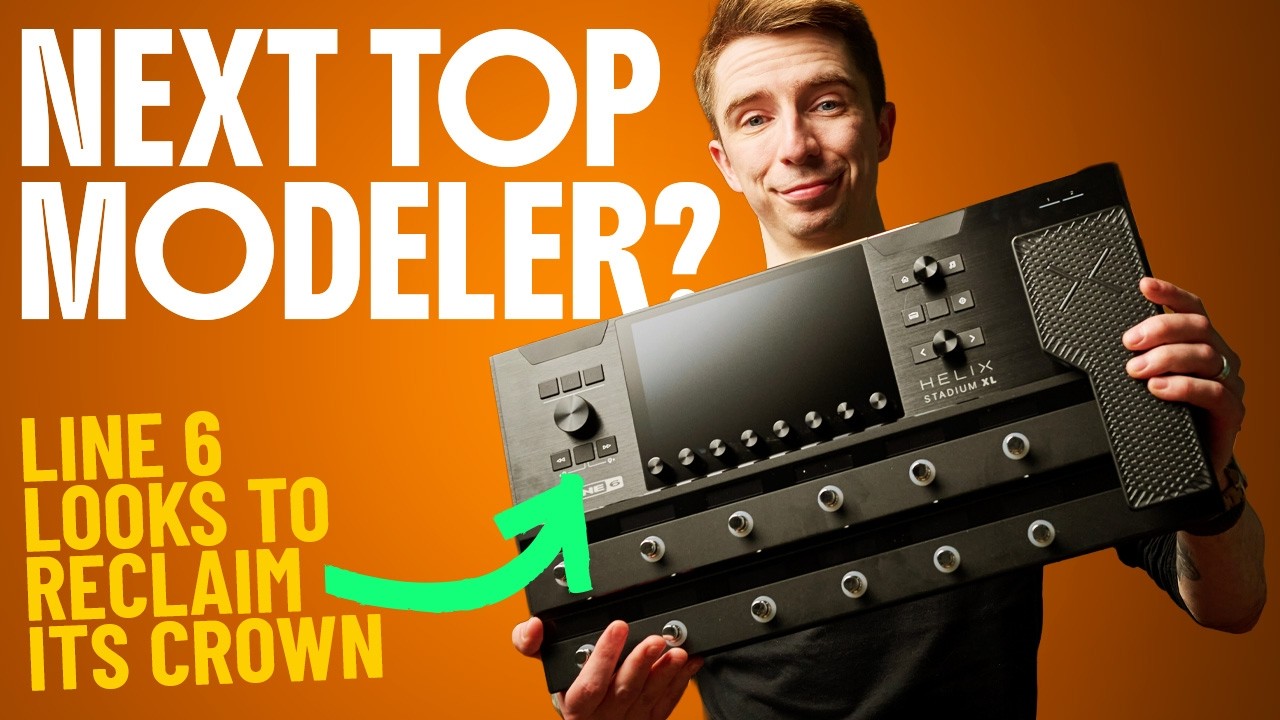
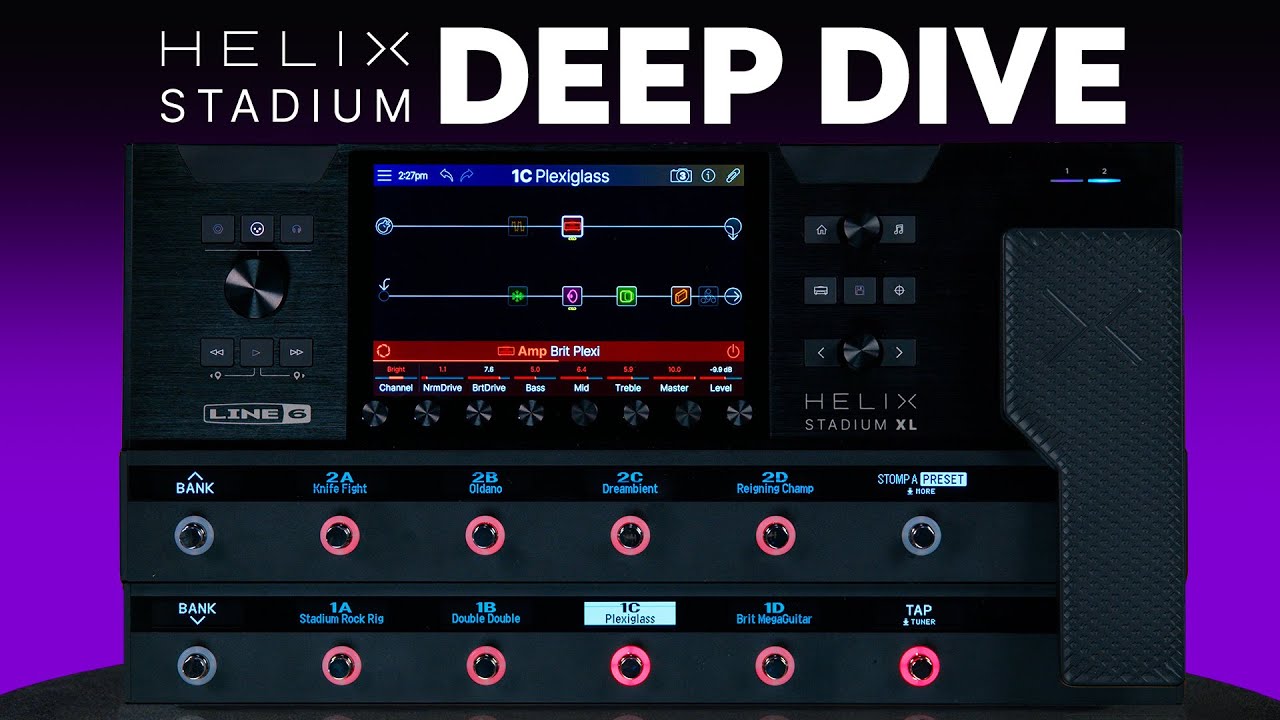
The star of the show is the eight-inch touch screen, which is bright enough that I have no worries about it getting lost under stage lights. Each model/effect on the Stadium XL Floor has a picture with it too, and the screen is of a high enough resolution that all these images sport an impressive level of detail.

The Scribble Strips have been improved as the text is now set in a high-contrast, OLED design. Meaning it is much easier to read against a black background compared to the original Helix’s blue-ish hue.
Around the back is an impressive array of I/O featuring two ¼” control outputs, two ¼” instrument inputs, an XLR input, four effects loops (or two stereo effects loops), stereo XLR output, stereo ¼” output, ¼” headphone output, Nexus Link, S/PDIF in and out, Micro SD slot, MIDI in and out, USB C and USB A. In other words, everything you might need.
The Nexus Link is perhaps the one that will raise the most questions. It’s Line 6’s way of expanding the I/O via yet-to-be-released modules that will be available as a separate purchase. The first will be the Expand D10, which, among other things, expands the I/O to allow Line 6 Powercab and Variax users to connect to the Stadium XL Floor. It’s nice to know that those users won’t be left behind.
Like the original Helix, the Stadium has an internal power supply, meaning it’s powered via a sturdy and readily available IEC cable, unlike some of its competition.

At 19.4”x10.1”x3.6”, it’s still a fairly big unit. It’s smaller than its predecessor at 22.05”x11.85”x3.58”, but still bigger than the Quad Cortex (11.4" x 7.5" x 1.9") or Fender Tone Master Pro (14.6”x10.3”x 3.8”). However, that bigger size is mitigated by the inclusion of an expression pedal.
The unit crashed at startup on one of the occasions I turned it on, an issue that was solved with the tried and tested “off and on again” and did not recur.
Usability

Usability rating: ★★★★★
Anyone who has used a Helix will be immediately at home on the Stadium XL Floor
Anyone who has used a Helix will be immediately at home on the Stadium XL Floor. It utilizes the same block-based signal chain, splitting the processing power across two paths, with the option to split each path into two.
Following the path your signal takes through the various blocks is made straightforward by its left-to-right nature and connecting lines. Furthering this, the icons have been massively expanded to reflect subcategories within each effect type, making it much easier to identify what’s going on within the preset.
As with the original, routing between the blocks is flexible, with splits easy to insert at any point. The capacitance-sensing footswitches have been carried over too, allowing the user to quickly select which block they want to adjust by touching the footswitch it is assigned to.
Then, after selecting the block you want to change, the parameters are displayed at the bottom of the screen, perfectly lining up with the mini encoders below it to make adjusting said parameters a tactile experience, almost as if you are adjusting knobs on any standard guitar pedal.

The Stadium XL Floor boasts eight of these mini encoders - two more than the original Helix. Also carried over is the same footswitch flexibility, allowing me to select whether they control Presets or Snapshots (Line 6’s way of seamlessly changing multiple parameters at once), or a combination of both, as well as Stomp Mode to turn on and off individual effects. So far, the Stadium feels like the first Helix, but better.
That 8” screen is not only bigger than the original Helix’s 6.2” screen but also the 7” screen of the Neural DSP Quad Cortex and Fender Tone Master Pro
A bigger change comes in the use of a delightfully responsive touchscreen. Blocks can now be dragged and dropped, and menus accessed and navigated via handy icons on the screen, minimising button presses, speeding up the process, and making the Stadium XL Floor feel altogether more modern.
That 8” screen is not only bigger than the original Helix’s 6.2” screen but also the 7” screen of the Neural DSP Quad Cortex and Fender Tone Master Pro. Helpful, as it allows more information to be displayed on a single page, again lending speed to my preset creation and editing.
Also utilizing this screen is Line 6’s Focus view. This is an innovative way of adjusting settings on individual models by dragging a cursor through five zones rather than tweaking parameters one at a time. The zones are called things like Clean, Rock Rhythm, and Lead. As the cursor is dragged between them, parameters are changed to reflect the tone indicated by the zone's title.

Those parameters also change in real time, giving the user an insight into how the sound is achieved, as well as a quick way to navigate between vastly different tones on each amp or effect model.
As with any multi-effects and amp modeling unit, there are a lot of things to navigate through. To aid this, Line 6 has added a Search tool that allows you to use text to search through all the effects, amps, and presets to get straight to what you need.
On top of this, the new Clips function can play a pre-recorded bit of audio through a preset in order to hear what it sounds like as you are browsing them. A massive time saver when looking for a sound that suits what you are trying to do.

Also new is the built-in WiFi and Bluetooth. Updates can be applied directly from the unit via WiFi, instead of plugging into a PC or Mac, and the Bluetooth can be used to connect a device for audio, such as jam tracks and anything else you might want to practice with.
Using the Helix Stadium XL Floor is a slick experience
There is also a desktop application, which is almost identical to the previous one for the Helix. Through it, you can edit and manage your own presets as well as drop in third-party presets and impulse responses. However, the interface on the hardware is so good with the big touchscreen that you will likely be doing most of your editing from the unit itself rather than the app. In short, using the Helix Stadium XL Floor is a slick experience.
Sounds

Sounds rating: ★★★★☆
Line 6 says that the inputs on the Stadium XL Floor have been improved, with one of the major benefits being an increased headroom. Given that all the old Helix models are available in the Stadium, I grab my own Helix Floor and set up a favourite model of mine - the Grammatico GSG with the 1x12 Open Cast cab - alongside the identical model on the Stadium XL Floor to see if this upgraded hardware makes any noticeable difference.
These differences are subtle, but important. Once you’ve heard them, it’s hard to go back
The short answer is yes.
Playing dynamics are better reflected, making me feel more connected to the sound, notes within sophisticated chords shine through with a slightly improved clarity, and the clean-up on the volume control is more convincing as harmonics and overtones are better retained as the control is turned down.
These differences are subtle, but important. Once you’ve heard them, it’s hard to go back.
The same improvement can be said of the Agoura amps. This is an approach to amp modeling that Line 6 has dubbed “Sub Component Behaviour Modeling”. To paraphrase a few of the highlights, power stage and tube emulation have been revamped, interactions between components within a modeled circuit are more accurately reflected, and Cab and Amp blocks communicate better to mimic real-world effects.

It responds to the dynamics within my playing particularly well
This all adds up to modeling that is more than just an upgrade to the previous HX models - it’s a whole new way of doing things.
Starting with the Essex TB30CC (VOX AC30), that trademark Vox midrange chime is accounted for, as well as the pokey high end that most might want to tame a little - as is the case with the real thing.
It responds to the dynamics within my playing particularly well, recreating my picking attack (and all my mistakes) with an accuracy beyond that of the previous Helix models. Similarly, when I turn down the volume control, it cleans up well, retaining plenty of the sonic goodness that drew me to the amp model in the first place.
The improved dynamics are reflected through all 16 of the Agoura guitar amp models. Along with the eight bass models, it makes 24 in total at the time of writing. Not that many, relatively speaking, but they cover everything from thick and lucious distortion via the Panama (Peavey 5150) models to classic rock with the Brit Plexi and Brit 2203 (Marshall Plexi and JCM800), and scoopy Fender cleans too. So all of the basic tonal food groups are there.

Modeling has become consistently better throughout the lifetime of the Helix, so the latter additions like the Brit 2203 (JCM800) are a lot closer to the quality of the new Agoura models
Some of the models do take some work to get right. I find myself spending a lot of time editing cab settings on the higher-gain Marshall tones, for example, as they initially sounded a bit thin to my ears, especially when compared to a UAFX Super Lead '68 Lion that I happen to have on loan at the moment.
Handily, as the legacy models are included with the Helix Stadium XL Floor, we have a means to directly compare the Agoura models with their HX predecessors on the same unit. Some models are drastically improved, such as the aforementioned AC30, while others, like the Marshall 2203 models, are quite similar at their core tone.
This is perhaps due to Line 6’s impressive commitment to improvements and updates. Modeling has become consistently better throughout the lifetime of the Helix, so the latter additions like the Brit 2203 (JCM800) are a lot closer to the quality of the new Agoura models. Even in that case, though, the aforementioned dynamic response to my playing is still improved within the Agoura models, making them just a bit better.
Those updates are a mouthwatering prospect. I never had any issues with DSP whilst setting up sensible presets with the Stadium XL FLoor, even when using power-hungry effects like the Polycapo. There is clearly a lot of capacity here, so if Line 6 stays true to form and consistently brings meaningful updates, the tone ceiling is high.

Something those legacy amps don’t have is the Hype control. This is designed to take the model slightly away from an accurate recreation of the real thing, into what Line 6 considers to be an idealised version of it. And for the Marshall amps, it’s a game-changer.
It moves the mid frequencies into a fuller place and tames that high end that I found myself dialing out. It’s still Marshall-esque, but a version of the model that’s a little kinder to play.
I also enjoyed the liveliness that Hype added to the Princess 76 model; however, on the Double Black (Fender Twin), it results in a more generic midrange that lacks the pleasing scooped character that the model has with the Hype control off. So it’s very much to be taken on a case-by-case basis, and tweaked to taste.
As for the effects, they have all been carried over from the previous Helix. I have previously felt that the drives are somewhat of a weakness of the Helix, if only in comparison to the success of the rest of the unit. This follows on the Stadium XL Floor too.

The Screamer 808, for example, pumps out a pleasing mid-humped gain sound and pushes driven amps into a tight saturation incredibly well, but lacks the compressed feel of a real Tube Screamer pedal.
And the Arbitrator Fuzz seems to have benefitted from the changes to the input and now feels a lot fuller and more rewarding on the Stadium XL Floor in comparison to the Helix Floor, but it lacks the EQ changes a Fuzz Face exhibits when the Level control is raised.
When it comes to the delays, reverbs, and modulations, however, I am glad to see the same effects brought over. Line 6 had this nailed on the old Helix, so there is no reason to mess with a winning formula.
A few personal favorites are the Hot Springs reverb, which accurately recreates that springy goodness, with all the drip you could want. The Transient Delay, which is a Line 6 original that mimics an analog delay's tendency to turn dark on the repeats and stay out of the way of the mix. And the Plastichorus, another Line 6 original that adds a rewarding wobble to the sound without getting in the way of your pick attack or burying your guitar in the mix.

The harmony effects all sound a little thin, with the exception of the Pitch Wham
There’s lots of fun to be had with the pitch and synth models, with everything from smooth, otherworldly sounds to spitty grit and aggression. The tracking on some of the synth models is not great, so it's best to mix some dry signal in if you are using those.
The harmony effects all sound a little thin, with the exception of the Pitch Wham, which is based on the DigiTech Whammy pedal and retains the full fatness of your guitar. The Polycapo is handy if your singer springs a difficult key change on you, but it does introduce some subtle warbling artifacts on chords, even when at unison. It’s still usable, but I’d keep this for emergencies or lead lines only.
While I’m pointing out some shortcomings, there is an audible pop when changing between some of the amp and cab models. For example, in one preset I have a gained-up Brit 2203 activated in one Snapshot and a clean Double Black in another. When I change from the 2203 to the Double Black that pop rears its head. It does not happen the other way round.
I found the same with the previous Helix at times. On both units, I get around it by very briefly muting my strings when I change Snapshot. An act which isn’t as intrusive or difficult to do as it sounds, but, nonetheless, it should not be an issue on a piece of gear in the four-figure range.
Live Use

I especially appreciated the full QWERTY keyboard to rename Snapshots with
The best way to inform all of this opinion is to use the gear in the heat of battle, so I brought the Stadium Xl Floor along to an ‘80s themed event I was playing. This required a rather involved preset, utilizing two Agoura models - the Double Black (Fender Twin Reverb) and Brit Plexi (Marshall 1959 Super Lead), and eight Snapshots.
Covering everything from squeaky cleans to saturated and synthy leads, it’s a context through which that big screen comes into its own, as it makes setting up the sounds quick and easy, and I especially appreciated the full QWERTY keyboard to rename Snapshots with.
While playing, the Scribble strips plus the LED’s mean that it’s a breeze to identify what the unit is doing in the very brief moments I had to glance down at it.

Tonally, things were pretty dialled in from the get-go, with a nice scoopy clean from the Double Black and plenty of fat gain from the 2203. I had the advantage of being on in-ears with a band that I know well and a sound engineer that I trust, meaning I could dial in the tones beforehand for the in-ears without the need to tweak anything on the night.
However, if I did feel the need to change something, it’s all right there on the massive touchscreen and the eight mini encoders situated just below it. Add all of this to a built-in expression pedal, and I am happy to make the potentially divisive statement that, in my experience, the Helix Stadium XL Floor is the easiest modeler to use live.
Verdict

The Delays, Reverbs, and Modulations sound as brilliant as ever
All of this comes at a price. At a little under $2200/£2000, it’s more expensive than competition like the Quad Cortex and Fender Tone Master Pro. However, with a bigger touch screen, an expression pedal, and incoming features such as Showcase, it does more. So in my opinion, that extra expense is justified.
Either way, this price point also has to be reflected in stellar tones, and happily, the Helix Stadium XL Floor is a great-sounding unit. The new Agoura amp models feel alive under the fingers, and the Delays, Reverbs, and Modulations sound as brilliant as ever.
Whilst I feel the Pitch and Synth effects need a little work, there is plenty of DSP available for improvement here, and with Line 6’s form for bringing consistent and meaningful updates, I’m excited to see where it goes with the Stadium platform.
Guitar World verdict: Line 6 was always going to have a tough job following up on the Helix. The original unit garnered many fans, meaning the sequel has a high bar to hit. With new amp models that feel lively under the fingers, increased processing power, a massive touchscreen, and a host of other features that not only modernise the Helix Stadium XL Floor but also make it one of the most user-friendly pieces of gear on the market, the Stadium easily surpasses its predecessor and is a great choice for any working guitarist.
Test |
Results |
Score |
|---|---|---|
Build quality |
A rock solid, aluminium construction that feels like it will handle anything you throw at it. |
★★★★★ |
Usability |
Usability was a major strength of the original Helix. The Stadium XL Floor takes the best of the original and improves on it even further. |
★★★★★ |
Sounds |
Improved amp modeling and stellar delays reverbs and modulations, just a bit of work needed on the pitch and synth. |
★★★★ |
Overall |
A fantastic sounding unit and a great choice for any working guitarist. |
★★★★½ |
Also try
Hands-on videos
Jay Leonard
Sweetwater
Steve Sterlacci