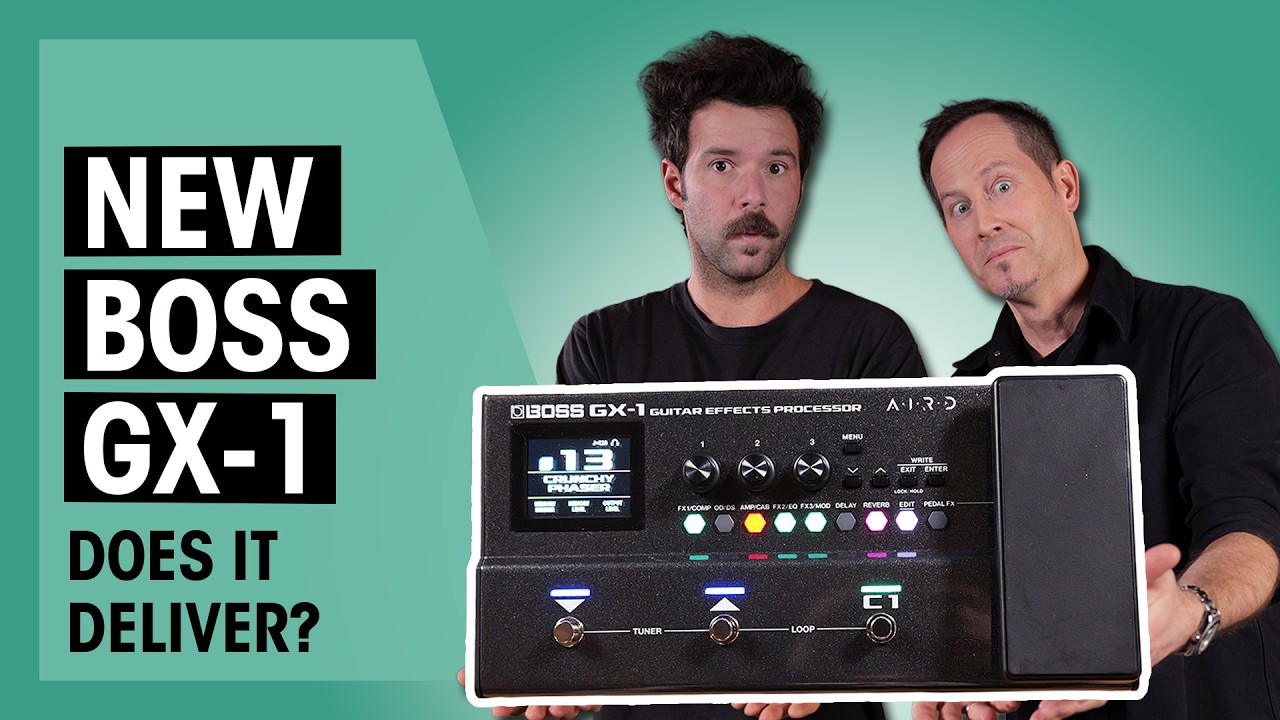
Guitar World Verdict
For beginners, I think the Boss GX-1 is a great choice. The build quality is outstanding, and the number of features gives younger and new players plenty to grow into. The sheer number of options in terms of amps and effects models means they’ll have the best possible playing platform going forward. That said, for experienced players looking for a cheap multi-effects unit, you may find the amp models limiting.
Reasons to buy
- +
Huge selection of amps and effects models.
- +
Easy to dive-in and start editing presets.
- +
Lightweight and slim build that’s very rugged.
- +
Can be powered via USB-C or 4x AA batteries.
Reasons to avoid
- -
The quality of amp modeling is very hit-and-miss.
- -
No power supply included.
You can trust Guitar World Our expert reviewers spend hours testing and comparing guitar products so you can choose the best for you. Find out more about how we test.
What is it?
As multi-effects pedals have gotten more and more advanced over the past ten years, I’ve seen that there’s a noticeable trickle-down effect to the beginner range of pedals. Where once these were questionable quality with the bare minimum needed to function, it's now entirely possible to get a full guitar rig for relatively little money.
With the launch of the Boss GX-1, you’re getting said full rig for well below $250, which is an incredible proposition for brand-new guitarists. Adding a high-resolution screen, Bluetooth connectivity, an expression pedal, and assignable footswitches makes it –– at least on paper –– one of the most complete entry-level units I've tested.

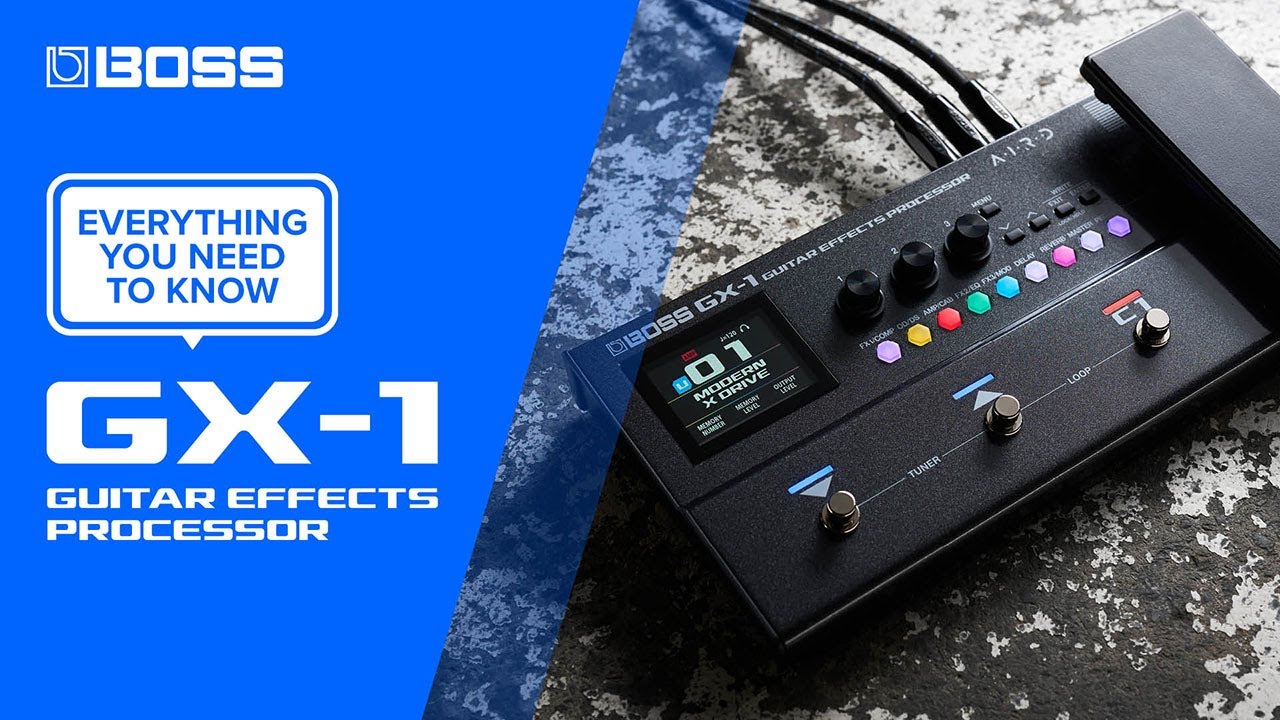
The GX-1 looks a far cry from the multi-effects pedals of old - the Boss ME-80, was amongst the first multi-effects pedals I tried alongside the plastic-y Zoom 606. It certainly looks much slicker than its predecessor, the Boss GT-1, with its full color screen, colored LED strips, and proper, grown-up metal footswitches. When compared to competitors like the Nux MG-300/400 and the Zoom G2X, it can definitely stake a claim as the best-looking budget multi-effects pedal on the market right now.
It’s got 38 base-level effects with many more variations on top of that, 23 amp models that include a slew of Boss originals as well as those based on some classic amplifiers. There's seven cab types, along with eight slots to load a third-party impulse response, as well as six microphone types and three blends to play with. Add 99 memories to save your presets, and that’s a lot of bang for relatively little buck, and certainly more than enough for any beginner guitarist to get stuck into.
Watch our Boss GX-1 demo:
Specs

- Launch price: $229.99/£225/€259
- Type: Multi-effects pedal
- Controls: 3x endless encoders, menu, up, down, exit, enter, fx1/comp, od/ds, amp/cab, fx2/EQ, fx3/mod, delay, reverb, edit, pedal fx, 3x footswitches, expression pedal
- Connectivity: 1/4-inch input, 2x 1/4-inch outputs, 1/4-inch headphones, 1/4-inch expression/switch, USB-C
- Features: USB-bus powered, Bluetooth connectivity
- Bypass: Buffered
- Power: 200mA (400mA via USB-C), 4x AA batteries, USB-C
- Dimensions: 307 (W) x 149 (D) x 56 (H) mm
- Weight: 1.2kg
- Options: N/A
- Contact: Boss
Build quality

Build quality rating: ★★★★★
Having owned many Boss pedals over the years, their credentials are well-known in the musical world, so it’s no surprise to find an extremely well-built bit of kit when I open the GX-1’s box. I find it surprisingly slim and lightweight, yet the sparkly black metal chassis feels very well put together, and I’d have no worries about throwing it into my backpack to take to rehearsal or even a gig.
Its professional looks stand out a mile versus the competition at this price point. The footswitches are nice and solid, although perhaps a little on the small side. To help combat this, Boss has launched a range of FSC-10 pedal toppers (pictured below) which are available as an additional purchase.
Each switch is headed by an LED strip that changes color depending on the function, and the soft, hexagonal signal chain buttons are color-coded to help you pick them out at a glance.

The expression pedal is small, but it feels solidly built with a good range of travel. I lean on it a bit to see how it feels, and I can’t see it going anywhere, even under some heavy wah use of Hendrix proportions. The 320 x 240-dot LCD screen is full-color and very bright, perfect for being seen in dark bedrooms or on dark stages.
Usability

Usability rating: ★★★★½
I start by marveling slightly at the fact that such a complex unit can be powered with just 4 AA batteries
I start by marveling slightly at the fact that such a complex unit can be powered with just 4 AA batteries. With the batteries in the unit turns itself on when I plug a guitar cable into the input, so it’s easy enough to power down by taking it out when you’re done playing. Boss gives the battery life as five hours, and I got a good three hours playing out of it with no issues this way.
Of course, batteries are great if you’re on the go, but chances are this unit will be played in bedrooms. There’s no power supply included, but it can be powered via a 9V pedalboard power supply at 200mA. Interestingly, you can also power it via USB-C (at 400mA), which is great as most players probably already have one of these to hand. That said, I’d like to see a power supply included for this kind of unit, as it’s aimed at beginners who are unlikely to already own one.
Plugging in an EMG-loaded Epiphone Explorer, I start by accessing the tuner, which is a little awkward when trying to press the two footswitches together. I’m about to start remonstrating until I realise the tuner also engages when the expression pedal is assigned to Volume and placed in the heel-down position. It’s a great, player-centric feature, and when you engage the tuner, the hexagonal signal chain buttons also show the progress of your tuning, which gives you a much clearer view of where you’re at.

I start flicking through the presets, and it’s immediately obvious that to tweak, I just need to hold down the appropriate effects button, and the screen changes to show which parameters are available. I can scroll up and down using the arrow buttons and tweak settings with the three endless encoders in the center of the unit. It’s very intuitive, much like a simple physical pedalboard, and I don’t see any issues with beginners getting started navigating their way around the unit.
Each preset also features an additional setting via the C1 footswitch, which users can customize to taste. This could be as simple as adding some delay to your original tone, or you can completely change from a clean to a dirty sound at the press of a button. Preset switching is seamless too, which means you can quickly jump between patches during a song if you need radically different sounds when playing.
As a company renowned for building some of the best looper pedals, it's not a surprise that the built-in one here is extremely usable. It's engaged slightly awkwardly by pressing the two right-most footswitches together, but once this action is done, you've got a very capable single-button looper with one press of the C1 footswitch to start recording, one to play-back, another press for overdubs, and a hold-down to clear the entire phrase.
Sounds

Sounds rating: ★★★★☆
Plugging my headphones in and getting started with some playing, I’m a little underwhelmed at the sound of some of the presets. The high-gain stuff is fizzy, and the mid-gain presets are quite harsh. The clean sounds are really nice however, and it’s here that I get the most play time as I work my way through each of the 99 memories.
I come across some really whacky effects when cycling through, like the S-bend effect from the Boss Harmonist, which bends notes up wonderfully. The tracking can be a bit off at times, but it’s super fun to hit the C1 switch and have your note go slowly up two octaves. There’s even some synth-style effects that you’d find in the much pricier Boss SY-1000, so you can add ethereal tones to your playing or just transform your electric into an acoustic guitar.

The range of effects, as you might expect from Boss, is simply fantastic. That said, the amp models just don’t cut it for me.
The range of effects, as you might expect from Boss, is simply fantastic. That said, the amp models just don’t cut it for me. I find myself having to keep changing the parameters every time I land on a preset that I like the sound of. Thinking perhaps it’s down to the pickups, I try a guitar with lower-output humbuckers, my Tele with single coils, and a metal guitar with Seymour Duncans, but each time I’m still dissatisfied with the sound of the amps.
It’s a shame as the effects are genuinely great, and I do think that for beginner guitar players, there will be little issue here. The amp sounds will be good enough to satisfy those with a less curated ear. If you’re a more experienced player looking for a cheap multi-effects pedal, however, you may find the amp models lack the real-world relevance to be useful to you.
Verdict

It gets so much right for the beginner market
I often find reaching a verdict when I’m reviewing a product the easiest part, but with the Boss GX-1, I’m genuinely torn. It gets so much right for the beginner market, with some awesome and no doubt inspiring features for younger players. For the price, it's fantastic value for the beginner market. For players such as myself who already have some experience, however, the amp models felt lacking.
Having used modelers from the likes of Neural DSP, Positive Grid, Blackstar, Universal Audio, and others, I can’t help but feel that Boss’ reliance on its original amp sounds is holding them back. The sound of guitar is classic tube amps from the likes of Fender, Marshall, Vox, Mesa, etc, and that’s what guitarists expect to hear when they plug in, whether it’s an amp modeler or a guitar plugin.
Guitar World verdict: For beginners, I think the Boss GX-1 is a great choice. The build quality is outstanding, and the number of features gives younger and new players plenty to grow into. The sheer number of options in terms of amps and effects models means they’ll have the best possible playing platform going forward. That said, for experienced players looking for a cheap multi-effects unit, you may find the amp models limiting.
Test |
Results |
Score |
|---|---|---|
Build quality |
Supremely rugged and surprisingly lightweight |
★★★★★ |
Usability |
Very easy to get to grips with |
★★★★½ |
Sounds |
Fine for beginners, but experienced players will want more from the amp models |
★★★★☆ |
Overall |
A fantastic option for beginner guitar players |
★★★★☆ |
Also try
Hands-on videos
BOSSchannel
Thomann's Guitars & Basses