Guitar World Verdict
If you’ve spent years (or hours) listening to Clarence White, Albert Lee, Brent Mason, Marty Stuart, Jimmy Page, Brad Paisley, Glenn Tilbrook and John Osborne pull magic out of their B-benders – and you’ve decided it’s time to dip your toes into the B-bender wading pool – the John Osborne Telecaster is an attractive, cost-effective way to get the job done.
Reasons to buy
- +
Fantastic value for a guitar with a pre-installed B-bender.
- +
Unique, custom, “aftermarket” looks.
- +
Extra-bright, lively and present bridge and neck pickups.
Reasons to avoid
- -
Its looks might be a step too far for traditionalists.
- -
Middle position can get “lost” in a live setting.
You can trust Guitar World Our expert reviewers spend hours testing and comparing guitar products so you can choose the best for you. Find out more about how we test.
What is it?
Almost across the board, Fender’s Artist Signature series Telecasters are unique creations that are truly deserving of their “signature” honorific. Take the psychedelic Jimmy Page Tele, the everything-but-the-kitchen-sink Brent Mason Tele or – to really drive home the point – the super-unconventional, “Huh?!?”-inducing Jack White Triplecaster.
These are definitely not your father’s – or your uncle’s, niece’s or cousin’s – Telecasters. I mean, unless you have Thanksgiving dinner at Jack White’s house.
There is no mistaking this guitar
Anyway, it’s safe to say that, with its new John Osborne Telecaster, Fender has stayed true to form; there is no mistaking this guitar – a faithful reproduction of Brothers Osborne fretboard acrobat John Osborne’s heavily modified 1968 Tele – for someone else’s signature model or, for that matter, any other Tele.
Besides the unique visual appointments, which we’ll get to soon enough, this sick puppy comes with a B-bender.

For those who need a refresher, a B-bender is a contraption that – with a downward push on the guitar’s neck – literally pulls your guitar's B string up a perfect whole step. So, a B note suddenly becomes a C# (or a shaky C if you don't pull the string all the way).
Some people say it makes a guitar sound like a pedal steel guitar, but that’s a bit much. It makes your guitar sound like a guitar with a B-bender, and that’s a truly magical thing to have in your arsenal. Anyone who’s ever bent their way from a 3rd-position Csus2 chord on the top three strings – voiced C, D, G – to a perfectly in-tune C major triad (C, E, G) knows what I’m talking about.

It is, however, the first Fender B-bender to be designed in-house
No, this is not the first B-bender to appear on a mass-produced Fender Tele; there’s the previously mentioned Brent Mason Tele with its Glaser bender, and let’s not forget Fender’s beloved – and now extinct – American Nashville B-Bender Tele, which sported the ingenious Parsons/Green bender system.
It is, however, the first Fender B-bender to be designed in-house; it has lovingly been named the “Fender B String Bender.”
I’ve been playing B-benders since 1999, so I was eager to get my mitts on this guitar. Let’s see how it goes!
Specs

- Launch price: $2,199 | £1,849 | €2,199
- Made: Mexico
- Body: Alder
- Neck: Maple / 1968 C, bolt-on
- Fingerboard material/radius: Maple, 7.25" (184.1 mm)
- Scale length: 25.5" (648 mm)
- Nut/width: Synthetic Bone / 42 mm
- Frets: 21, Jumbo
- Hardware: Fender Vintage tuners, Ashtray through-body bridge with 3x compensated brass barrel saddles with Fender B String Bender
- Electrics: 2x John Osborne Telecaster pickups, Master Volume, Master Tone, 3-position toggle
- Weight: 7.9 lb. / 3.6 kg.
- Left-handed options: No
- Finishes: Road Worn Olympic White
- Case: Vintage-style hardshell
- Contact: Fender
Build quality

Build quality rating: ★★★★☆
As soon as I open the Osborne’s black hardshell case, my eyeballs don’t know where to go first. But – who am I kidding? – it’s got to be the custom black pickguard that covers most of the body, making the guitar look like an obscure Cold War-era comic book hero who’s about to get his or her own Marvel franchise.
It’s held on tight with 13 screws; the only part that isn’t snug to the body is the thin, descending piece near the control panel, a place where it’d be impossible to fit a 14th screw. It doesn’t get in the way, but I could see it getting knocked off during a particularly nasty roadhouse-gig rumble. Hey, it happens!
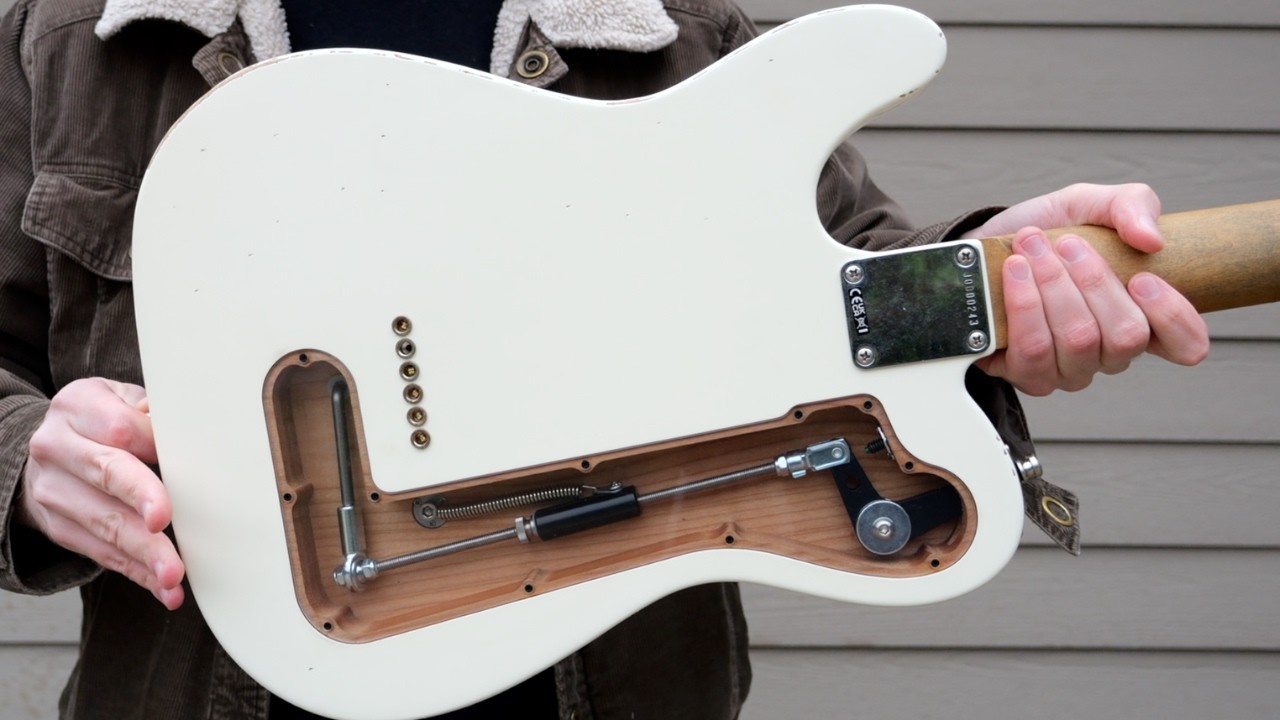
Fender has turned an unassuming volume/tone knob into an important part of the bender mechanism
The neck pickup’s exposed magnets – which give it a look similar to creations by Lollar, Fralin, Porter or TV Jones – lend the guitar a custom, aftermarket-enhanced look. Meanwhile, the dark, hand-oiled maple neck is kinda stunning. It’s like a stained – and now perfectly faded – piece of ancient living-room furniture that gets passed down from generation to generation.
The three-way toggle, which is more like what you’d find on a Jazzmaster or Les Paul, is nice and tight and devoid of wobbles and shakes; the same goes for the volume and tone knobs, which is a good sign. Speaking of knobs, Fender has turned an unassuming volume/tone knob into an important part of the bender mechanism.
It sits to the right of the bridge (from the POV of the guitarist), and – when you engage the bender with your fretting hand – you can watch as the repurposed knob swivels to the right, literally pulling the B string toward the bridge.

When you flip the guitar over, you can see the guts of the bender, thanks to a recessed, clear-plastic cover. It’s like when you visited that chocolate factory on your fourth-grade class trip, and they suddenly took you into the kitchen to see how the chocolate is made.
The bender looks, well, like a bender – similar to, yet completely different from the Gene Parsons-installed Parsons/White bender in my Palir Titan T-style. Hey, an Egyptian mongoose and a common dwarf mongoose look different from each other, but they both look like mongooses.
The body has your typical Road Worn finish with plenty of tiny craters here and there and a nice chunk of exposed wood right where your picking arm meets the body. To be honest, I’ve been playing this guitar so often that – at this point – I can’t tell which craters and scratches are mine and which were applied in Ensenada, Mexico, but I’m not too worried about it.
Playability

Playability rating: ★★★★½
I lowered the bridge saddles a bit and was ready to go, even testing it over the course of a few gigs at the New Jersey Shore
The John Osborne Tele’s 1968 C-shape neck feels particularly comfy. Fender could probably get away with calling it a “1968 U,” although it actually reminds me of the Soft V neck on my Jimmie Vaughan Tex-Mex Strat. Regardless of which uppercase letter you want to stick with, this neck melts into your hands. Its light, hand-oiled finish makes it easy to feel “at one with” the guitar.
The action on our test model was on the high side, but I lowered the bridge saddles a bit and was ready to go, even testing it over the course of a few gigs at the New Jersey Shore – a legendary Telecaster proving ground since the E Street Band were regulars at the Stone Pony.
The B-bender functions, well, like a B-bender. That said, compared to other benders in my collection, I’d say this one has a shorter stroke, meaning there’s not a lot of travel time (and/or space) between an un-bent B note and a bent/pulled C#.

It still gets you where you want to go, but – as Gene Parsons explained to me a decade ago, long-stroke benders give you that – and I’m totally paraphrasing here – “sweet” Clarence White effect.
Despite a night’s worth of bending (every third song or so), the B string stayed in tune after a few first-set adjustments. Which reminds me: all B-benders have a fine-tuning mechanism, and this one lives just below the all-important upper strap button, the one that moves up and down when you push down on the John Osborne Tele’s neck.

The John Osborne Tele is as nicely balanced as any standard Tele – and the weight is also about the same
The fine tuning is done with a supplied ⅛-inch Allen wrench, which happens to be a common size in case you lose it, which I did in about three minutes.
The John Osborne Tele is as nicely balanced as any standard Tele – and the weight is also about the same. I can hear you now: Given the added B-bender, how is this possible? Well, just think about the amount of wood that had to be removed from the body to make room for the bender. The guitar weighs 7.9 lb., exactly the same as my American Professional I and II series Teles.
Compare that to my Fender Custom Shop 60s Rosewood Closet Classic Tele (which is based on George Harrison’s Let It Be Tele, another ’68), which lurches in at 9.5 lb., the same as my 1998 Nashville B-Bender Tele. So we’re talkin’ 1.6 lb. lighter than the ol’ Nashville. Something to consider!
Sounds

Sounds rating: ★★★★★
At the aforementioned gigs, the John Osborne Tele and I shared the stage with an amplified acoustic guitar, an electric bass, drums and keyboards. As usual, I was plugged into my Fender Tone Master Deluxe Reverb.
With nothing but a touch of reverb courtesy of a J. Rockett Boing pedal and delay from a TC Electronic Plethora X5, I had zero trouble cutting through the mix. The bridge pickup is super bright, articulate and chimey, with what I’d swear is a touch of extra snap. The neck pickup is equally commanding, with what feels like an extra serving of fatness, just right for those moments when the band veers into Stevie Ray Vaughan territory.
That said, the middle position – where I usually feel most at home, even when soloing – faded a bit too easily into the mix. That familiar “quack” is still there, but, sadly, the middle position was relegated to rhythm at these gigs. On the bright side, this actually can be helpful when you need to sit back and let other people do their thing – like that eternally loud keyboard guy!
Back home, now running the guitar through a Vox MV50 Clean head and matching Vox cab, followed by a Supro 1624T DualTone, I was finally able to appreciate the richness of the middle position. There’s a distinctive ring to it, something you hear from chambered or semi-hollow Teles like the Fender American Elite Telecaster Thinline.

The bridge pickup sounds exceedingly present and lively – obviously perfect for in-your-face country music, but also just right for classic rock, blues and pretty much anything else
Meanwhile, the bridge pickup sounds exceedingly present and lively – obviously perfect for in-your-face country music, but also just right for classic rock, blues and pretty much anything else.
Using the bridge pickup with the tone rolled way down opened the door to some convincing jazz tones, just with a slight quack or twang. Picture Charlie Christian in a cowboy hat.
In terms of slightly heavier sounds, it just so happens I had to brush up on Cream’s SWLABR and Crossroads for a completely unrelated set of gigs. I tackled SWLABR with the neck pickup through an Aclam The Mocker fuzz; I hit Crossroads with the bridge pickup and a J. Rockett Archer overdrive. In both cases, I was able to convincingly reproduce these very disparate Clap-tones.
Verdict

The Telecaster turned 75 this year, and Fender has been having fun with some of its 2026 releases. Nowhere is that more evident than the John Osborne Tele. To put it simply, this guitar sings its ass off and has off-the-charts stage presence, kinda like the country-rock duo that inspired it.
The John Osborne Telecaster is a serious case of one-stop shopping
There are certainly more appealing B-bender units out there – I swear, the Parsons bender in my Palir Titan is one of the greatest things ever crafted by humans since the Cognitive Revolution 50,000 years ago – but the catch is, if you want one of those benders installed in your guitar, you have to pay for the bender, plus postage (both ways), plus installation – and then there’s the wait, and we might be talking months (or longer), folks. The John Osborne Telecaster is a serious case of one-stop shopping.
Interestingly, for just about the same price you could head to eBay or Reverb and pick up a used late-Nineties Fender Nashville B-Bender Tele. The Nashville probably has the better bender, but the Osborne Tele has a custom look and a lot more style, plus it weighs considerably less.
Guitar World verdict: If you’ve spent years (or hours) listening to Clarence White, Albert Lee, Brent Mason, Marty Stuart, Jimmy Page, Brad Paisley, Glenn Tilbrook and John Osborne pull magic out of their B-benders – and you’ve decided it’s time to dip your toes into the B-bender wading pool – the John Osborne Telecaster is an attractive, cost-effective way to get the job done.
Test |
Results |
Score |
|---|---|---|
Build quality |
Impressive. Give someone in Ensenada a raise! |
★★★★☆ |
Playability |
Superlative neck feel – a potential future classic. |
★★★★½ |
Sounds |
Classic Tele twang with an extra jolt of caffeine. |
★★★★★ |
Overall |
A true value-for-money guitar. |
★★★★½ |
Also try
Hands-on videos
Fender x John Osbourne

The Trogly's Guitar Show
Cream City Music