

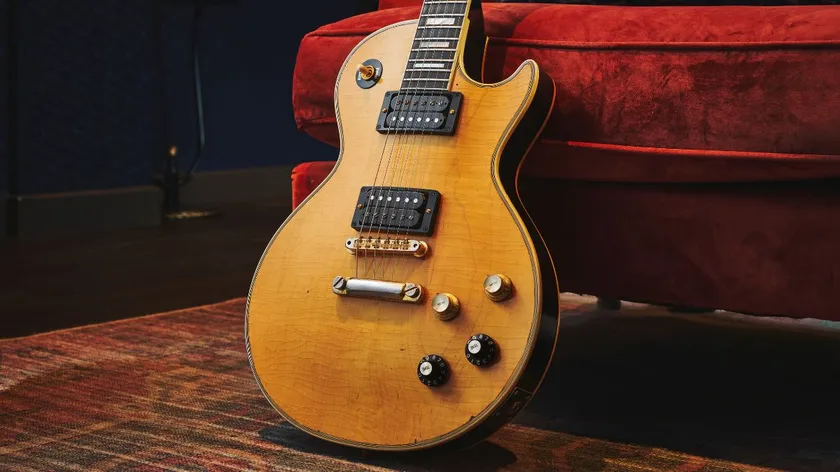


This isn’t a guitar I would normally choose for an article, but I think it demonstrates just how extreme Gibson’s custom division was prepared to get in order to make a customer happy back in the day.
Although T-Bone Walker and Sister Rosetta Tharpe played these guitars, the Barney Kessel has never been a particularly popular model, but this one is custom-made in every single way. The body shape was initially designed for Tal Farlow, but he clearly didn’t like it because his signature model eventually became a far more traditional single-cutaway.
Instead, Barney Kessel lent his name to the project, despite having no design input, and the Barney Kessel Regular and Custom models were introduced in 1961. Besides a few promotional photos, there is little evidence to suggest Kessel played one and he remained faithful to his ES-350 with a Charlie Christian pickup.
This guitar was based on the Barney Kessel Custom, so it has the ‘bow tie’ inlays, rather than split parallelograms, and a musical note inlay on the peghead, rather than a crown. But things start getting really interesting when you look at the body.
It’s only 2 ¼-inches deep as opposed to the standard three-inch depth, and the top is solid spruce with solid maple back and sides. Early Barney Kessels had laminated spruce tops, but from around 1965 until 1974, when the model was discontinued, production-line bodies were made entirely from laminated maple.

The back is beautifully figured and there’s no centre seam, so they carved it from an unusually wide single piece of maple. The neck is a laminate construction with three strips of figured maple sandwiching two thin strips of darker walnut. ‘Waffle back’ Kluson tuners grace the headstock, and there is three-ply binding on the back and front.
A Bigsby was also mounted, rather than the standard Barney Kessel tailpiece, but things really start getting funky with the electronics. In addition to the three-way selector switch and regular volume and tone controls for each of the Patent Number T-Top pickups, it has a standby switch, a master volume on the upper horn and a Varitone.


All of these were factory fitted – and on top of that, it’s stereo. It’s almost as if the person who ordered it liked some Gretsch features, but this is all Gibson.
Without effects, the guitar sounds tonally rich, and although there’s a vague difference when you compare it to a full-depth Barney Kessel, there’s not much in i
There’s the usual stinger on the back of the headstock, but the metal parts are chrome-plated, rather than gold as you would expect to see on a Barney Kessel Custom model. It has never been messed with and it’s a completely original guitar that plays very well and sounds really good.
When I was trying it through a Gibson GA-79 amplifier and a Leslie cabinet that I have in the shop and messing with the Varitone, I was getting a lot of Yes and King Crimson flavour.
The neck attachment and deep cutaways allow remarkable upper-fret access for what is essentially a jazz guitar. I particularly like the way that the pickguard is shaped to follow the curve of the cutaway.
Without effects, the guitar sounds tonally rich, and although there’s a vague difference when you compare it to a full-depth Barney Kessel, there’s not much in it. At first, I figured it might sound more like a Byrdland, but with the longer 25.5-inch scale length, it really doesn’t. It just sounds wonderful.

The cherry sunburst and the ‘witch hat’ knobs are typical of 1967, which is when Gibson made this guitar. There is a bit of finish-cracking around the standby switch, but it’s only superficial. It was definitely used and there is a bit of tarnishing on the pickups and hardware.
The pickguard looks a bit like the Tal Farlow design, but it’s a one-off shape and there’s a ‘custom’ plaque up on the headstock. It still has all the build-order paperwork that came from CMI [Chicago Musical Instruments], which was the parent company of Gibson, detailing all the custom appointments, along with the original case.
When the Gibson Barney Kessel was introduced, customers would have paid $395 for the Regular model and $560 for the Custom, but somebody must have paid a lot more money for this guitar. Everything about it is a total freak – but, without doubt, it’s a one of one.
- Vintage guitar veteran David Davidson owns Well Strung Guitars in Farmingdale, New York / info@wellstrungguitars.com / 001 (516) 221-0563
- This article first appeared in Guitarist. Subscribe and save.
