


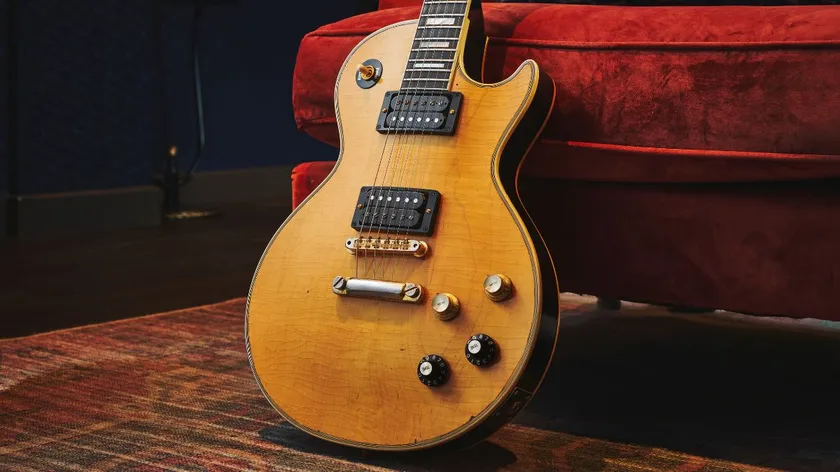


We know the guitars Eric Clapton played in Cream. All of them Gibson: the ‘Beano’ Les Paul, the ‘Fool’ SG, the cherry red ES-335 and the sunburst Firebird I.
While that list is, of course, correct, dig a little deeper and a few oddities and anomalies poke their heads above the parapet. But as with anything musically historical, evidence is often vague or contradictory, so what follows here is as close as we can get with the sources available.
With Clapton only just having left John Mayall’s Bluesbreakers, the ‘Beano’ Les Paul was predictably his instrument of choice in early Cream rehearsals.
It was used at the band’s initial get-together at Ginger Baker’s flat in Neasden, Northwest London in mid-July 1966, and the ‘secret’ two-set gig at the Twisted Wheel in Manchester, over the evening and early hours of 29 and 30 July respectively.
Sadly, though this guitar, with its recognisable double-cream open-topped neck humbucker and all-black bridge pickup, was stolen soon after.
Eric then played some early Cream shows, including the Windsor Jazz and Blues Festival on 31 July, on a Bigsby-equipped ’59 Les Paul. From what we can gather, The Rolling Stones’ Keith Richards loaned his Satisfaction Les Paul to Eric for some gigs and recording, then in 1967 Keith (or some say the band’s keyboard player, Ian Stewart) sold it to Mick Taylor.
Taylor used it during his tenure with The Bluesbreakers and, somewhat ironically, when he was conscripted into The Stones in 1969. It’s almost certain that the guitar also appeared on Cream’s debut album, Fresh Cream.
It currently resides in the Metropolitan Museum of Art in New York (The Met). Taylor has asserted it to be his own Les Paul that was stolen in the legendary heist of Stones guitars at Villa Nellcôte, in Villefranche-sur-Mer on the French Riviera, and is in dispute with The Met. Meanwhile, the museum claims its provenance is well documented and that the guitar was never officially owned by Taylor.

Clapton’s Bluesbreakers Les Paul had been purchased for a meagre £80 after Andy Summers, later of The Police and owner of a Les Paul that Eric had coveted, had tipped him off about another’s whereabouts.
Upon the theft of this instrument, Clapton contacted Summers to see if he could purloin his original Standard, most likely a 1960 model as Eric’s first LP was also thought to have been (although some say Eric’s was a ’59). He has commented on how he liked its slim neck, a characteristic of 1960 models.
Summers recalled: “Knowing that I had the other one, Eric starts calling me and asking if I would sell it. I’d moved on to the Fender Telecaster by then, and also there was something wrong with my Les Paul; the back pickup wasn’t working. He was offering me £200 for it, more than twice what I’d paid for it.”
Apparently, Clapton didn’t have the bridge pickup fixed. It seems he used it (neck pickup only, the inspiration for ‘woman’ tone’, perhaps?) and Richards’ Bigsby Les Paul on the Fresh Cream album sessions. These began in early August 1966. It seems the ‘Summersburst’ suffered a headstock break and was eventually sold or stolen.
On 16 August 1966 Cream played London’s legendary Marquee club, and Eric is pictured playing a cherry red 1960 Les Paul Special double-cutaway with twin P-90s. He tells the audience that it’s a new guitar and he’s only just getting used to it. Was this a stop-gap (some say it was borrowed) between the ‘Beano’ Les Paul stolen in rehearsals and getting the Andy Summers guitar?
Playing The Fool

Clapton’s most famous Gibson and the one he was most photographed with in Cream is undoubtedly his 1964 SG Standard. Nicknamed the ‘Fool’ after the Dutch art syndicate led by Simon Posthuma and Marijke Koger who gave it its psychedelic paint job, the guitar underwent several changes during Clapton’s ownership of it.
The Maestro Vibrola’s ‘lyre’ chrome coverplate was removed, presumably to display the Fool’s artwork underneath. And although EC may have occasionally used the Vibrola for some light chord wobble (White Room, perhaps?), usually he preferred the arm swept back out of the way, especially when playing live. Later, he would remove it completely.
The Fool SG debuted on 25 March 1967 at the RKO Theatre in Manhattan. Eric loved its ‘access all areas’ neck and full-fat, fruity tones, and played it extensively until mid-1968, including on the brilliant live Crossroads and Spoonful from Wheels Of Fire.
On Cream’s demise, Eric gave the guitar to George Harrison, who in turn presented it to Apple-signing Jackie Lomax. Lomax later passed it on to guitarist/producer Todd Rundgren (who produced Meatloaf’s Bat Out Of Hell among many others). The Fool SG sold for a staggering £1.023 million ($1.27 million) on 16 November 2023.

Another Les Paul that Clapton obtained during this time was a three-pickup, black Gibson Les Paul Custom, which he bought in Manny’s Music in New York, March 1967. Eric would often play this guitar during his Blind Faith period, but it also appeared on the album Disraeli Gears, released in November 1967.
Other instruments for the recordings include the Fool SG, and one or two unspecified electric 12-strings for the Byrds-like Dance The Night Away. These were possibly a Fender Electric XII and/or Rickenbacker 12-string. There’s no evidence to suggest it, but it would be lovely to think that George Harrison gifted Eric one of his Ricky 12s.
A more surprising guitar owned and played by Clapton in Cream was a Danelectro DC-59 Shorthorn, similar to the one played by Jimmy Page. Eric later used it in Blind Faith with what looks like a sponge-effect paint job, but he was pictured playing the original black-and-white Dano with Cream at the Swan pub in Birmingham, May 1967.
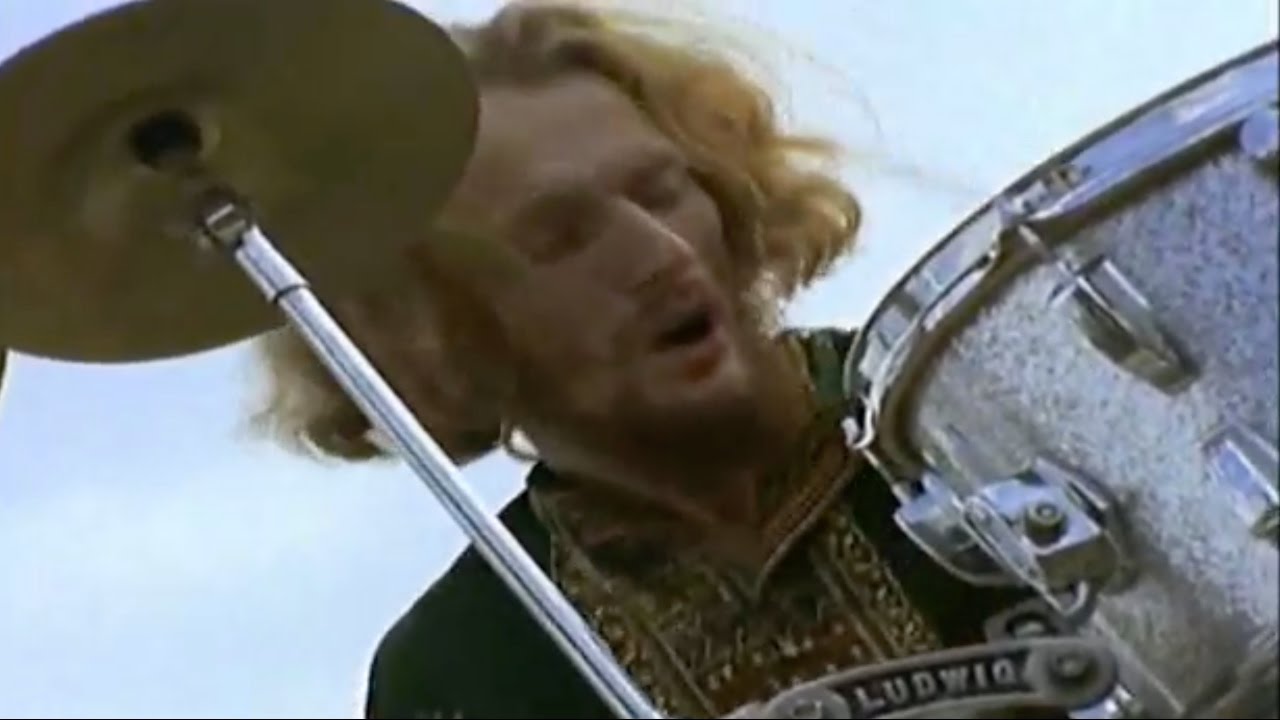
For Blind Faith’s free debut concert in Hyde Park on 7 June 1969, Clapton sported a 1962 bound-bodied Fender Custom Telecaster with a small-headstock maple Stratocaster neck. This was actually the neck from his Layla Strat, ‘Brownie’.
However, Eric had acquired the Tele in early 1968, and appeared playing it with Cream in the Danish film Det Var En Lørdag (It Was A Saturday Night). Interestingly, in the film the same Tele body sported a post-CBS large-headstock, rosewood-’board Strat neck. Whether it was ever played on a Cream album, we can’t say.
Clapton bought another Les Paul, originally a 1957 Goldtop that had been refinished in see-through cherry red by its second owner, Rick Derringer (Johnny and Edgar Winter, Steely Dan), who got it from Lovin’ Spoonful guitarist John Sebastian.
It’s not known whether he ever used it in Cream, but Eric famously gave the instrument to George Harrison and then played the solo on The Beatles’ While My Guitar Gently Weeps on it. Harrison christened the guitar ‘Lucy’ after American comedienne Lucille Ball, and used it for his solo on Something.

Clapton also acquired a 1953 Les Paul Goldtop around this time and played it with Cream at Hunter College Auditorium, New York City on 29 March 1968.
A Gibson guitar that Clapton enjoyed during this same year, but was not often photographed with, was his sunburst 1964 Firebird I. This instrument remained in the touring arsenal until Cream’s final shows on 25 and 26 November at London’s Royal Albert Hall.
![Cream play their farewell show at the Royal Albert Hall [L-R]: Jack Bruce, Ginger Baker, and Eric Clapton – Clapton plays his ES-335.](https://cdn.mos.cms.futurecdn.net/tknxDMXCJKX8L8YMPoE3i8-1200-80.jpg.webp)
The Firebird featured on the first of these shows, and the ES-335 on the second. Eric is said to have bought the guitar on 13 April 1968, remarking that he loved the guitar’s bright and articulate single bridge pickup. He notably used it for his blistering intro and solos in the live rendition of Sitting On Top Of The World from the band’s farewell album Goodbye.
Another Les Paul that surfaced during Cream’s dying days was a 1958 Les Paul known as the ‘Darkburst’. Eric played it on some 1968 US Cream concerts, but in 1969 while Free was supporting Blind Faith on a few US shows, traded it to Paul Kossoff for his Les Paul Custom. It ended up with that band’s singer, Paul Rodgers, who later sold it at auction, with Clapton verifying its provenance.
Seeing Red
We’ve left Eric’s cherry red 1964 ES-335 until last, not only because it was the final six-string he played with Cream at the 26 November Royal Albert Hall farewell concert, but also because questions abound regarding the guitar’s past.
Did Clapton really buy it new in 1964 while in The Yardbirds, as he has proposed? The fact that there are no photos of Eric with the guitar either in The Yardbirds, with John Mayall, or at any time prior to his last run of Cream shows suggests not.
Would he have borrowed guitars for gigs and albums had he owned this rather special guitar? Tele-master Jerry Donahue is adamant that this is not the case and that he personally sold Eric the ES-335 while working at Selmer’s music store in London in 1968.
Jerry asserts it was bought for the Royal Albert Hall farewell concerts. This story seems plausible, even though it flies in the face of auction records and what many, including Clapton himself, believe. Whatever the case, the guitar sold at Christie’s in New York in 2004 for $847,500 (£645,197).
Gibson has released modern recreations of Clapton’s ‘Beano’ Les Paul, the ‘Fool’ SG, Firebird I, ‘Lucy’ Les Paul and ES-335. There has been a Danelectro remake of the painted Blind Faith Shorthorn, and Fender even released a Blind Faith bound-bodied Tele-Strat. Such is the esteem in which Clapton’s Cream guitars are held, today these instruments exchange hands for eye-watering sums.
So, that’s the story of Eric Clapton’s guitars from the short but extraordinary, musically spectacular period between July 1966 and November 1968. While the details of some of the guitars might remain sketchy, one thing we know for certain is we’ll never see a combination of such talents – Eric Clapton, Jack Bruce and Ginger Baker – again.
- This article first appeared in Guitarist. Subscribe and save.

