Guitar World Verdict
It might be the guitar that no one expected, but the PRS SE Ed Sheeran Hollowbody I Piezo Baritone is a very capable machine indeed. From the typical quality PRS build to the added versatility of the piezo bridge, it’s a guitar that can indeed be a singer-songwriter’s tool, or a guitar for chugging metal. It may stop just short of being a shred machine or a true tool for djent riffing, but it still allows you to cover a lot of ground.
Pros
- +
Versatile pickups can handle a huge variety of sounds.
- +
Piezo bridge adds extra flexibility and some unique tones.
- +
Hefty neck profile feels great for riffing and open chords.
- +
The usual excellent PRS build quality and attention to detail.
Cons
- -
The neck profile makes it difficult to shred on.
- -
Doesn’t quite handle super high-gain tones with low tunings.
You can trust Guitar World Our expert reviewers spend hours testing and comparing guitar products so you can choose the best for you. Find out more about how we test.
What is it?
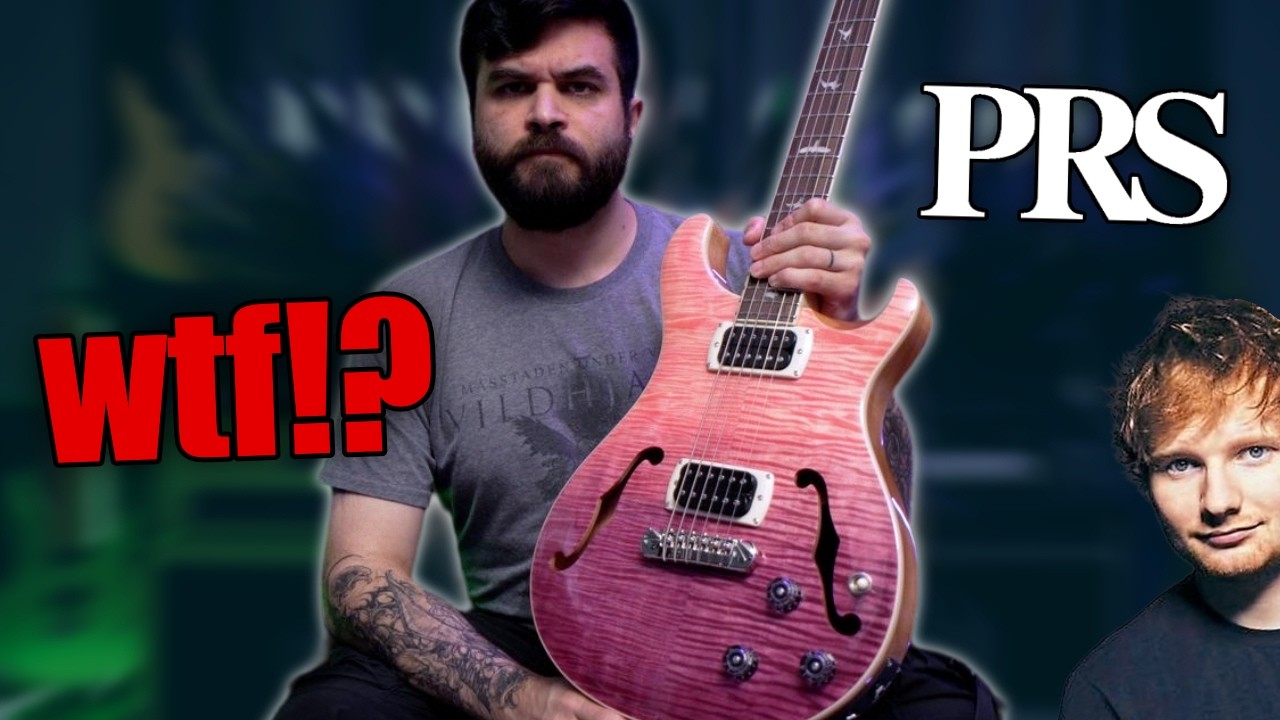
I can’t imagine many people had an Ed Sheeran baritone guitar on their bingo cards after he hooked up with PRS back in 2019, but that’s exactly what we’re looking at today with the PRS SE Ed Sheeran Hollowbody I Piezo Baritone. It’s Ed’s first signature electric guitar ever, never mind his first with PRS, and it has certainly taken the guitar community by surprise.
If you’re a racing fan, you may have spied Ed using a Rosso Corsa baritone in the video for his song ‘Drive’, a guitar which he had custom-built specifically for that song by PRS. It’s a pretty different instrument in terms of spec, but the interest in the guitar from that video is what led to the development of the SE model we see today.

The SE Ed Sheeran baritone features a hollow body design with a flat back composed of a maple top and a flame maple veneer, and a mahogany back and sides. It features a center block, and the top is a shallow violin carve with a cream binding, accompanied by dual f-holes that don’t feature the binding of the popular Hollowbody II models.
The neck is maple, shaped to the usual PRS Wide Fat profile. It’s got a rosewood fretboard with a 10-inch radius, cream binding that matches the body, and the classic PRS Bird inlays. It’s a set neck with a 27.7-inch scale length to ensure it can handle the lower tunings of a baritone.
The tuners are PRS-designed and feature ‘winged’ buttons that are wider than the usual ovals I’ve come across on PRS guitars. The bridge is a PRS adjustable stoptail with a PRS/LR Baggs piezo under the saddle, and the pickups come in the form of two 85/15 “S” humbuckers.
Separate volume controls for the piezo and magnetic pickups are combined with a master tone control and a 3-way toggle switch selector. There are two output jacks that offer a mix of piezo and magnetic pickups or magnetic pickups only.
Specs

- Launch price: $1,499 | £1,499 | €1,799
- Made: Indonesia
- Type: Six-string hollow body baritone guitar
- Body: Maple top with flame maple veneer, mahogany back
- Neck: Maple set neck / Wide Fat profile
- Fingerboard: Rosewood
- Scale length: 27.7", 703mm
- Nut/width: PRS synthetic / 43mm
- Frets: 22, PRS standard fret wire
- Hardware: PRS-designed tuners, PRS adjustable stop tail piezo bridge
- String spacing at bridge: 52mm
- Electrics: 2x 85/15 “S” humbuckers, magnetic volume, piezo volume, tone control & 3-way toggle pickup switch
- Weight: 6.6 lbs / 3 kg
- Left-handed options: N/A
- Finishes: Orange Tiger Smokeburst (as reviewed), Kaleidoscope, Pink Ombre
- Case: PRS gig bag
- Contact: PRS
Build quality

Build quality rating: ★★★★½
As with every PRS SE guitar I’ve come across over the past few years, the build quality here is close to faultless. A close inspection reveals a very small spec of black in the binding on the bass side, where the neck meets the body, and on the treble side at the same point, there’s what looks like some paint bleeding over onto the binding. That aside, I can find nothing out of place in terms of the aesthetic.
It’s got a decent heft to it, even with the hollow body construction, coming in at 3kg on my scales. It all adds to the feeling of solidity, though. On the lower cutaway, there’s some sculpting to help you get at the upper frets more easily, while on the reverse of the guitar, a very slight belly cut aids the comfort factor. The knobs are well applied, and the toggle switch moves with a firm and satisfying click through its three positions.

Looking at the output jack, unusually, there are two outputs, with one marked ‘mix/piezo’ and the other marked ‘mag’. Both are marked so that when you look at them from the playing position, the writing is the right way up, which is a nice touch. There’s a compartment that houses a 9V battery which powers the preamp of the piezo system, although this is only engaged when plugged into the ‘mix/piezo’ jack, so you can use it as an entirely passive instrument with the other output jack.
Playability

Playability rating: ★★★★½
It’s not quite slinky enough for proper shred stuff
Sitting down to play the Ed Sheeran Hollowbody baritone on the sofa, the neck feels pretty hefty compared to the standard-scale guitar I’ve been playing before it. It’s not quite a baseball bat, but it’s not far off either, feeling very full in my hand as I strum some open chords. It’s certainly not giving me the ‘shredders’ part of the marketing material around this guitar as I try some legato and three-note-per-string runs.
Trying out some lead work, I can get around pretty quickly, but it’s not quite slinky enough for proper shred stuff. Jumbo frets might have helped here, allowing me to get around the fretboard a bit quicker, but as it is out of the box, I’d be hesitant to call this a shred guitar. Getting my ruler out to quantify that feeling, the action measures around 2mm, so there’s definitely potential for improvement here in that regard.

Bending isn’t as hard as on some of the baritones I’ve played. It’s pretty easy to get a full tone out of it with a supporting finger or two, and I don’t feel as though I have to really fight to eke those out. It does take a bit of adjustment to nail that 22nd fret bend, as my hand naturally hits the non-sculpted part of the cutaway. A little tilt as I reach for that fret solves this, however, and it doesn’t take me long to start accurately hitting it on a consistent basis.
Changing the tuning to drop A and pulling out some ‘Ashes of the Wake’-era Lamb of God riffs, it’s very satisfying indeed to play. The thicker neck profile makes for a nice anchor when alternate picking and digging in with palm muted riffs, and it’s super satisfying to chug along with. Although the scale is comparatively long compared to a normal PRS, it doesn’t feel ginormous, offering a nice balance between length and string tension with the 14-68 gauge strings that come on it from the factory.
Sounds

Sounds rating: ★★★★½
Keen to try the piezo pickup, I plug it straight into a Fender 64 Princeton reissue to see what the clean tones are like. Starting with just the piezo pickup engaged, it sounds great on the treble end of the fretboard, with very little of that ‘plink’ you might expect from this kind of pickup. The low stuff isn’t quite as nice though. It feels as though the piezo struggles to pick up the low string, which results in it getting drowned out when I pick some arpeggiated open chords.
Bringing in the magnetic pickup adds some more of the low end back in, giving it a fuller sound overall. When I switch to the neck humbucker with the piezo and both volume knobs on full, it’s an absolutely delightful tone blend of high-end from the piezo and warm tones from the neck humbucker, that leave me picking arpeggios for a long time. With some spring reverb and a gentle touch of tremolo from the amp, it’s clean tone heaven.
The tone control only affects the magnetic pickups, and rolling this off when combining with the piezo adds huge versatility to the guitar. Switching back to just the neck humbucker makes it feel almost dull in comparison, but that’s also partially because adding the piezo in also increases the overall volume of the guitar, and for the human ear, louder equals better.

I find a very smooth lead tone from the humbuckers
Sticking my Joyo Klon clone in front of the amp and dialing up the volume, I find a very smooth lead tone from the humbuckers. Even with some drive applied to chords, they ring out very clearly, but that changes when I add in the piezo. Here, it feels a bit overwhelming, with the individual strings getting lost thanks to the extra high-end the piezo adds. It also makes itself a bit too present on lead work, with that piezo pluck enhanced by the addition of overdrive in the signal chain.
Turning up the gain on the amp and on my overdrive pedal, slow, doomy power chords sound really powerful, and here adding in the piezo gives them some more clank that really suits that particular type of sound. Excited to see if this thing can djent, in lieu of an actual high-gain, metal amp, I switch to my audio interface and Nolly’s Neural DSP plugin.

With the 5150 model selected and the bridge humbucker engaged, there’s a definite metal rhythm tone available here. The low tuning naturally helps some, but the mid-gain of the pickups means it stays pretty articulate. I have to mess with the settings a bit to get it as tight as I’d like, but it’s more than usable for tracking chugs. It works great for leads, too, maintaining that smooth sound and feel when I add some reverb and delay.
Dropping the low string all the way down to an octave below ‘E’ (like a standard bass), it stays surprisingly stable for some djent tones. With the humbuckers on their own, there just isn’t the definition for this type of riffing, though.
Adding the piezo in brings back some clarity, with that clankiness that marks the sound of a lot of down-tuned modern metal. While it can handle these tones, I don’t think it’s all that usable, as it doesn’t have the natural compression of a set of active pickups, making it very difficult to control any extraneous noise with a high-gain amp.
Verdict

I can see the PRS SE Ed Sheeran baritone finding fans across different genres, provided you can get past the name on the headstock. If you’re willing to look beyond your prejudices, you’ll find a very well-made guitar with a playable neck that’s capable of a wide variety of different tones.
It’s not quite capable of proper djent tones and super shreddy stuff
While the marketing speak of singer-songwriter to metal head holds true to some degree, it’s not quite capable of proper djent tones and super shreddy stuff, thanks to the pickups and the neck profile. That said, for pretty much any style, you’ll find a sound here, and perhaps some truly unique ones once you start blending in that piezo pickup.
Guitar World verdict: It might be the guitar that no one expected, but the PRS SE Ed Sheeran Hollowbody I Piezo Baritone is a very capable machine indeed. From the typical quality PRS build to the added versatility of the piezo bridge, it’s a guitar that can indeed be a singer-songwriter’s tool, or a guitar for chugging metal. It may stop just short of being a shred machine or a true tool for djent riffing, but it still allows you to cover a lot of ground.
Test |
Results |
Score |
|---|---|---|
Build quality |
PRS’ typical build quality, with some very tiny finish blemishes |
★★★★½ |
Playability |
Thicker neck profile is great for a majority of styles, but not sleek enough for shredding |
★★★★½ |
Sounds |
Pickups and ultra versatile, and adding the piezo unlocks some unique tones |
★★★★½ |
Overall |
A great baritone guitar that can play a wide variety of roles |
★★★★½ |
Also try
Hands-on videos
John Nathan Cordy
Andrew Baena