Guitar World Verdict
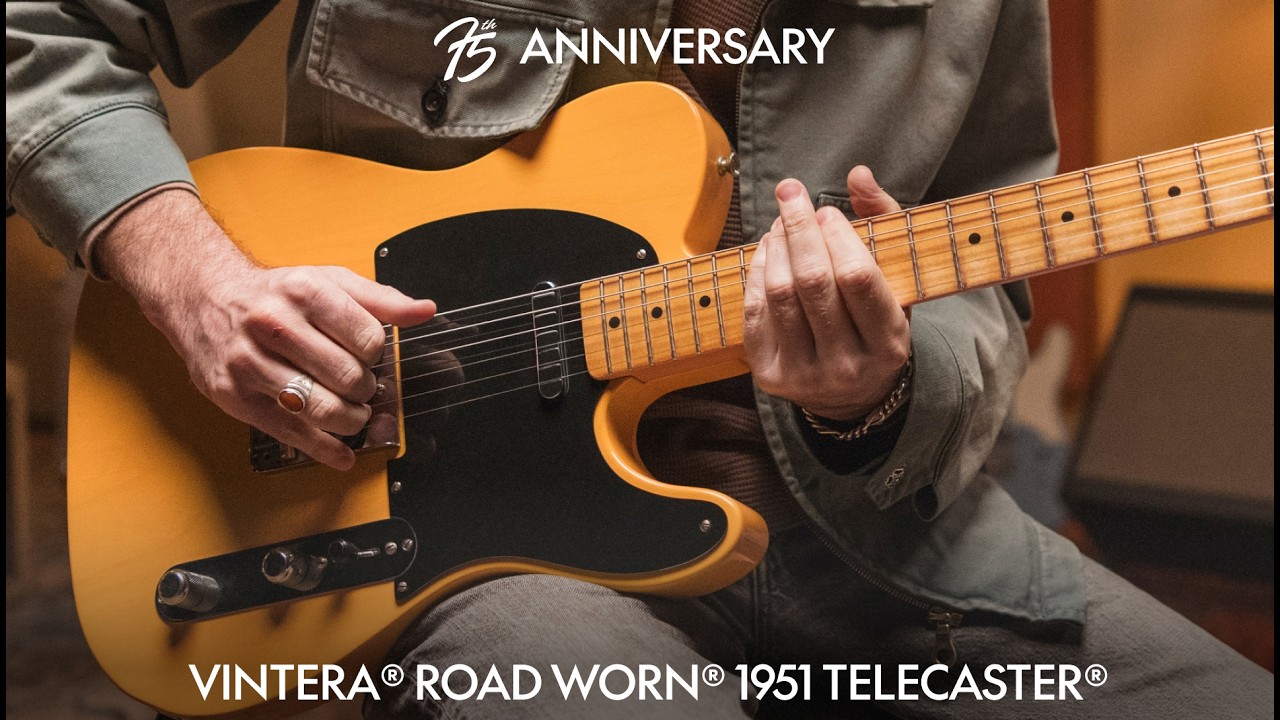
Quite possibly my favorite Telecaster to come out of the Vintera range, this 75th Anniversary spin-off offers an exceptional Road Worn finish, fantastic pickups, and effortless playability. With a tiny bit of tweaking, this could be a world-beater.
Reasons to buy
- +
That 1951 'U' neck is now my all-time favorite profile.
- +
Effortlessly playable and nicely set up.
- +
Pure Vintage pickups offer a huge range of exceptional tones.
- +
Road Worn finish is nicely applied and highly convincing.
Reasons to avoid
- -
Gauge 9 strings don't seem to do it justice. Shipping with 10s would be better.
- -
The pickup selector switch won't stay on.
- -
Knurling on the control knobs could be more liberal.
You can trust Guitar World Our expert reviewers spend hours testing and comparing guitar products so you can choose the best for you. Find out more about how we test.
What is it?
You probably know by now that 2026 is a big year for Fender: it’s the year Leo Fender’s iconic Telecaster design celebrates its 75th birthday. It goes without saying that the Big F has grand plans to celebrate the historic milestone of the world’s first mass-produced solidbody electric guitar, and part of that agenda includes the release of the 75th Anniversary Telecaster Collection.
There were five new models in total, but the one I have here is the Vintera Road Worn 1951 iteration – a stunning, lightly aged Blackguard design that pays homage to the model that superseded early Broadcaster and Nocaster single-cuts to become the first-ever Tele.
It’s been given a cool ‘closet classic’ relic’ing vibe, with checking on the body, an artificially worn fretboard – with the lower register twanging zone seeing more of the aging, naturally, and subtly aged hardware.

Overall, it’s a lovely looking Telecaster at first glance, heralding from the Mexican-made Vintera range with a bounty of 1951-inspired specs to provide an affordable yet faithful take on the early Blackguard experience.
That means there’s also a generously profiled neck, a 7.25” fingerboard radius a lá early Fenders, vintage-style tuners, vintage-style three-saddle bridge, Pure Vintage 1951 Telecaster pickups… you get the picture. In other words, it’s a classic Vintera Telecaster that’s been given a 75th Anniversary makeover, complete with a commemorative 75th Anniversary four-bolt neckplate.
Specs

- Launch price: $1,899 | £1,599 | €1,899
- Made: Mexico
- Type: Six-string electric guitar
- Body: Ash
- Neck: Maple / 1951 "U"
- Fingerboard: Maple, 7.25" / 184.1mm
- Scale length: 25.5" / 648mm
- Nut/width: Bone / 42mm
- Frets: 21
- Hardware: 3-saddle vintage-style strings-through-body w/ brass barrel saddles / 4-bolt vintage-style neck plate / Butterfly string tree / Fender vintage-style tuning machines
- String spacing at bridge: 53mm
- Electrics: Pure Vintage '51 Single-Coil Tele x2 / Master Volume, Master Tone Controls / 3-position blade switch
- Weight: 7.4lb/3.39kg
- Left-handed options: No
- Finishes: Butterscotch Blonde
- Cases: Tweed Hard Case
- Contact: Fender
Build quality

Build quality rating: ★★★★½
The Road Worn treatment has been applied very nicely indeed here, and that’s not always a given. We’ve seen how the wear on some Ensenada factory Road Worn Fenders can sometimes look templated up close and under the lights, but there’s no such issues here.
That is down to the fact this really is a light aging job, and no finish has actually been taken away, so the margin for error is wider. That said, Fender still had to get the job done, and I like what I see.

Though akin to the ‘Heirloom’ treatment which made its full debut on the American Ultra Luxe Vintage models from 2025, it looks to be a continuation of what we saw on models like the Vintera II Road Worn 60s Stratocaster from the same year.
The fingerboard wear feels natural, and the all-over body checking (while not to everyone’s taste) is more convincing to me than some of the actual worn finish aging I've seen in the past. Even the aged hardware feels like a premium job, even if it is quite sparing.
The beautifully set up straight out the box, with well-finished frets as we'd expect. The only thing that pulls it down is the pickup selector switch cap – that thing just does not want to stay on. It comes off almost every time I change position.
Not too much of an issue in a controlled environment, but losing that thing on a dark stage? Good luck finding it again. You could apply some sort of adhesive to keep it in place, but that will cause headaches down the line. Something a bit more snug would have been better. Other than that, this is an exceptional Telecaster that’s been dialed in really nicely.
Playability

Playability rating: ★★★★★
This is the best Vintera Telecaster I’ve played in quite some time
Vintera models frequently offer good bang for your buck, especially compared to some of the California-made vintage spec Fenders, but this is the best Vintera Telecaster I’ve played in quite some time. I need to start with the neck – that 1951 U profile is meaty, chunky in the hand, and feels absolutely exquisite. When paired with the satin-finished neck, as opposed to gloss, it becomes a delight to get around, with maximum slick and minimal fuss.
I have no hesitation in saying I actually prefer this neck to the slimmer C of my American Vintage II Thinline Telecaster – a painful admission to make about a $2k+ guitar.
The shoulders of the neck are nicely sloped, so it doesn’t feel like you’re playing a baseball bat, but the central hump feels like a really natural fit in the palm of your hand, especially towards the nut. Open chime-y chords and open-string runs in the E minor pentatonic position – a go-to first-base pit stop when playing a Telecaster – is a dreamworld with this guitar.
I’m also surprised to find myself really enjoying the 7.25” radius here. The Thinline I have offers a 7.25” radius, and while I have no issues with it, it’s not really my favorite radius. John Mayer may disagree with me, but I feel it does make a slight difference – and for more adventurous leads I tend to pick up my Gibson SG or Stratocaster copy.
That said, this 75th Anniversary Telecaster can handle anything I throw at it, from more progressive, textural ambient playing to full throttle drive, with a serious robustness. Bends are dangerously easy.

I’m a fan of low action, but this one finely threads the line of being slightly too low on a 7.25" radius that usually requires slightly higher clearance (I measure it as 1.50mm clearance from the low E at 12th, 1.25mm from the high E here). I enjoy a bit of slide guitar on a Tele every now and then, but you wouldn’t really be able to do that here at risk of fretting out the notes. I had planned to take this to a few rehearsals, but I just didn’t feel confident in taking a slide to it. That said, it’s obviously a trade off: for basic playing, lead lines, and chords, this really is as good as it gets.
The jury is still out on the 9 gauge strings it's been strung with at the factory, because I think 10s would do this guitar far more justice. The 9s just lack the snap and oomph I get from Teles with 10s, and that I think makes Teles what they are. Sure, a lighter gauge contributes to those dangerously easy bends, but this guitar is so well-tuned that 10s would be fine on it.
You can get the twang and the snap, especially when plugged in, but unplugged it feels a bit anemic – a tad polite. This isn’t a guitar designed to be played politely, though. It’s inspired be a workhorse Tele.
Sounds

Sounds rating: ★★★★½
The unplugged tone test reveals a guitar that is full of life, resonant, extremely expressive, and filled with a natural character that lives up to the Telecaster name. Like I said, I think 10s would give this a bit more beef – both sonically and physically – but I recognize that’s entirely a subjective thing. An easy swap anyway.
The Pure Vintage 1951 Telecaster pickups are inspiring. As expected from the spec, they come across with a slightly cooler output when run through various amp models on a Neural DSP Quad Cortex mini, so need a bit of help to level things out, but they have a seriously healthy helping of bite and grit when given something to play with.

What surprised me was just how long I spent on the bridge pickup
I’m really impressed by the clarity and note separation offered here. It handles cleans and drives well on equal measures. When run through a Dumble or Vox capture – with some tape delay – you get an incredibly present tone that has plenty of high end but never thins out, even on the bridge pickup.
When cranked through a Champ or a Deluxe Reverb, the Tele springs to life, and offers great articulation that responds to your playing while retaining its character.
What surprised me was just how long I spent on the bridge pickup. I am very particular about bridge single-coils. Everyone knows how temperamental they can be, and I hate the tinny tone that many have. No such issues were found here. The lead pickup retained a really punchy presence that never got away from me.
Of course, it has that Tele twang, and the middle and neck positions do a good job of dialing in a bit more beef without ever feeling muddy or ‘wishy washy’. Again, I’m upset this didn’t quite make it to rehearsals, because I bet this would slice right through a mix without breaking a sweat.

Verdict

This might be the finest-playing and best-sounding Mexican-made Telecaster I’ve ever put my hands on, and the highest form of praise I can give it is that it gives my $2,800 American Vintage II Telecaster a serious run for its money. Superb playability combined with excellent Road Worn finishing and some hugely impressive tones result in a Blackguard-inspired Telecaster that shines.
This might be the finest-playing and best-sounding Mexican-made Telecaster I’ve ever put my hands on
It’s not perfect, of course, but by gosh is it close, and the marks it does drop aren’t too significant to the overall package. A tighter switch top would be nice. Perhaps the action could be a bit more forgiving. Maybe the knurled knobs could be improved.
But this is a Telecaster inspired by a model from 1951, so you’re buying into the full experience here. A stunning ode to the first-ever mass-produced solidbody electric, and a fantastic way to celebrate its 75th birthday. One that will delight vintage purists,Telecaster traditionalists, and general guitar fans alike.
Guitar World verdict: Quite possibly my favorite Telecaster to come out of the Vintera range, this 75th Anniversary spin-off offers an exceptional Road Worn finish, fantastic pickups, and effortless playability. With a tiny bit of tweaking, this could be a world-beater.
Test |
Results |
Score |
|---|---|---|
Build quality |
Great finishing and the Road Worn treatment is exceptional in this case. |
★★★★½ |
Playability |
Super neck profile, nicely set up. |
★★★★★ |
Sounds |
Light and resonant, and those Pure Vintage pickups really sing. |
★★★★½ |
Overall |
An exemplary Vintera Tele and a worthy addition to the 75th Anniversary collection. |
★★★★½ |
Also try
Hands-on videos
Andertons

Guitar Center

Fender