


Sean Lennon and his musical partner in crime Les Claypool wanted to up the ante for the Claypool Lennon Delirium's third album, The Great Parrot-ox and the Golden Egg of Empathy.
They’ve done that, tackling important themes including AI and sustainability in a rock opera of sorts. It’s important stuff – but in typical fashion, the duo went about it from a humorous angle. “It wasn’t about what was in the news in terms of negative things,” Lennon says. “We were just kind of trying to write something compelling that basically made us laugh.”
And though he’s an outright pedal fiend, he doesn’t muck about when it comes to his guitars. “I’m a boring guitar player,” he admits. “I’m a little bit lazy. I can’t even get to the point where I’m gonna have a different guitar for every song!
“I just like to change sounds with pickup settings and pedals, and maybe the amp settings a little bit. I don’t switch out 100 guitars; it’s too much to think about.”
He confirms that his inspiration as a player comes from his Beatle father, John Lennon. “It hasn’t just impacted me,” he says of his dad's influence. “It’s more than that. It’s the only reason I play music.
“I always say that I don’t think I was especially gifted as a musician. I have talent – but there are a lot of people on Instagram, and if you look you realize they’re prodigal geniuses. I didn’t like playing music because my band was successful, or because I’d get noticed as a guitar player. I just played because I missed my dad. That was it.”
How did The Great Parrot-Ox and the Golden Egg of Empathy kick off?
It started with us wanting to not just do another Delirium record. It felt like a third album is kind of a milestone for a band, so we wanted to do something bigger – a full-blown rock opera with a film concept. That was kind of shooting for the stars! We wanted something epic and expansive.
Big topics such as AI and sustainability run throughout. Are those important issues to you and Les?
We’d written one or two other stories that we abandoned because we weren’t excited enough about them. I’d been reading about the paperclip dilemma, a thought experiment – it’s basically a warning against what could go wrong if you design an out-of-control AI system.
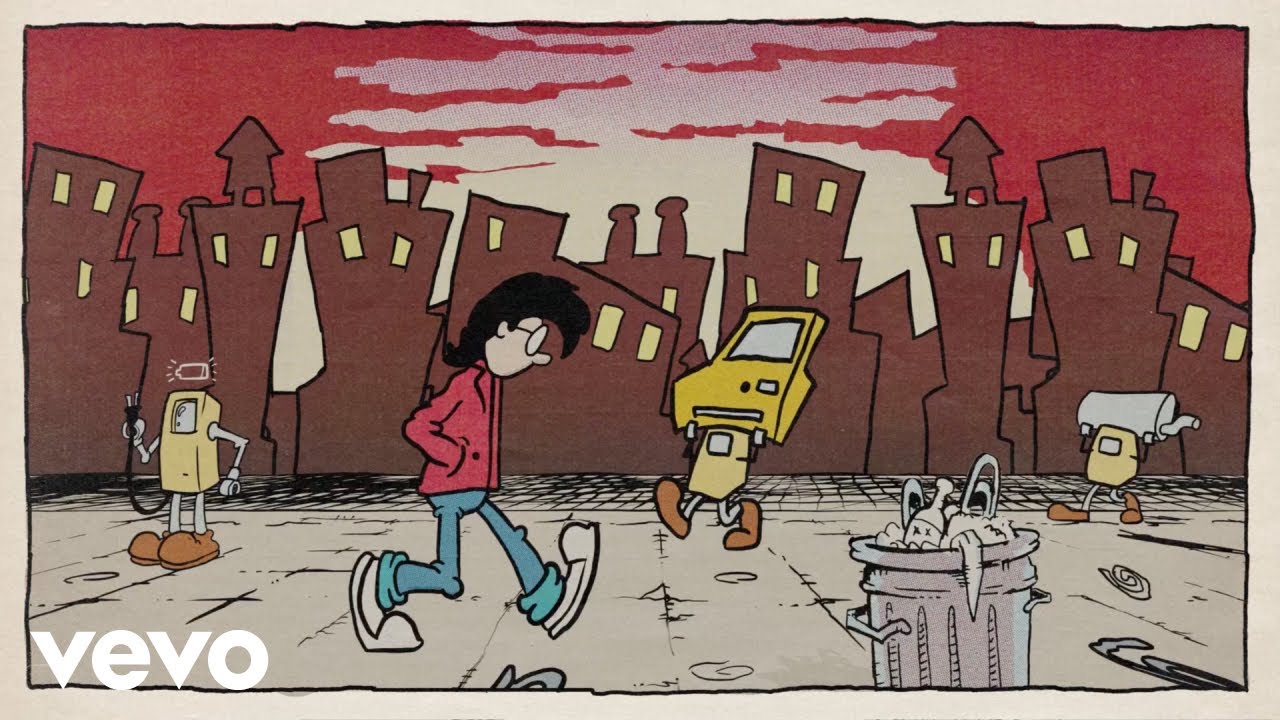
A super-intelligent robot could just turn everything on the planet into paper clips because it doesn’t know that it shouldn’t do that – it was programmed that way. We just thought it would be funny to turn that into a story where it’s actually happening.
It wasn’t like we were trying to be relevant – we just thought it was funny! But it turned out to be timed really well. It feels like we're sort of at a peak for people wondering if we’ve gone too far with this stuff.
What’s the division of labor between you and Les in the studio?
We’ve done a lot of different songs in a lot of different ways. We’ve jammed on ideas and maybe five or 10 ideas will come out, and we’ll record them on a cellphone. Then we go home and see if either of us hears anything interesting.
I’d say the most common method is not unlike the early John and Paul method: each of us has an idea for a song, we bring it to the other person, and if they like it, we finish it off together.

Do you generally write on guitar?
I usually write on an acoustic guitar because I’m too lazy to set up an amp just to write a song! But my comfort zone is also to have a keyboard or piano nearby. I’ve found that, when I’m stuck or confused, it unlocks something in my brain if I figure it out on the piano. But with the Delirium, I mostly write on guitar.
Do you have a favorite acoustic?
You could say, ‘What’s this pedal?’ and I knew. Now there’s just so much stuff out there I have no clue
Yeah! My guitar teacher – I only took two lessons with her, and I forget her name because I was so young – had a Martin 00-15, the mahogany one. When I was working on my [2006] solo album Friendly Fire, I bought one from a vintage shop in LA. That’s my favorite guitar.
It’s very small and easy to carry. I toured Friendly Fire with it. I just love the look of it. I associate the dark brown mahogany with learning to finger-pick at summer camp, so it’s sort of my earliest idea of a guitar.
Do you still tour with that guitar?
I don’t know if this is uncool or whatever – but do you know those Fender guitars that are acoustic but look like an electric guitar? They’re like $600.

An Acoustasonic?
Yeah! I’ve trashed a bunch of acoustics in my life, so I take those Fenders on tour now because I’m not too worried about banging them up. They’re actually even lighter than an acoustic, so I tend to write with them when I’m with Les because they’re easier to carry. Those Fenders are great.
A lot of modern guitar companies have really figured out how to machine the necks now so they play very well – whereas for most of my life, to get a really great guitar, it would have to be old. But in the last 10 or 20 years, everyone has really stepped up their game, and even cheaper guitars play pretty well.
Looking at two of the singles from the new record, what gear did you use on WAP (What a Predicament) and Meat Machine?
We always record at Les’ studio, Rancho Relaxo. He has one Mesa/Boogie with a couple of 10” speakers; it was in his extra shower, where he stores things. We found that, and it just stayed on for like three weeks!
I ran my pedalboard through it, and essentially all the sounds I’m getting are from pedals. I don’t do a lot of amp and guitar-swapping; part of the quality and charm of the Delerium records is having a very limited palette.
What tends to catch your ear as far as pedals go?
I used to be known as a pedal guy – an effects pedal expert – in the ‘90s and early 2000s, but there was a pedal renaissance and all these boutique pedal companies came out, and I just couldn't keep up anymore!
I was the guy where you could say, ‘Hey, what’s this?’, and I pretty much knew. But now there’s just so much stuff out there that I have no clue. There’s just so many great pedal companies.
I probably have a little more facility with my fingers than my dad – but I don’t think I’m as good a songwriter!
What’s the most interesting pedal on your board now?
My Delirium pedalboard is pretty basic stuff. But the most interesting one is on the song Melody of Entropy. There’s a famous pedal called the Tremopolis – have you heard of it?
I can’t say I have…
It’s famous because it’s impossible to get. It’s extremely bizarre. It’s a tremolo pedal made by this very strange guy who disappeared. No one knows where he is, this pink-haired dude on Facebook who made a couple of these pedals.

They’re extremely strange – this tremolo reacts to volume, like an attack. The speed of the tremolo changes drastically depending on how the guitar is played, and it makes some really wild sounds. The tremolo goes up so fast that it almost sounds like a glitch. It’s really great!
It’s very much featured on Melody of Entropy. We wrote that song because of the pedal. I was like, “Hey Les, I wanna show you this weird pedal I brought!” I was just playing something to show him how it worked, and it wound up being the song.
What electric guitars do you favor?
My favorite guitars of all-time are Jazzmasters. I have a ’67 and a ’59 that’s really fancy. They’re my favorites, but I don’t like touring with them because I’m scared of damaging them. So Nels Cline introduced me to the guy at Bilt Guitars, and they made me a bunch of custom guitars for the Delirium.
Is that the SS Zaftig and the Revelator?
Yeah. If you’re a Delirium fan, you’ll know my silver Bilt guitar and my green sparkle one. They’re incredibly well-made – they’re the first guitars I ever had custom-made for myself, and they’re the first new guitars that I think are as well-made as the ‘50s Fender stuff. They’re beautifully crafted.

It goes without saying that you have a great guitar-related lineage through your dad. Do you think you play like him?
I think I’m always gonna be rooted in a British harmony kind of thing, but I don’t think we play exactly the same. I think his playing was a lot more raw; I probably spent a lot more time trying to learn certain things. I don’t think he ever cared to do that, so I do think we play differently.
I probably have a little more facility with my fingers – but I don’t think I’m as good a songwriter as him, so there’s that!
Learning to play guitar was only cool because it made me think about my dad, who wasn’t around
Do you have any of your dad’s old guitars?
My mom [Yoko Ono] has his guitars. Growing up, I was allowed to play with them because they were still lying around in our apartment. But I think my mom realized they were precious items that she probably shouldn’t let me destroy! So I was banned from playing them by the time I was 12, maybe.
I’m glad she did that, and I’m very grateful because she also let me get my own guitars, which is all I needed. So I don’t play his guitars, but I’m looking into taking care of them.

I’m making sure they’re happy, you know? I feel like a happy guitar should be worked on, played, and restored. It’s something I think my mom was less interested in because she’s not a guitar player.
It’s not that they weren’t taken care of; it’s that they were sitting in storage. I think it’s just entropy – if you leave any object in the closet for long enough, it just starts to fall apart. I’m having them looked at by some people I really trust.
Overall, can you measure your dad’s impact on your playing?
When I think of music I think of my dad. So it’s fundamental to me. Learning to play guitar was only cool because it made me think about him. He wasn’t around, so it was definitely a way for me to feel closer to him.
The first songs I learned to play were Beatles songs, and after that it was like Hendrix and Zeppelin. But my foundation, my initial reason for wanting to play music at all, was my dad.

What’s next for you?
I’m really excited about the tour for this record. I feel like the response for the first couple of singles has been bigger than our other albums.
But “big” is a relative term! I know we’re still an indie band, but it feels like we have a lot of fans now. I guess it’s from years of touring and putting out multiple records – you build an audience. I’m really excited to go out there and play these songs for people who seem excited about them too.
- The Great Parrot-ox and the Golden Egg of Empathy is on sale now. Check out The Claypool Lennon Delirium’s upcoming tour dates.

