





Guitar World Verdict
A little amp that delivers big, the Orange Baby Terror is perfect for the studio, small stages, or rehearsals when you need an amp that will happily break up at lower volumes. It’s the classic Orange bark, alongside some well-chosen features in a fun and affordable package.
Reasons to buy
- +
Tiny.
- +
Brilliant, tube-like driven sounds at low volumes.
- +
Dynamically responds to the guitar's volume control and pick attack.
Reasons to avoid
- -
Not a lot of clean headroom to play with.
- -
A bit inconvenient for home practice.
- -
Only loud enough for smaller stages.
- -
Direct out is unemulated.
You can trust Guitar World Our expert reviewers spend hours testing and comparing guitar products so you can choose the best for you. Find out more about how we test.
What is it?
You will always stand out with an Orange amplifier in your backline, not only because of its brightly colored aesthetic, but also because of a classic tone that has been powering players since 1968. With that sort of heritage, some brands would be content only to lean on past successes and put out re-issue after re-issue, but Orange has consistently launched creative new products alongside its classic amps. Case in point: the new Baby Terror.
It joins Orange’s ‘Baby’ line of products, which utilizes tried and tested solid-state tech but with interesting features aimed at the gigging musician. It’s stable mates include products such as the Pedal Baby, which is a rack-mount power amp built to work with the relatively modern convention of pedalboard pre-amps, and the two-channel Dual Baby, the first channel of which informs part of the Baby Terror's design.

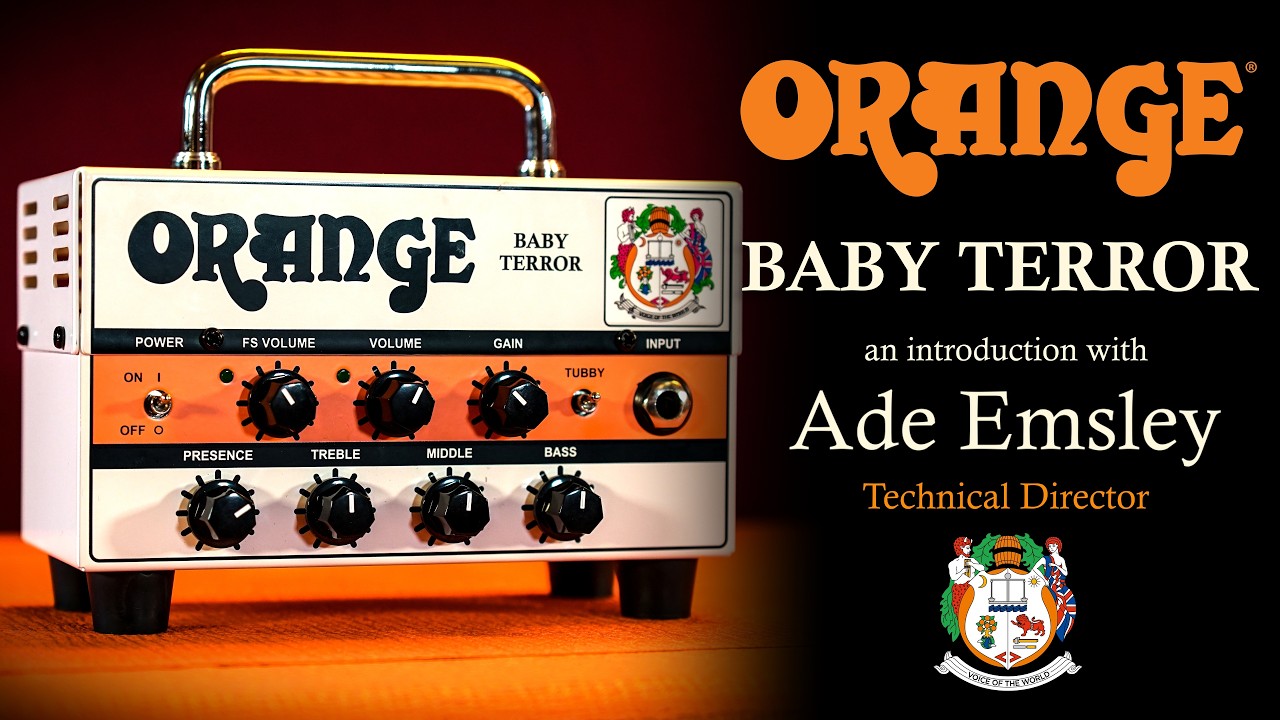
Form factor-wise, Baby Terror takes obvious influence from the Micro Terror line and is an impressively tiny 20-watt guitar amp head. Like the rest of the Baby series, it is solid-state and boasts a couple of interesting features. Namely, the Tubby switch first found on the Dual Baby, a footswitchable volume boost and a balanced XLR output, all of which we will dive into.
If you are a tube amplifier aficionado, don’t let the solid-state thing put you off. Orange has form for using this tech in a way that feels impressively tube-like, not only in the Baby lineup but also in the Crush series of products.
In other words, the Baby Terror has a pretty high bar to meet.
Specs

- Launch price: $249 | £199 | €236
- Type: Lunchbox head
- Origin: China
- Output: 20 watts
- Channels: 1
- Controls: FS Volume, Volume, Gain, Presence, Treble, Middle, Bass, Tubby switch
- Connectivity: 1/4" input, speaker output, effects loop, XLR direct out
- Footswitch: Purchased separately
- Weight: 3.3lbs/1.5kgs
- Dimensions: 165x140x100mm/6.4"x5.5"x3.9"
- Contact: Orange
Build quality

Build quality rating: ★★★★½
A metal chassis, a big, chunky metal handle, and some equally chunky rubber feet give this baby box a rather hardy feel. Being solid-state too, the internals are not as sensitive as fragile glass tubes, so it really makes an impression as a tough little thing.
Little being the operative word, as at 165 x 140 x 100 mm and just 1.5kg, it is delightfully small, even for a lunchbox-style head.
The controls on the front panel all feel robust in use, as do the inputs and outputs on the back, with the exception of the external power adapter. With a product designed to run straight into a mains socket and potentially gigged with, I would always rather see an IEC cable instead of the comparatively flimsy DC adapter included here.
All of this is protected within a handy soft case, which is thick enough to feel premium and offer some shielding from the inevitable scuffs that come with taking advantage of the amp's portability.
Usability and features

Usability and features rating: ★★★★☆
Orange has forgone its trademark icons in favor of simple text to label these controls
As a one-channel amplifier, the Baby Terror is, by nature, a simple beast. On the front panel sit the three-band EQ, Presence, Volume, and Gain controls, all of which are clearly labeled and self-explanatory.
I say clearly labeled, as Orange has forgone its trademark icons in favor of simple text to label these controls. Personally, having previously criticized those icons for their lack of beginner-friendliness, I am a fan of this choice.
Also on the front panel lie two of the features that make this amp interesting beyond its diminutive stature. Namely, the Tubby switch, which thickens up the low end on cleaner settings, and a second footswitchable Volume control.

The latter is particularly handy for providing a little boost to get your solos to rise above the mix in a live band. To be clear, it is not a second channel, but rather a second volume to control the single channel with.
What is a shame, though, is that, unlike a lot of amplifiers, the Baby Terror does not come with a footswitch, so you'll need to invest in an Orange FS-1 Mini or similar to make full use of this.
The rear of the amp sports the input for a footswitch, the 8/16ohms output, as well as an effects loop that is particularly handy on a single-channel amp that likes to break up, and a balanced XLR direct out.
It’s great to have that direct output, but it is not cabinet-emulated, so you will have to run your own Impulse Response or cabinet emulation externally to properly use this. With so many other options to go direct without this added hassle, un-emulated direct outs feel a little superfluous in the current market.

On a related note, Orange says that the Baby Terror is suitable for desktop practice. I disagree.
While of course you can use it at home, that unemulated output makes utilising the XLR out for this use a bit of a faff magnet, and for most, using the Baby Terror with a guitar cabinet at home will take up more room than is convenient. You could buy a small cabinet specifically for home practice, but it would make more sense to put that cash into one of the many, and generally very affordable, home practice amps on the market that tend to boast home targeted features such as Bluetooth connectivity.
It's worth mentioning the Orange Micro Terror here, as its auxiliary input makes it a slightly better option for jamming at home. However, its headphone output is also un-emulated, so it runs into the same issue.
Still, the Baby Terror is an amp that costs just $249/£199, so I am not expecting a smorgasbord of bells and whistles, and I am appreciative of those features that are here. Assuming that they don’t come at the expense of tone, of course.
Sounds

Sounds rating: ★★★★☆
Thankfully, there is nothing to worry about as far as that goes. I am putting it through its paces via an Orange PPC212V cab, a Gibson SG, Fender Elite Stratocaster, and a humbucker-loaded Orangewood Clementine semi (because, orange).
The Baby Terror possesses the familiar, mid-forward growl with a high-end presence that we have come to expect from Orange amplifiers. Like most Orange amps, it is built to drive, as it gets into edge-of-breakup territory relatively quickly at about halfway on the Gain control with my Stratocaster, and a little before that with my SG.
The Gain control needs to be set at least a quarter of the way up before any decent volume comes out of the amp too (even with the master volume set at full), meaning that there isn’t much clean headroom to play around with here.
So it's not for the country pickers, but perfect if you want an amp that breaks up without pushing too many decibels. Assuming you don't want to distort your time-based effects, this is where the effects loop comes in handy too and keeps the amp viable as a pedal platform.

Getting a clean tone is all about rolling back the volume control on the guitar
Because of this, and as a solid-state amp with just 20 watts, it’s not suited to situations where you need things loud, but it will give you enough to monitor yourself on smaller stages, at rehearsals, or to do some studio recording with, while using the DI to send things to front-of-house.
Getting a clean tone, then, is all about rolling back the volume control on the guitar. Knocking just a little off the volume control with the amp set up on the edge of breakup gets straight into sparkly cleans with a little bit of grit as I dig in. It’s an old-school approach, but one that yields a very dynamic feel.
It does not quite have some of the luscious overtones of more expensive amplifiers, but that does not stop it from being a ton of fun to play.

Pushing the gain further reveals that the Baby Terror is capable of some meaty saturated tones, comfortably within heavy rock territory.
Throughout all of this playing, I find the amp to be relatively tight in the low end, with a tendency to get a little muddy as the gain gets cranked. For this, though, we have the Tubby switch, so I flick it to see if it solves the problem, and the answer is a resounding yes.
It reduces the low end, which results in those distorted palm-muted riffs sounding incredibly tight, and lends leads a little more cut. It is a subtle change, but one that is in exactly the right place. It’s almost as if Orange have been doing this for nearly 60 years.

EQ-wise, the Mid control is pretty subtle, leaving me feeling like I could do with a little bit more range here. The Bass, Treble and Presence controls, however, all offer enough to allow plenty of room for tweaking.
It may not do clean all that well, but it can do just about everything else
Lastly, I dig out my Browne Amplification Ethane pedal and find that the amp takes pedals incredibly well. Pushing it with the Tube Screamer-esque side of the overdrive pedal cuts the bass further, reduces airy highs and boosts the gain into a territory more than suitable for metal and heavier styles of music.
Alternatively, the Blues Breaker-inspired Carbon side of the pedal boosts the amp into more gain, with the pedal reflected in the way the tone stays bright, perfect for those classic rock riffs.
In short, it may not do clean all that well, but it can do just about everything else.
Verdict

The Baby line of products is proof that solid state can sound great, and the Baby Terror, as the newest addition to this lineup, is no different.
Built to rock, it is a low-headroom machine that reacts well to your guitar's volume control and responds dynamically to your pick attack. It has a delightfully old-school feel about it, furthered by the lack of modern digital wizardry that often complicates things.
It does not have quite enough volume for big stages, nor is it practical for use as a home practice amp
The other side of that coin is that the Baby Terror doesn’t boast a ton of fancy features, but the footswitchable second volume control, an effects loop, and the Tubby switch are great additions that add facility in the places guitarists most need them.
For a lot of users, the Baby Terror is going to fall between the cracks as it does not have quite enough volume for big stages, nor is it practical for use as a home practice amp in the current market. But for studios, smaller gigs where space is often a premium, and rehearsal rooms, it’s a capable little thing.
Guitar World verdict: A tiny amp that delivers big, the Orange Baby Terror is perfect for the studio, small stages or rehearsals, when you need an amp that will happily break up at lower volumes. It’s the classic Orange bark, alongside some well-chosen features in a fun and affordable package.
Test |
Results |
Score |
|---|---|---|
Build quality |
A tough metal chassis that garners no complaints outside of the DC adapter. |
★★★★½ |
Usability and features |
Not the most fully featured amplifier, but is easy to use as a result, and the features it does have are well placed. |
★★★★☆ |
Sounds |
Not for those who need pristine cleans, but great for everything else. |
★★★★☆ |
Overall |
A capable amp providing that classic Orange growl, perfect for the studio, small stages and rehearsals. |
★★★★☆ |
Also try


Hands-on videos
Orange
Gear 4 Music

zZounds


