




The octave pedal (or ‘octaver’) is a mainstay of today’s bass pedalboards. It might not always be on, but many players will use theirs far more than you might expect. If you haven’t used one before, you should definitely give it a try; it might be exactly what your rig has been missing.
In brief, an octaver creates a replica of your instrument’s signal and pitch-shifts it down (or up) an octave, with this pitch-shifted signal heard alongside your original note. The effect is of two separate instruments playing the same note, an octave apart. For bass, the most commonly used setting is an octave below the normal signal – we’re talking about seriously low notes.
You’ll often hear (and feel) them at points when the bass needs to provide extra ‘oomph’ – think of a big chorus or the middle-8 of a pop or rock song. Many other songs and sections have had the sound as more of a feature in its own right.
Once upon a time, the octaver was a purely analogue device, but today’s market is quite diverse – there are probably more digital than analog models now, and these offer a wider range of sounds and capabilities. The major benefits are increased adjustability, and better pitch tracking – how quickly the pedal produces a reliable octave signal. Most current digital octavers will also boast ‘polyphonic’ settings, which means that they are designed to track multiple notes at once.
This is a short-list of some of the best octave pedals for bass in the current market, but it’s certainly not exhaustive – there are lots of great octavers out there, and there are many that could easily have ended up in this guide.
To kick things off, I've gone for the classic Boss OC-5 as my number one pick. It boasts the usual Boss build quality and is a mainstay of many bassist's pedalboards thanks to its top tier performance.
Below, you'll find more standout octave pedals for bass, alongside practical information and a FAQ section which should answer more of your questions.
For the guitarists out there, we have a dedicated best octave pedals guide for six-string players.
Best overall
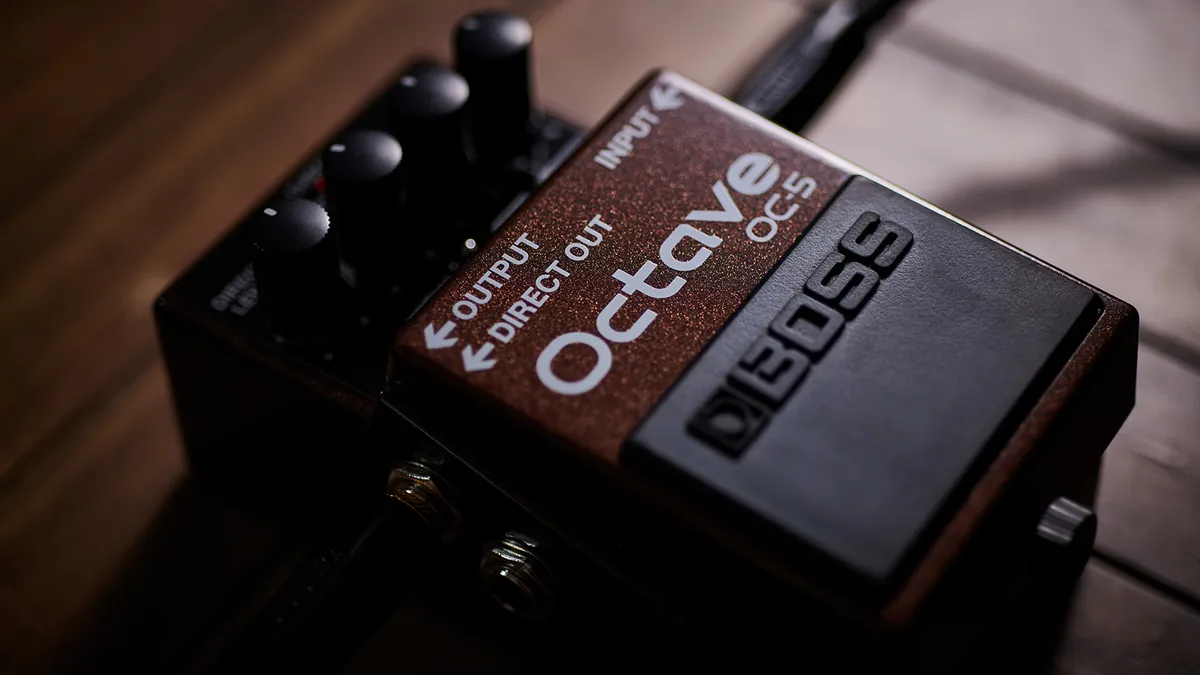
✅ Buy if you want some sweet vintage tones: The Boss OC-5 is a classic and is full of old school charm and a whole lot more.
❌ Avoid if you want a more feature-rich pedal: What’s here is great, but you may be a player who’s looking for a bit more from their pedal.
The original OC-2 is octave pedal royalty, and Boss knows it. The famous brown box was launched in 1982 and is still a reference tone for a huge number of bassists seeking their own perfect octave sound.
The vintage pedal is specifically referred to in the product blurb for the OC-5, whose Vintage mode is intended to give a ‘spot-on recreation’ of those sounds. But there’s also plenty of emphasis given to everything else this modern, high-powered version can do. For the first time, it boasts an octave-up setting as well as down, and the newly-enhanced Poly mode tracks multiple notes at once – with a setting even allowing the octave to be isolated to the lowest note in a chord. A Direct Out jack allows the dry and wet signals to be sent to separate destinations, for blended sounds.
There are several reasons I've selected the OC-5 as the best overall – its feature set and price-to-performance ratio is superb, it sounds great and tracks superbly, and being a Boss compact pedal, it’s housed in a legendarily durable, practical and space-efficient enclosure. In many ways, it’s the obvious choice – but that’s not to say you shouldn’t also consider some of of the alternatives I've picked out below.

"For too long, the OC series has been the unsung hero in the Boss catalog. For compact octave effects, it's unbeatable. It handles the conventional octave functions with ease, and in poly mode, there's some quasi-synth textures to discover."
Read more: Boss OC-5 review
Best budget

✅ Buy if you want an excellent pedal that doesn’t break the bank: The Sub n’ Up is a flexible and great-sounding pedal that has a ton going on under the hood.
❌ Avoid if you want bells and whistles from a standalone pedal: To make the most of editing, you’re going to have to get your phone or laptop involved.
TC's compact TonePrint form-factor is a bit of an institution in the pedal world at this point, having given us such classics as the Flashback delay and Hall of Fame reverb. The Sub n’ Up stuffs an awful lot of octave goodness into the format, offering (as the name suggests) both octave-down and octave-up sounds, with polyphonic capabilities too.
This is another pedal that’s equally pitched (no pun intended) at guitarists and bassists – but its digital engine is advanced enough that, even in the bass register, tracking is superb. And then, of course, there's the TonePrint feature. If you’ve used other TC pedals in the range, you’ll already know how impressive this is. You can load in external, often artist-developed settings, and the Sub n’ Up can take on amazing, synth-like modulated sounds, or a simple, perfectly dialled-in vintage octave tone, or anything in between. There’s a deep-editing facility for tweaking your own settings, too.
With all this considered, the Sub n’ Up punches well above its relatively small price tag (around $119 or £80). You can, of course, go cheaper still if you want – but why bother, when a pedal of this capability is available for this price.
"The pedal features a groundbreaking octave engine in polyphonic mode that allows fast and accurate tracking for complex chords and speed runs. But if you love the imperfection of monophonic analog tones, set the toggle to Classic to get some sluggish bass rumble."
Read more: TC Electronic Sub 'n' Up review
Best for beginners

✅ Buy if you want an octave pedal that's simple to use: Some of the pedals I've included in this guide are for more experienced players, but the M288 is easy to use straight out the box.
❌ Avoid if you’re more experienced and want more features in your pedal: Bass veterans may well want something more from their octaver – and this pedal might not fit their requirements.
This is far from MXR's first octave pedal. Their history with the effect is longer than most – going all the way back to the barely-usable, robotic fart generator that was the Blue Box of the mid-1970s. In fact, the Bass Octave Deluxe is far from the only octave pedal in the company's current line-up, too – but it's the one to go for, especially if you value simplicity and usability without the learning curve that some other octavers can present.
This is an all-analog circuit, excelling at fat, chunky retro sounds, and the controls are easy to get to grips with. The two tone controls are ‘Girth’ and ‘Growl’, for the octave signal’s low-end and midrange respectively – in other words, they do what they say on the tin.
Of course, it offers a dry level control for the all-important signal blend and, finally, there’s a button labelled ‘Mid +’ – no prizes for guessing that this is a midrange boost, letting the MXR slam its way through a dense mix with a serious push at either 400Hz or 800Hz (adjustable internally).
Overall, it’s not over-burdened with complex controls, and it’s intuitive to dial in. It won’t take long to get the Bass Octave Deluxe to sound great.
Best value

✅ Buy if you want a full-featured pedal for a good price: The T85's price belies its performance and is a seriously neat pedal.
❌ Avoid if you’re a newer player: With so many settings, new players might prefer a simpler option.
Laney’s amps have accumulated generations of fans, but their Black Country Customs effects range is a newer phenomenon. There’s been a steady stream of very interesting circuits, however, and in a solid, compact MXR-sized enclosure with British build – at pretty sensible prices to boot. This, The 85, is the company’s take on the octave pedal, and has clearly had the same level of thoughtful design put into it.
The 85 always provides a sub-octave sound as the foundation of its tone, with its own separate volume control. There’s more, though – a central mini-switch controls the pitch of the second added interval in the signal. Two octaves down, one octave up or, interestingly, a 5th up.
One presumes, then, that the ‘8’ in the pedal’s name is for octave, and the ‘5’ is for that 5th-up setting, which will make for instant power chords on every note you play. It's probably not a setting you'll use all the time (unless you're in a Blink 182 covers band), but it certainly has a lot of potential as a writing tool, and nothing else on this list short of the larger, more expensive Bass Whammy offers the option.
They don’t get quite the same attention as the biggest hitters in the market, but don’t sleep on Laney’s BCC pedals.
Best premium

✅ Buy if you want a truly versatile pedal: The Kaamos features both overdrive and octave in a single unit.
❌ Avoid if you're on a budget: The Kaamos is a great pedal, but all its tricks come at a price.
The Kaamos is the fruit of a collaboration between Darkglass and top-level session bassist Amos Heller – ‘fruit’ being the key word, owing to its punningly-named octave modes. ‘Sublime’, ‘Sublemon’ and ‘Subcitri’ offer three different voices, the latter being a polyphonic setting. Then, as befits a Darkglass product, we find a growling distortion circuit plucked directly from the well-liked Alpha Omicron drive pedal.
The octave can be set in series or parallel with the dry signal. The Kaamos even includes a built-in effects loop which can be shifted to different stages in the pedal’s circuit to allow for optimal positioning of different effects. Serious technical wizardry, then, but it’d be pointless if it didn’t deliver the sonic goods.
This is a Darkglass, though, so of course it does. All three modes have fantastic, defined and characterful sounds on tap, and there’s so much control over the octave signal that it’s practically impossible not to find the sound you’re after.
A serious investment but, in a slightly perverse way, one could look at the Kaamos as a value proposition. Overdrive and octave are two staples of most bass pedalboards, and here we find both in one reasonably-sized box. Add to that Darkglass's unfailingly accomplished quality in design and build, and it's really quite a package.
Most versatile

✅ Buy if you want a pedal that's a bit of a wild card: This is more of a box of tricks than a traditional octave pedal, but that just means you can have a load of fun cooking up new sounds.
❌ Avoid if you’re a traditionalist: This pedal produces some off-the-wall tones, so those looking for a more traditional approach should look elsewhere.
I was initially reluctant about including the Bass Whammy, as it's not strictly an octave pedal – but that's one of the sounds it does best, whether you want a traditional octave down, an octave up, or foot-controlled pitch-shifting madness. As wild cards go, they don't come much wilder than this.
Unlike other pedals in this guide, it doesn't have any form of blend control, the octave signal being blended in at a set level. For fully-wet effect sounds, though, you can scroll over to the pitch-shifting settings and enjoy the subterranean roar – and the expression pedal means that you can dive-bomb it down for effect, if you want. You can pitch your signal up to two octaves up or down, via useful scale intervals – 2nds, 4ths and 5ths.
It’s an absolute feast of possibilities, and with true bypass it doesn’t have the tone-coloration issues of older Whammy models. It also has a switch for ‘Classic’ or ‘Chords’ processing – the old, glitchy monophonic digital weirdness that became an early Whammy trademark, or a more modern and digitally-advanced polyphonic mode with excellent tracking.
With sturdy all-steel build quality, and a relatively sensible size and price for all its utility, it’s a compelling package.
How to choose an octave pedal?
If you’re in the market for an octave pedal but are new to the sound, think first about what sort of octave tones you like, and what will be the most useful to you. Have a listen to some well-known players or songs that use these effects, and get an idea of what you like and don’t like about the sounds.
From there, think carefully about how much you want to spend. Some players will use their octaver a lot, and some will find only limited uses for it – in the latter case, it’s probably not worth spending a fortune, unless you do have a very specific sound in mind that needs to be just right. At the same time, even if you’re leaning heavily on your octave sound, you may find that a relatively inexpensive pedal will do just fine.
As this round-up shows, you don’t have to break the bank to find an octave pedal that really does everything most players could ever need. Even the cheaper pedals here will be more than good enough for a pro-level board, with high-quality sounds and sturdy construction.
FAQs
Should I go for an analog or digital octaver?
This depends on what sort of sound you’re looking for. If you want a more lo-fi, old-school sound, analog will get you there. If you’re after a cleaner and clearer sound with more precise pitch tracking, digital is the way to go.
It’s worth bearing in mind, too, that many modern digital octavers are able to create a pretty convincing replica of an old-school analog tone, but you’ll never get an analog device to pull the same trick in reverse.
For many users, then, digital will be better value and more flexible.
Where does an octaver go in my signal chain?
Earlier is better. You want to make sure the octave pedal receives the clearest and strongest possible instrument signal, so put it near the front of your chain. If you have a compressor, try placing the octaver just after that, but before any drive or modulation effects.
How should I use an octaver for bass?
If you use an octaver for already-low notes, such as the first few on your bass's bottom E string, you’ll probably find that it sounds like a garbled mess. That’s because your speaker can’t accurately reproduce such low frequencies, which are getting towards the extreme bottom end of the human hearing range – your ears will be struggling with it too.
Generally, you should keep your exploits above C2 (the lowest C note on a standard-tuned four-string bass guitar), and then you’ll find just how great this effect can sound. It thickens up higher notes, and creates massive low-end when you’re playing around the middle of the neck.
Can I use a guitar octave pedal for bass?
Definitely – it won’t cause any problems and will usually sound fine; the technology is similar. While a good few of the pedals in this guide are bass-specific, there are also a few (including my top pick) that are designed to work equally well for guitar and bass, or have separate modes to optimize them one way or the other. Don’t be put off by this – a good octave pedal is a good octave pedal, even if it was designed to work with guitar too.
How we test gear at Guitar World
Here at Guitar World, we're experts in our field, with many years of playing and product testing between us. We live and breathe everything guitar and bass related, and we draw on this knowledge and experience of using products in live, recording and rehearsal scenarios when selecting the products for our guides.
When choosing what we believe to be the best octave pedals for bass, we combined our hands-on experience, user reviews and testimonies and engaged in lengthy discussions with our editorial colleagues to reach a consensus about the top products in any given category.
First and foremost, we are musicians and music fans, and we want other players to find the right product for them. So we take into careful consideration everything from budget to feature set, ease of use and durability to come up with a list of what we can safely say are the best octave pedals for bass available right now.
Read more about our rating system, how we choose the gear we feature, and exactly how we test each product.
Why you can trust us
☑️ A global audience of 3.8 million guitarists monthly
☑️ 1,200+ reviews on GuitarWorld.com
☑️ 30+ years of product testing at Guitar World
Guitar World boasts more than 44 years of expertise and stands as the ultimate authority on all things related to guitars. The magazine and website feature expertly written gear round-ups and top-quality, authoritative reviews penned by a team of highly experienced industry professionals.
Guitar World's inaugural print issue hit the shelves in July 1980, and ever since, it has been captivating players and enthusiasts with engaging lessons, insightful interviews with the biggest guitar heroes, and priceless buying advice for newbie players.
Furthermore, GuitarWorld.com continues this legacy online and serves as the hub of the world's foremost authorities on guitar playing. The site not only hosts content from Guitar World but also showcases articles from respected publications such as Guitarist, Total Guitar, Guitar Techniques, and Bass Player.
With a reach extending to 3.8 million players each month, GuitarWorld.com is a go-to destination for guitar fanatics globally.
Meet the expert

Connor Flys is a guitarist and bassist for everything from modern country to extreme metal, and the self-styled "supermarket own-brand Steve Lukather" in an acclaimed UK-based Toto tribute band. He is also an utter gear obsessive – with an ever-growing collection of guitars and pedals, and a faintly unsettling knowledge of Ibanez model codes.

