


When it comes to must-have pedals for bass guitarists, adding one of the best bass compressor pedals should be at the top of your list, next to a good tuner. Compression is crucial to getting your bass to fit into the mix, whether you're recording, playing with a band, or just jamming along to your favorite tracks in your bedroom, enabling you to deliver a more consistent performance.
Compression is one of the most misunderstood topics in all of music, and to be fair, it's quite hard to get your head around. In simple terms, compression evens out the dynamics of your playing. It makes the loud bits quieter and the quiet bits louder, which is especially necessary with an instrument as dynamic as a bass guitar. You can use compression subtly, just to tame the peaks of certain notes, or as a proper effect, completely squashing or crushing your tone.
If you are new to compression, I recommend you go for one of the simpler pedals in this guide to get you started. Something like the Electro-Harmonix Bass Preacher or TC Electronic Spectra Comp will be great for learning the ropes. If you already know your opto-comps from your FET comps, the Origin Effects Cali76 Bass Compressor is probably the most complete bass comp around at the moment.
If you're still wondering exactly what compressor to go for, have a look at our how to choose section, where I'll guide you through all the steps you need to take to make the right buying decision. I've also put together a comprehensive FAQ that answers loads of common questions.
Best overall

This pedal aims to replicate how a studio-style 1176 compressor would affect your bass signal, with some added clarity on that precious low end. It’s incredibly musical and very versatile, plus it’s built like a tank, so it’s impressively road-worthy.
Origin Effects are known for making some of the best effects pedals out there, and this bass compressor is up there with the best of them. This is a studio-grade FET compressor with fully variable input, output and ratio controls so you can dial in exactly the level of compression you want, as well as how it reacts with your volume. There’s also a dry knob that allows for parallel compression – this means you can blend in your clean, unaffected signal alongside your compressed sound for a more natural tone.
In addition, you’ve got a high pass filter that leaves your low end untouched, while compressing the top end. This helps keep those bottom strings sound nice and fat, whilst keeping everything else higher up more in check. Lastly, there’s a single attack and release knob which allows for easy sweeping through various settings for how quickly the compression kicks in and finishes. This is a superb bass compressor, adding more body and sensitivity to your tone, whilst retaining your natural dynamics and expression.
Best budget

Electro-Harmonix are one of the biggest names in the pedal game, so it’s only right that they have a unit dedicated to bass compression. The Bass Preacher is a compact pedal with two easy to dial in knobs and a three-way attack switch.
Having the different attack speed settings allows you to control how quickly it grabs your signal and affects it. So, whether you’re playing slap bass and want a quick attack, or playing with a plectrum and want some of that pick noise to come through first with a slower attack, then you’ve got all basses covered (pun intended).
This won’t take up much space on your pedalboard, and it does the job. It’s nothing fancy, but if you’re after something simple and easy to use with a range of applications then this is certainly one of the best bass compressor pedals out there.
Best for versatility

Featuring a blend of analog and digital technology, the Darkglass Hyper Luminal Compressor is functional, versatile and comprehensive, and affects your bass signal in a way that’s musical and dynamic, making it one of the best bass compressor pedals out there right now.
On board the Hyper Luminal Compressor you’ve got four traditional-style knobs for controlling the amount of compression, attack and release time, output volume and a blend for your dry signal. Then you’ve touch sensors that control the compression ratio and the mode. It’s the ability to change the compression mode that really makes this model stand out, as you can choose between BUS (modelled after an SSL bus compressor), FET (1176 style) and SYM (Darkglass’s old Super Symmetry compressor pedal).
Even if you don’t understand the differences between these various compression styles (and it really isn’t crucial that you do), it’s nice to have slightly different flavors of compression available at the touch of a button.
Best for transparency

If you're looking for a bass compressor that won't color your tone and gives you plenty of options for tweaking, the Empress Effects Bass Compressor is hard to beat. This fully featured unit gives you lots of options but stays out of the way in terms of tone.
We love the metering on this pedal, with 10 LEDs that show you both gain reduction and input gain levels. There are plenty of controls for sculpting your sound too, whether you want something subtle or you want to make things really squishy. The ratios might be a little selective for some, but for most players, there are plenty of options here.
The sound of the Empress Bass Compressor is simply sumptuous. It'll make your low-end super fat and chewy with the right settings, and it always remains super transparent, keeping your original tone intact. There is an option to add some coloration via the switchable circuit, although it does add an EQ bump too.
Best compact

The Dyna Comp is somewhat of a legend within the world of compressor pedals, and the bass version lives up to that legend. Super compact, with a range of controllable parameters that make it easy to dial in your desired sound, the MXR M282 has it all, making it one of the best bass compressor pedals on the market.
This compressor is built around a CA3080 circuit that is known for having a good dynamic range and being transparent, meaning your inherent tone shines through.
What we really like about this compressor is the clean knob which lets you blend in your dry, unaffected signal as much or as little as you want. With this, you can get a nice, heavily compressed sound, then dial in some dry signal so that it doesn’t sound too squashed. The attack switch lets you choose between a slower, more vintage style attack and a quick, modern attack, making it ideal for pretty much any style of bass player.
Best for beginners

This one-knob bass compressor manages to apply studio-grade, multi-band compression to your bass signal, whilst acting as one of the easiest to use pedals out there. If you want something that’s super simple to set up, without having to really get into the ins and outs of compression, then this could be the best option for you.
Whether you want a little or a lot, the TC Spectra Comp applies compression equally to your low, mid and high frequencies so your tone is balanced, punchy and sustains when you need it to.
As with many of TC’s pedals, the Spectra Comp is equipped with Tone Print technology allowing you to dial up some pretty big artists’ carefully tweaked signature settings with your smartphone, meaning that there’s actually quite a bit more packed into this tiny pedal than you might think.
More options...
How to choose
If you're here looking for your first bass compressor pedal, then this is where you need to start. I've been playing in live bands and engineering and producing bands for over 20 years now, so I've come across lots of different bass players with differing styles that require particular treatments. Here's what you should be looking at before you buy a bass compressor pedal.
1. Compression 101
You can trust Guitar World Our expert reviewers spend hours testing and comparing guitar products so you can choose the best for you. Find out more about how we test.
First of all, we need to understand what compression actually does to a bass guitar, and why it's so important. Compression narrows the dynamic range of your instrument, which in simple terms means it makes the louder bits quieter and the quieter bits louder, which results in a more even performance.
Because low end frequencies require a lot more power to move them, if you don't control them they can completely take over a live performance. You'll often hear this in local venues which are smaller, where the bass ends up completely dominating the sound of the performance. By adding a compressor to your setup, you get the following:
Low end control: A compressor 'glues' the low end together, which means all the notes hit with the same volume instead of the lower stuff being much louder than your higher pitched notes.
Better sustain: As a compressor evens out loud and quiet, it can also make your note sustain better, lifting the volume where the note would ordinarily die out.
A level mix: By using a compressor you're giving your live sound or recording engineer a much more predictable signal, which makes it easier for them to deliver a better sound to your audience.
2. Playing technique
Your core playing technique is also a part of deciding which compressor to go for. There are three primary techniques for bass, slap, fingerstyle, or using a guitar pick. Here's what you should look for depending on your preferred technique:
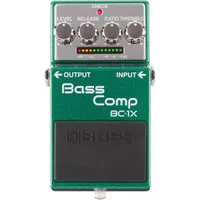
Slap players: Slap playing results in a lot of dynamic range, and some huge spikes in volume. To compensate, look for a compressor with a fast attack time, so it clamps down on those spikes quickly. Look at the Cali76 or Boss BC-1X in this guide for a good match here.
Fingerstyle players: No matter how good a player you are, using your fingers inherently means there will be different dynamics in your playing. For this playing style, you'll want a smooth, optical compressor like the Diamond Pedals Bass Comp or Ampeg Opto Comp, which will allow you to tame the peaks, but keep the natural feel of your playing style.
Pick players: For playing with a pick, you want to keep that initial attack, but get something that helps with the sustain, which can die out quicker due to striking the string harder. The Darkglass Hyper Luminal or EHX Bass Preacher are great options for that.
3. Genre
Last, but not least, you should think about the style you'll primarily be playing in. Different genres expect different levels and types of compression. There's no hard and fast rules here of course, because breaking these genre type rules can give you a more original sound, but here's what people typically expect from the most popular genres of music.
Rock & metal: You'll be competing with loud distorted guitars here, and you want to form a cohesive whole with the guitarist(s) to deliver that huge sound required from rock and metal. VCA or FET compressors are particularly well suited to these styles, like those from Darkglass or MXR, and get you that punchy and aggressive bass tone.
Funk, pop, R&B: For these styles, the typical bass tone is one that is very tight and rhythmic. You'll want a compressor that can really squash your sound with a fast attack, but ideally has a blend knob so you can mix some of the more organic tone back into it.
Jazz and blues: For these styles you'll definitely want a transparent, studio style compression. There's a couple in this guide like the Cali76 and Empress Bass Compressor that will deliver a nice, even playing performance without coloring the tone too much.
FAQs

Where does a bass compressor go in my signal chain?
For most players, a bass compressor pedal should be the first pedal in your chain. The only real exception to this rule is if you're using a wah or filter pedal, in this instance you should place your compressor after that, but before everything else.
Can I use a guitar compressor on my bass?
You can, but a lot of guitar specific compressors cut off the low end to help improve the overall clarity. If it's your only option then go for it, but I would always advise using a bass specific compressor for bass guitar, as it's designed to handle the low end frequencies in a specific way.
What are the different types of compressor?
Different compressors use different methods to even out your playing dynamics. These are some of the most popular ones you'll come across:
Optical (Opto): Turns your audio signal into light, passing it through a resistor which then determines how much compression is applied. Use one of these for a smooth, musical type of compression great for fingerstyle players.
VCA (Voltage Controlled Amplifier): This is the studio type compression that's very transparent, great for adding control without being immediately obvious.
FET (Field-Effect Transistor): This is another studio style compressor that adds a bit of grit to the sound, making it a great match for rock players. The classic 1176 studio compressor is a FET type comp.
Do I need a blend or mix knob?
It's not a necessity, but for bass players it can be a very useful thing. When blending a compressed signal with a dry one, you're performing something called parallel compression which is used a lot of engineering and production. Doing this adds a sense of control to the overall sound, whilst still retaining some of the dynamics of your playing.
What's the difference between running a pedal at 18V and 9V?
When you run a pedal at 18V, you get more headroom, which means the pedal can handle more volume. This is especially useful if you're using a bass with active pickups, as their output can be particularly hot. Running a pedal at 18V means you're less likely to 'clip' it, avoiding any unwanted distortion whilst still being able to crank the volume.
Is using a compressor cheating?
No it's not. Every bass tone you've ever heard on any great record for the past 50 or 60 years has been compressed to some degree. Learning to play with a compressor is par for the course for any bass guitarist, and learning to use one is just the same as learning good technique, how to EQ your amp, or arrange your pedals.
How we test
Here at Guitar World, we are experts in our field, with many years of playing and product testing between us. We live and breathe everything guitar-related, and we draw on this knowledge and experience of using products in live, recording and rehearsal scenarios when selecting the products for our guides.
When choosing what we believe to be the best bass compressors available right now, we combine our hands-on experience, user reviews and testimonies and engage in lengthy discussions with our editorial colleagues to reach a consensus about the top products in any given category.
First and foremost, we are guitarists, and we want other players to find the right product for them. So we take into careful consideration everything from budget to feature set, ease of use and durability to come up with a list of what we can safely say are the best bass compressors on the market right now.
Read more about our rating system, how we choose the gear we feature, and exactly how we test each product.
Related buying guides
- These are the best guitar tuners
- Best short-scale basses: the ultimate guide
- Check out the best cheap guitar pedals
- Best bass amps for practice: top combos for home use
- Take a look at the best bass guitars

