


Last month, we explored legato phrasing techniques with a look at those I use in my solo in the Testament song So Many Lies. To recap, the term legato means “smooth and connected,” and, on the guitar, legato phrasing can be achieved via the use of such techniques as hammer-ons, pull-offs and finger slides, which can be used instead of picking to articulate notes.
Another solo of mine that features legato phrasing, and, additionally, fretboard tapping, is the one I play in The Pale King, which I recorded with Testament for 2015’s Brotherhood of the Snake. On the recording, the guitars are tuned down a half step, but for this lesson my guitar is in standard tuning at concert pitch.
The use of tapping in this solo was inspired by Eddie Van Halen, but, as was the case with my solo in So Many Lies, my overall legato phrasing approach here was informed by the brilliant style of Allan Holdsworth.
Figure 1 illustrates the initial fretboard shape that kicks off the first phrase of my solo in The Pale King. Played over a Bm chord and on the 1st string in 7th position, the notes B, D and E are fretted with a double hammer-on, followed by a high A note that I tap with my pick-hand middle finger. These notes reference the B minor pentatonic scale (B, D, E, F#, A).
Figure 2 shows the complete opening lick. I begin by tapping the high A note then pull-off to E, D and B, followed by a fret-hand “hammer-on from nowhere” to A on the B string’s 10th fret. On beat 2, I move the five- note sequence over to the B and G strings and use the same shape, with the slight variation of ending on the G string’s 9th fret (E). I then repeat these 10 notes on beats 3 and 4.
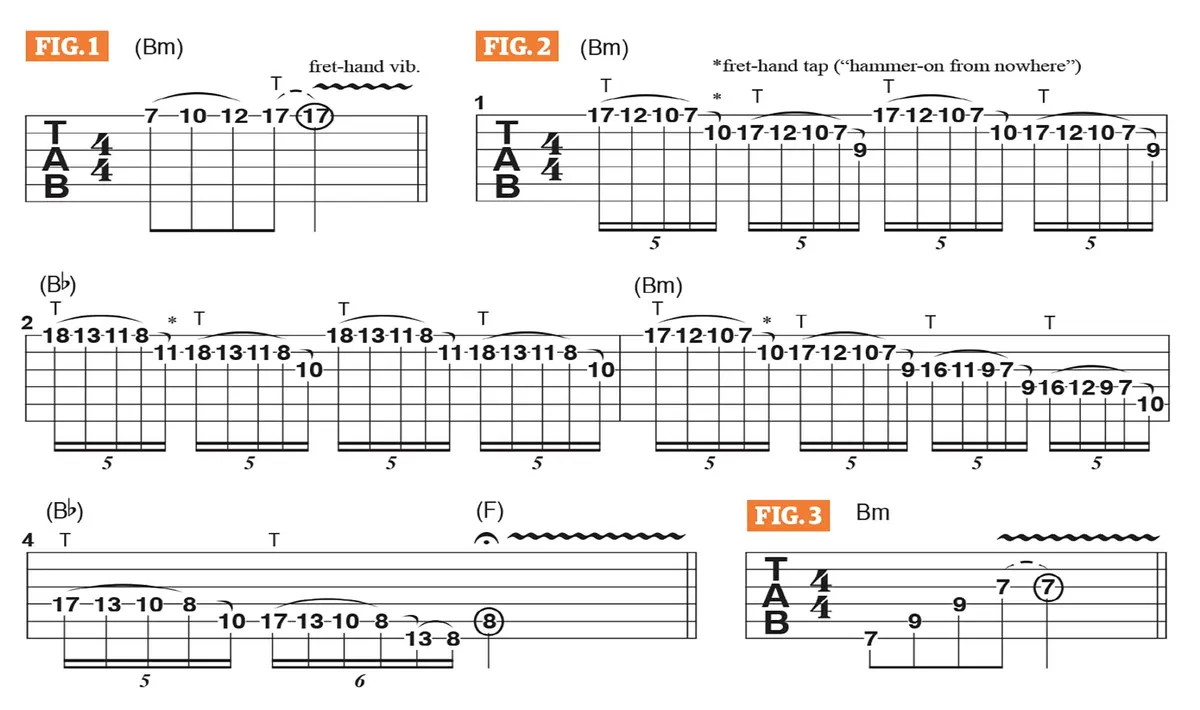
In bar 2, I play the very same thing one fret higher, as if I were transposing it to C minor pentatonic. But the backing chord here moves down to Bb (major), which completely changes the intervallic relationships between the notes and the chord.
Going back to Bm, bar 3 begins with a restatement of the initial B minor pentatonic phrase, but here I continue to descend through the scale on beats 3 and 4, moving over to the G and D strings.
The phrase ends in bar 4 with tapped lines based on Bb across beats 1 and 2, followed by an F half note that sustains through beats 3 and 4.
Figures 3 and 4 outline the backing Bm and Bb chords, played as arpeggios.

Figure 5 focuses on the individual solo notes played on the 1st string, and Figure 6 illustrates this specific pattern played repeatedly, which offers a great way to develop good fret-hand legato “traction.”
Make each hammer-on and tap quick and firm, and, when pulling-off, flick the string downward.

During the solo, I do the “hammer-on from nowhere” onto the A note on the B string’s 10th fret, as demonstrated in Figure 7.
Figure 8 offers a an effective way to practice the beginning of the solo and get your tapping motor running, by simply moving the same tapped pattern across the top two strings.

Next month, I’ll break down the shift to the phrases I play over the Bb chord, as well as how this riff culminates on the low F note.
- This article first appeared in Guitar World. Subscribe and save.
