

Last month, I began describing my approach to layering and overdubbing complementary guitar parts, using the Blackberry Smoke song Morningside, from our 2021 album, You Hear Georgia, as an example.
This time, I’d like to continue detailing the way I arranged complimentary guitar parts in this song, specifically during its solo section.
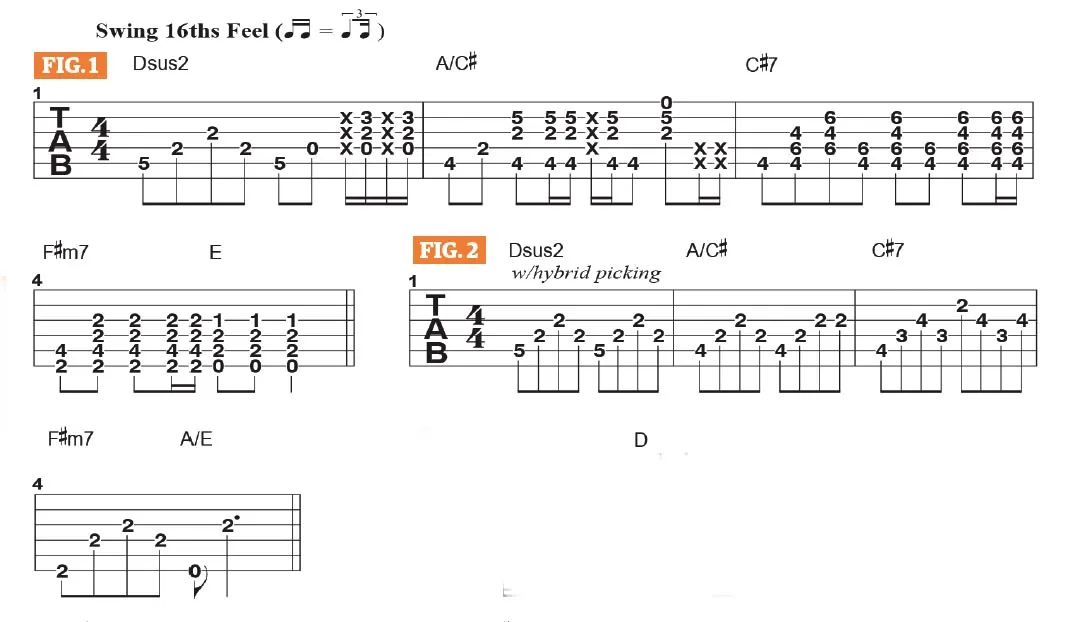
Figure 1 shows the rhythm part behind the solo. I begin by arpeggiating a 2nd-position Dsus2 chord voicing, allowing the notes of the chord to ring together, followed by an alternating “low string/high string” approach for the subsequent chords, A/C#, C#7, F#m7 and E.
I love the challenge of making multiple guitar parts work together, especially if it’s not a “big riff”-type of song. I like the sound of the single-note arpeggiations and smaller chord voicings here, as this approach serves to leave more sonic space for the featured solo guitar.
Musically, this song meanders a bit, so we needed an orchestrated approach between the guitars and keyboard to make everything work well together. When we get to the guitar solo section, Benji Shanks plays the first solo, I play the second, and then Paul Jackson and I play harmonized lines to close out the section.
It’s so much fun to put these different parts, played by different guitarists, together; it’s sort of like a football or basketball team, because there are so many of us! There have been a variety of great three-guitar bands over the years, and, like the best team players, Benji and Paul are so good at staying out of each other’s way.
During Benji’s solo, I arpeggiate the progression Dsus2 - A/C# - C#7 - F#m7 - E, allowing all the notes of each chord to ring together, as shown in Figure 2.
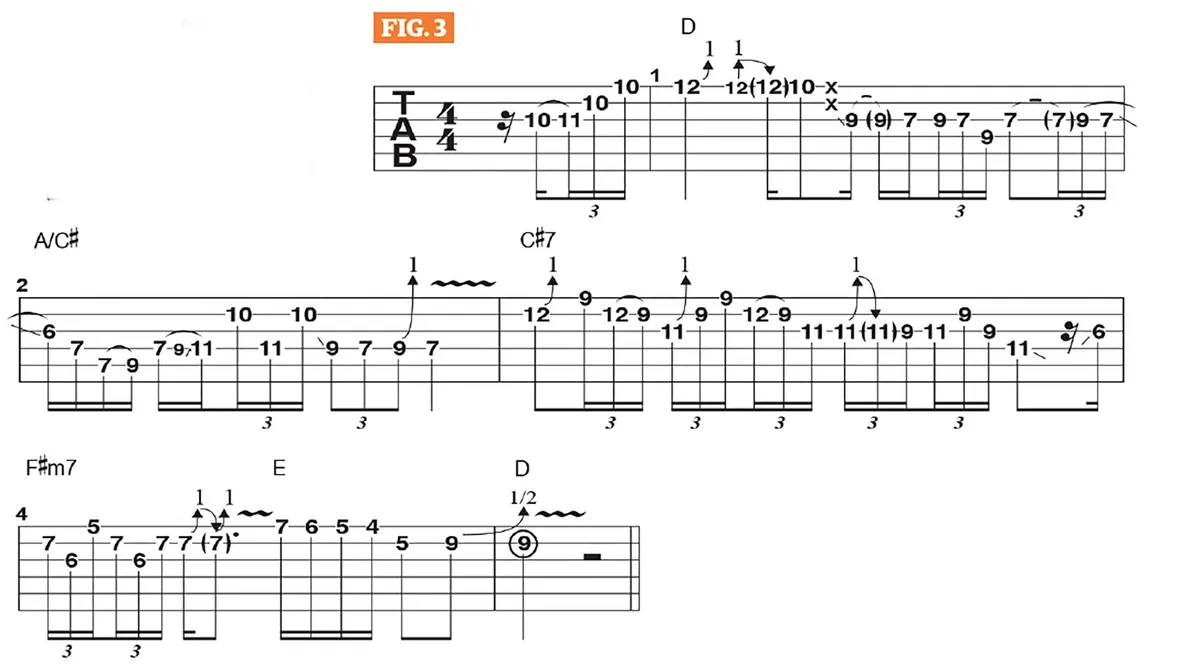
Figure 3 presents my solo. Over D, I begin by playing the notes of an ascending D major triad — F#, A and D — in 10th position, followed by lines based on the D major pentatonic scale (D, E, F#, A, B). Notice the reverse rake and slide at the end of beat 2 into beat 3. Over A/C#, I rely on A major pentatonic (A, B, C#, E, F#) and play 6th intervals between the notes A and C# on the upbeat of beat 2.
Over the following C#7 and F#m7 chords, I stick with the tried-and-true blues-rock approach of playing notes from C# minor pentatonic (C#, E, F#, G#, B) and F# minor pentatonic (F#, A, B, C#, E), respectively, bringing in chromaticism (notes half steps apart) over E into the return to the tonic, D.
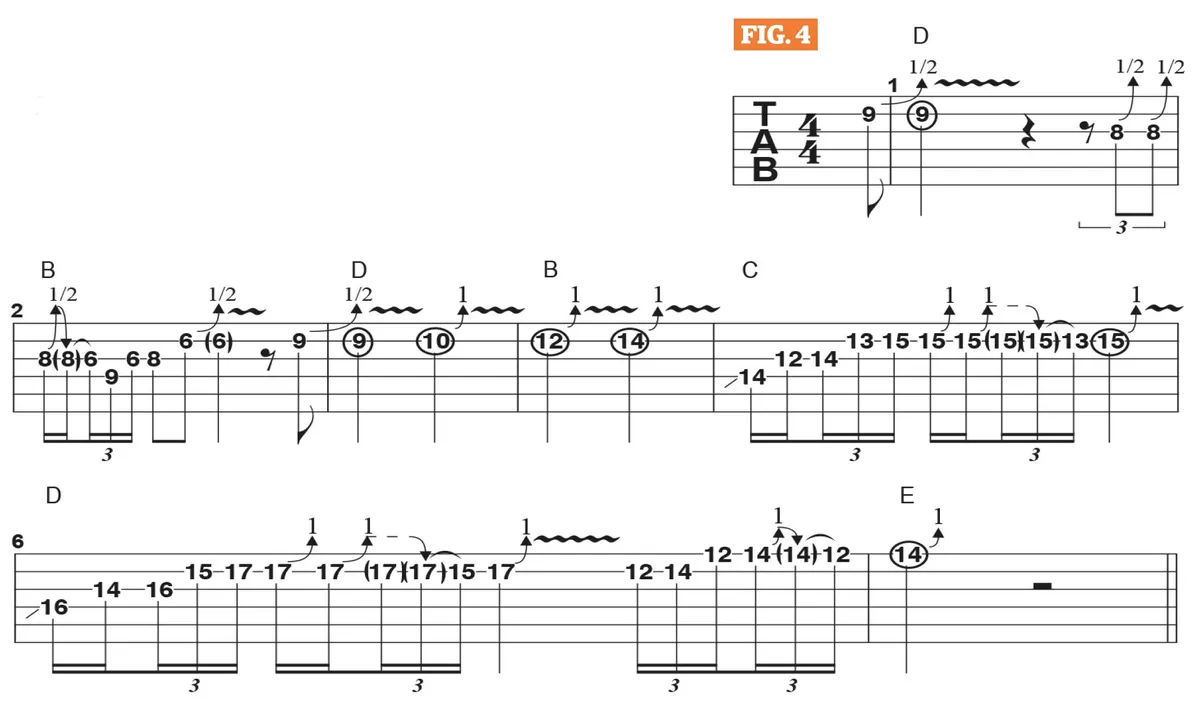
Figure 4 shows the part I play for the harmonized solo, where Paul plays the main melody line and I play a harmony to it. In bars 1-4, the progression alternates between D and B, so my lines target the triadic chord tones: D, F# and A for the D chord and, for the B chord, B, D# and F#.
The section ends with a twist in the progression, of C to D to E, and here I simply rely on notes from C major pentatonic (C, D, E, G, A), D major pentatonic and E major pentatonic (E, F#, G#, B, C#), respectively.
Altogether, these myriad guitar parts weave a wide musical picture that serves to bring the song to an entirely new place before returning to the pre-chorus section.
- This article first appeared in Guitar World. Subscribe and save.
