


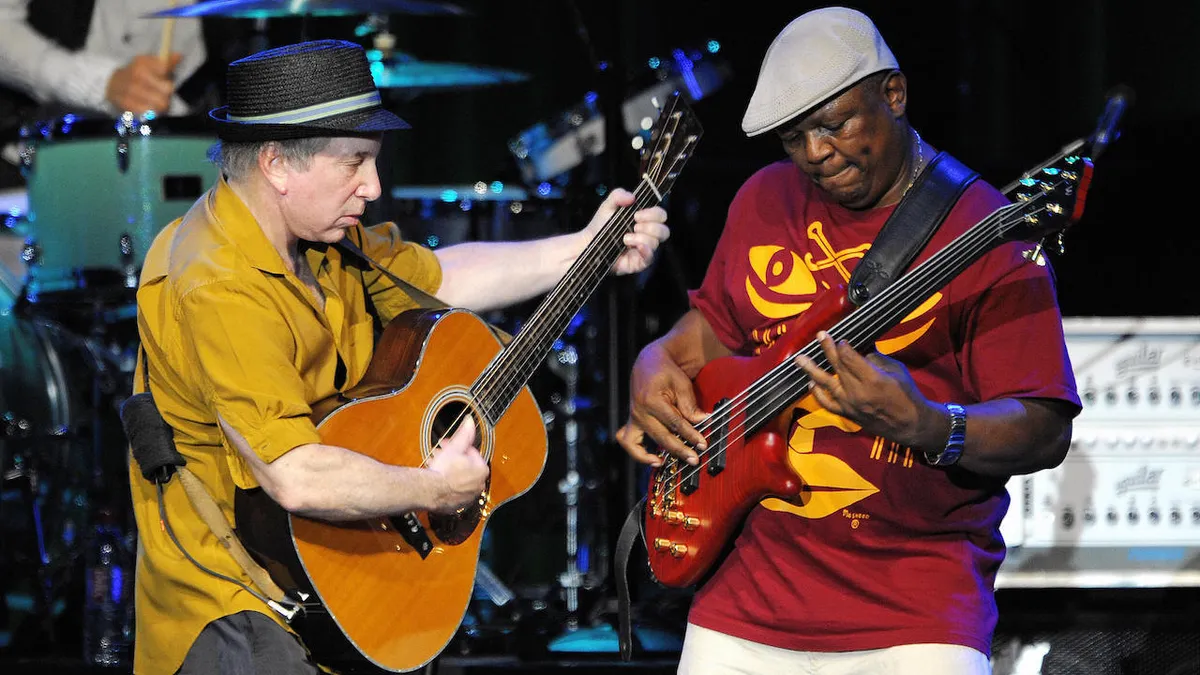
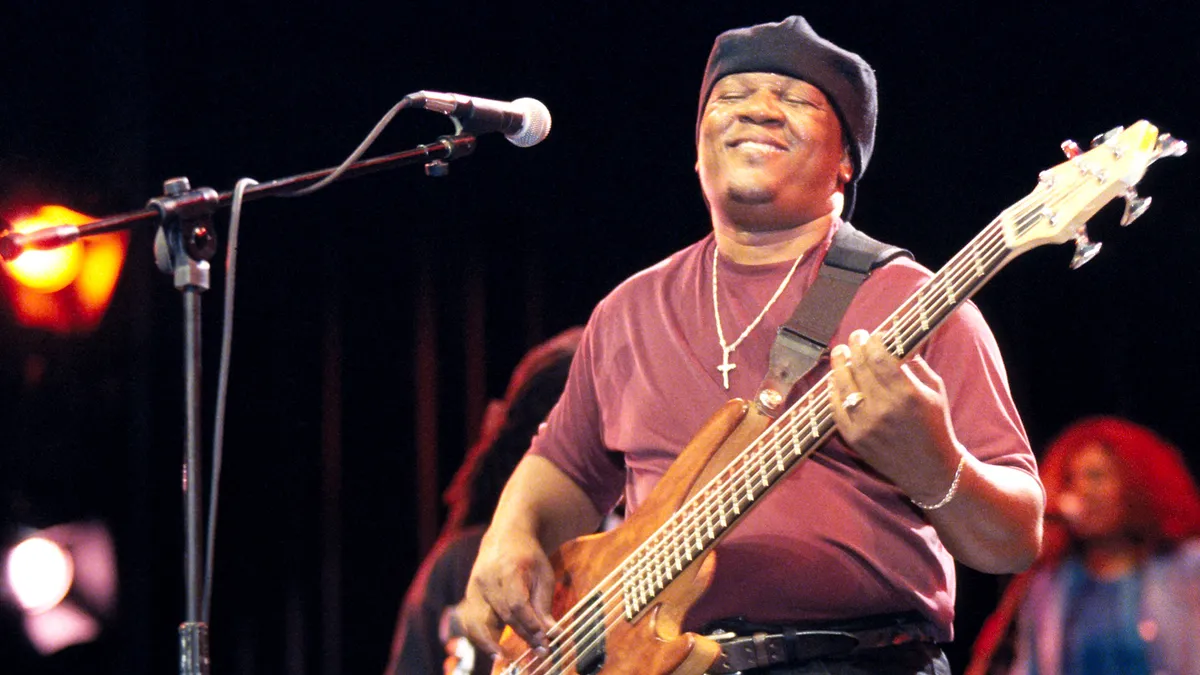
Since his groundbreaking bass work on Paul Simon’s Graceland, Bakithi Kumalo’s unmistakable fretless tone on classics like The Boy in the Bubble still stands as a pitch-perfect example of bass playing beyond the American tradition.
As noted engineer Roy Halee remarked in Sound On Sound magazine, “Oh, man – that bassline is off-the-wall great.”
Raised in Soweto, South Africa, Kumalo grew up surrounded by church music. His uncle had a big band that played Count Basie and Duke Ellington, but it was the traditional music he heard on the streets, in the countryside of Zululand, and at the clubs of Zimbabwe that made the deepest impression.
“Other bass players would rather play blues and jazz, but I wanted to learn South African music, the music that the government was hiding,” Kumalo told Bass Player back in 2017. “I grew up hearing James Jamerson, but in the township, I'd see all these people playing a South African style of bass and it was amazing.”
The lure of a good bass and steady gigs enticed Kumalo to join an 18-month show band tour of Zululand, in the remote province of Natal, with cover band the VIPs.
“We played schools and hospitals and prisons, and it was very rough. And since there weren't any supermarkets, either, we ended up not eating much – just living on bread and oranges and sugar cane.”
It was on this barebones tour that Kumalo made a radical change in his playing technique. “Before, I was playing everything with my thumb; my uncle's bass player used a pick, so I had never seen anybody play with his fingers.
“Then I dreamt of somebody playing bass with his fingers, so the next morning I tried it. It was a bit difficult, but I worked on it. That dream saved me.”
Kumalo’s welcome home from Natal was almost as rough as the tour. “My mother could hardly look at me, because I looked so bad from being on the road so long. She said, ‘You have to get a regular job. If you go back to play music one more time, you're not staying in my house!’ Luckily, some of my friends called with some recording work. That's when the whole thing started.”
Kumalo soon found himself in demand throughout Soweto. “I was really happening! I did a lot of local records and got involved in studio work. I was playing 12 songs a day, for about 10 rand a track – which is about five dollars!
“There were a lot of studios where they liked my playing, but the other bass players really hated me; I was so young and everybody wanted to work with me. Most of the bassists I grew up with lost work. But I just wanted to play.”
What kind of music were you playing with the VIPs?
Mostly soul, but also traditional music, I-IV-V and IV-I-IV-I-V grooves. Once in a while, we'd hear a song like Have You Ever Seen the Rain or Mother and Child Reunion on the radio, and even though we didn't understand the words, we'd pick it up and make our own thing. We got an offer to go to Zululand, and that was the beginning of my journey.
How was that first tour?
It was rough. The bass strings broke, and I had to tie them together. Then I would forget and slide up and down the strings, cutting my fingers and getting blood all over the bass. After a while, our car broke down, but there was no phone and I couldn't write to my mother. I got stuck for 16 months in the middle of the bush. I was terrified that I was going to die there.
How did you get home?
I stopped a car on the road to Johannesburg and asked for a ride. When I got home, I had chickenpox because I had only been eating sugarcane and oranges. My mother didn't even recognize me; she thought I had died.
How did your career continue when you got back?
I didn't have a bass, so I took a piece of cardboard, cut it like a bass, and drew strings and frets on it. I'd play that piece of cardboard when I heard a song on the radio. Between that and rubber bullets flying all over the place, it was a struggle, man. I was scared to death. But music was always the thing that I felt was going to save me. I was very lucky that I got a gig at Gallo Records right around the time my mother bought me a fretless, in 1982.
The one you later used with Paul Simon?
Yes, the Washburn. I got it right before I went on a tour to Zimbabwe. Man, I was in heaven with all that Zimbabwean music!
Were you consciously integrating tribal music into your playing?
In the studio, I worked with all the different tribes – Shangaan, Ndebele, Tswana, Sotho, Pedi, Xhosa – because they knew I could listen and follow.
Even though that Zululand trip was rough, I learned so much by being around people working in the fields and singing in the countryside. When I came back to the city, I was loaded with information about our music, and I loved it. I didn't want to play anything else.
You represent a distinctly South African style of bass, which is so different from Cameroonian and Nigerian bass.
Vincent Nguini, a great guitar player from Cameroon, explained to me that Cameroonian music is all about the ceremonies. Sometimes it's in 9/8 or other rhythms – it depends on the ceremony.
In Nigerian music, the bass part is based on the talking drum, the same way that in Brazilian music, the bass plays the surdo part, which then takes a different part of the groove. The bass should be the support, the heart of the music.
Which South African bass players had an impact on your playing?
Joseph Makwela was the first person I saw playing electric bass. He was a mbaqanga guy – he played with Mahlathini and the Mahotella Queens – and he played melodies up high, which was a big influence when I picked up fretless.
Sipho Gumede, who toured with Letta Mbulu and Caiphus Semenya, top South African artists who had left during the struggle, taught me a lot. Sipho would say, ‘Before you play a bunch of notes, get your tone right, and then everything's going to be easy and simple.’
How can someone develop a style as distinctive as yours?
Don't spend time trying to play stuff that's already been created. Go research all kinds of music to come up with something, and don't be stuck on one thing.
I listened to the left hand of the accordion guy; in Zimbabwe, I listened to the mbira. My part on Diamonds was a little piece I took from the guitar. I had no idea that I might have a voice someday. I was just playing the way I was playing, but Graceland created the voice. So I stayed with it.
