

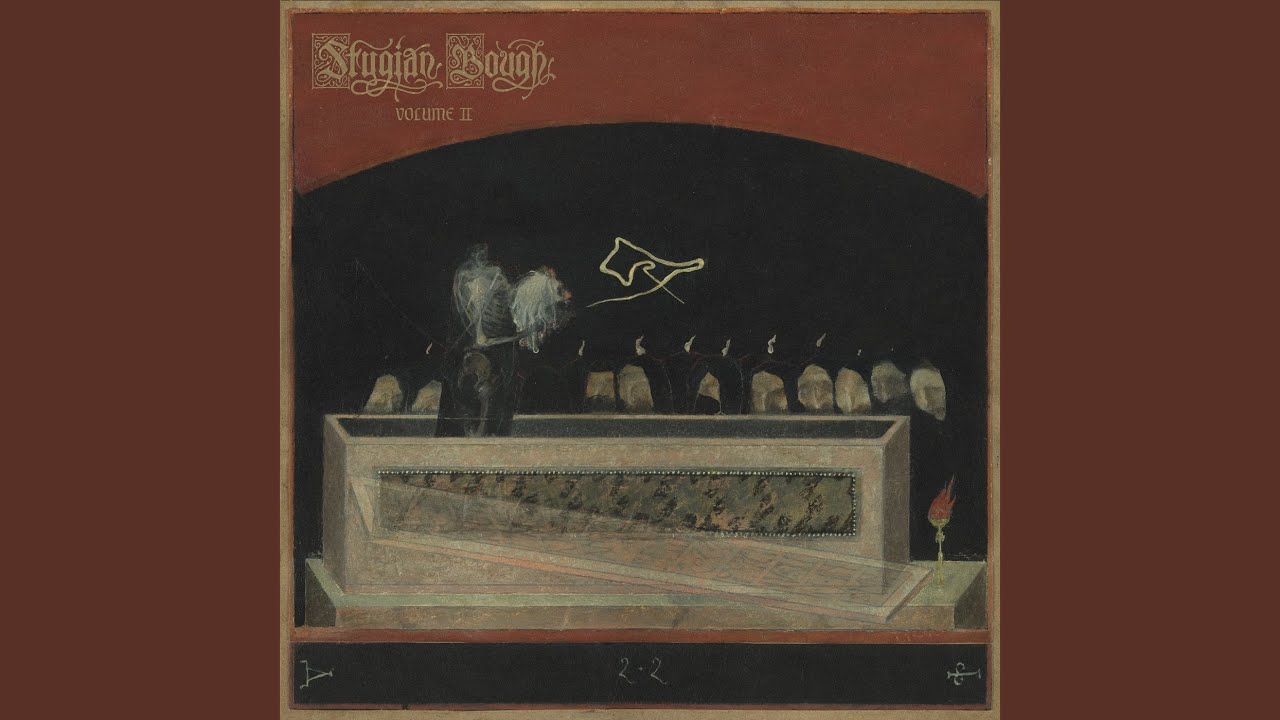
Stygian Bough bassist and vocalist Dylan Desmond says there are some unexpected influences on their new album, Volume II. “I felt we were doing a weird mash-up of Thergothon or Mournful Congregation with the guitar harmonies of Thin Lizzy,” he says. “We wanted to focus on key moments, building drama with those melodic lines.”
Desmond has been half of funeral doom duo Bell Witch since 2010, wielding an Ibanez 7-string before a wall of tube amps. Their breakout third album, 2017’s Mirror Reaper – consisting of a single 84-minute track – distilled their sound: mournful, musically complex and very heavy.
After founding drummer/vocalist Adrian Guerra had left in 2015 (passing away the following year), Erik Moggridge of Aerial Ruin stepped in to contribute Mirror Reaper’s remaining vocals. That sparked further collaboration under the Stygian Bough moniker, with Volume I released in 2020.
Desmond admits that incorporating Moggridge’s guitar was initially a challenge. “In Bell Witch I’m always trying to fill out the whole spectrum, even in the shrill highs,” he explains. “Erik and I were staring at each other in the studio, wondering, ‘Where does the guitar even fit?’
“If I had a riff or melody I’d give that to Erik, then I’d add a counter melody. Or sometimes the simplest thing was for Erik to play an octave or two up, so he didn’t compete with the EQ where the bass sits.”
The evolution of Desmond’s two-handed tapping bass style was mostly by chance, he reports. “My dad was a guitar player. I instantly didn’t want to play guitar because I secretly did want to! He advised me: ‘Everyone always needs a drummer or bassist.’”
Desmond’s first 6-string was bought off a friend, who claimed people only buy them to look cool, and never use them. “He told me I couldn’t even play that thing – so I had to learn the 6-string to prove him wrong!
“I've always approached the bass guitar with the idea of recreating a bass/dual guitar trio on one instrument. I play the bass lines with my left hand and tap melodies on the right, similar to a piano or Chapman Stick.”
He cites US guitarist Michael Hedges as a major influence: “He played a harp guitar and did all this two-hand tapping that was so cool. Sometimes it would sound like there were four guitars. He’s a wizard.”

Desmond now plays an Ibanez BTB747, but explains the difference is more than just the presence of a seventh string. “There’s nitro or methamphetamine in those pickups!
“They’re essentially the same model – neck-through, same wood, pickups and strings – but the 7 screams through the amps and notes really sustain in ways they don’t on the 6. Maybe it’s a pickup upgrade or the extra wood on the neck, but it feels like a little magic trick between the two.”
Another key to his sound is his triple-amp setup, featuring two guitar tube amps. “Originally, like everyone, I just used an SVT,” he says. “Then the guitarist from my band before Bell Witch was selling his gear, so I thought, ‘Why not?’
“I thought if I could fill out as much of that tonal EQ territory as a guitar, it would be fun and challenging. Having the guitar amps makes everything sound so thick. The overtones hit different compared to one amp, especially with different effect chains, and two reverbs or modulations going.”
To balance those chains, he uses a custom ABCD splitter/effect loop. “I had my buddy Brian Sours build me a Phase Linear Distribution Amplifier, made to isolate and distribute signal between four outputs and a DI from one input.
“I split my signal into an SVT II for low frequencies, a 70s Ampeg V4 for mids, and a Verellen Loucks for upper-mids and highs. The SVT has a Perestroika muff, while the other two have a Benedict B1 and Pig Mine distortion, with modulation and reverb from BlueSky, Strymon and Chase Bliss.
Solid-state amps don’t grip the note or work with my tapping. Tube amps can handle all that information
“The two guitar amps combined with different modulation patterns create a ‘doubling’ or ‘dual mono’ effect in the mid and high frequencies. Magic can happen in a live performance – like one amp falling into feedback while the other sustains a fretted note.”
Despite an impending US and EU tour with he hefty rig, Desmond isn’t tempted by digital or solid-state alternatives.
“What I’m trying to do with Bell Witch and Stygian Bough is long-sustained dramatic cliffhanger notes,” he says. “Solid-state amps just don’t grip the note or work with my tapping. But tube amps can handle all that information from the pickups.
“And carrying around big heavy shit is part of the deal. Catch me in 20 years, I might say different – we’ll see!”
- Stygian Bough: Volume II is out now on Profound Lore Records.