


For most modern music fans, the mere mention of Swinging London usually inspires Austin Powers-like visions of mini skirts and Nehru jackets, psychedelic-coloured Rolls Royces, and hobnobbing pop stars. But surely that's just a hagiographic dream, right? It couldn't possibly have been as groovy as all that.
“Actually, it was exactly like that,” the late John Lodge told Bass Player back in 2017. “Music and fashion came together. There was Carnaby Street and King's Road. The place was alive, and clubs were everywhere.
“You'd walk into the Speakeasy Club, and there'd be George Harrison and Paul McCartney at a table. Stevie Winwood would be there. The Stones would come around. The Moodies went there, too, of course.”
As bassist and co-vocalist for the Moody Blues since 1966, Lodge had a VIP seat for the era that briefly made London the capital of cool.
“Each week it seemed as if there was something new going on, or one of the bands was the first to accomplish some new feat.
“I remember going to Chas Chandler's apartment one night, and he played us the first Jimi Hendrix album. And I remember Mick Jagger having the first stereo system in his car; we couldn't believe it. It was a magical time.”
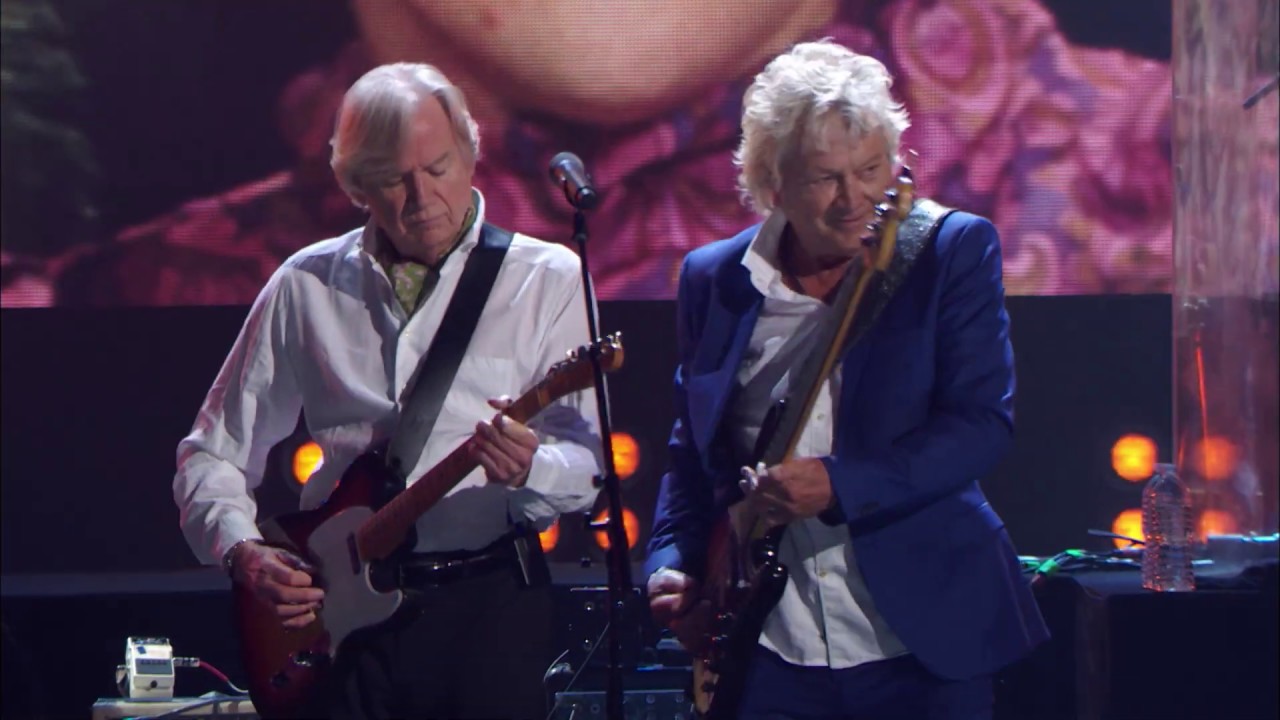
Always a fan of Fender guitars, Lodge played a double-neck for many years that was half P-Bass/half Telecaster. “There are songs like Isn't Life Strange? and One More Time to Live in which I play acoustic guitar and then, halfway through, I change to bass guitar. So I said, ‘How can I do this? Can't it be easier?’
“Rickenbacker had a double-neck guitar and bass, so I bought one of those and played it onstage. Then Fender came to me and said, ‘Why are you playing that?’ I said, ‘Because Fender doesn't make one.’ So they did! It's really something else, and yes, it is as heavy as you might think. The thing weighs a ton.”
You started on the guitar and then switched to bass.
That's right. Music came to me very late. I was probably 11 years old when I saw The Girl Can't Help It, and that changed everything for me. I had thought of being a footballer, but seeing that movie fixed all that. When I saw Little Richard and Gene Vincent, I thought, 'That's it ... I want to play guitar.’

I started on this very cheap thing – it went for two pounds and 10 shillings – but as I'd listen to jukeboxes, I noticed that all the songs had these rhythm parts that drove the music. It wasn't the guitar; it was the piano playing by Fats Domino, Little Richard, and Jerry Lee Lewis. And there was always something driving the songs, and I knew it wasn't a double bass. I couldn't figure out what it was.
Then a group called the Treniers came to England – they'd been in The Girl Can't Help It – and I went to see them in Birmingham. I could see this guy playing what looked like a white Stratocaster. I looked closer and saw it had four strings.
I went to my music shop, and they had a bass called a Hofner President. It was a blonde semi-acoustic. So I bought that, and I learned all these riffs from Little Richard and Jerry Lee Lewis and Fats Domino.
And then James Jamerson became a big influence on you.
Definitely. I got into Motown and the Philly sound. I heard James Jamerson really driving those records, and I started to learn all of Jamerson's basslines, and it was a revelation. You didn't have to play the root notes. You could play non-root notes on the chords and change the whole picture of the song.
Unlike Jamerson, you decided to play with a pick.
I did, yes. I always liked the sound of a cello, and I wanted to combine that sound with the type of playing Jamerson did. For me, using a pick was the only way to do that. I needed that click for playing arpeggios on the bass. Songs like Tuesday Afternoon and I'm Just a Singer are a cross between a cello and Jamerson. Maybe other guys can get that with their fingers; I needed to use a pick.
What was it like when vou saw all of these incredible bassists coming up, like John Entwistle and Noel Redding?
That, too, was remarkable. It's a little strange, though, because for a while there were no bass players in England, at least nobody you'd hear about. We knew the people from America – Jamerson and Carol Kaye. I suppose we were all learning.
What about Paul McCartney?
He was learning at the same time as the rest of us. When I was in El Riot & the Rebels with Ray Thomas, we used to do a gig every week at this one venue, and one night the promoter said, ‘We've got a band that just recorded their first record, Love Me Do.’ It was the Beatles. So that's when I first saw them.
Paul started doing great things on the bass. I think he was learning, as we all were, from Carol Kaye and Pet Sounds and all the stuff from America. We all picked up on that stuff at the same time.
What was your first really good bass?
One day my music shop had a sign in the window: Direct From The USA, and there it was – a Fender Precision. I rushed home and said, ‘Dad, you've got to come and help me,’ and he came back up to the store and helped me get the bass. I've used it on nearly every single Moody Blues recording.

That's the 1960 Precision, right?
Yes, 1960 Precision Bass, three-color. They added red to the sunburst, and it's got a tortoiseshell pickguard.
In addition to your P-Bass, you also use a replica of a 1962 Jazz.
I record with the Precision a lot of the time, but onstage I like the Jazz Bass. It's a Custom Shop model with a tortoiseshell pickguard and a brass nut. The pickups are active, and I love that in a live setting.
I don't want to be incredibly loud onstage, so I go from a Darkglass Vintage Ultra bass preamp into the PA. I usually use a Whirlwind A/B selector to send the signal to both amps from there. That setup works well with active pickups.

You and drummer Graeme Edge joined the Moodies at the same time. Did you form an instant bond as a rhythm section?
When Ray Thomas and I were in El Riot & the Rebels, we used to go see Graeme play in another band called Gerry Levene & the Avengers. I loved what he did with his snare and cymbals. He was like Keith Moon a bit – he'd play across the tempo, adding a new dimension to the sound.
He didn't always play the off-beat, which sort of let the other instruments breathe. I liked that, and we locked in right away. It seemed like no matter what I threw at him, he could play it, and vice versa.
One of your first songs for the band, Ride My See-Saw, has a very busy bass part. Did you ever think of simplifying it to make it easier to sing?
Not really. Actually, I wrote Ride My See-Saw on a Harmony acoustic guitar, and then I worked out the bass part later as I sang over it.
It's exactly the same with I'm Just a Singer (in a Rock and Roll Band). I wrote that on the Harmony and then worked out the bass part with the chord sequence. I learned to sing while playing the bass, so I kind of think of them as one thing.
Even though I'm Just a Singer is a blazing rocker, the bass part is funky. Was there a little Jamerson coming through there?
I think so. His style was a big part of what I was doing, but it also goes back to the early rock & roll that I liked. The left hand of those piano players drove the music. The song was the bass part; you can sing the bass. Take away the basslines and the tunes are quite empty.
In 1972, I'm Just a Singer battled the rerelease of Nights in White Satin on the charts. Was that frustrating, or was it all just fabulous?
When Nights was up there with Singer, I only thought, ‘It's amazing. We've got two Moody Blues singles in the Top Five. We've got two Moody Blues albums in the Top Five. This is fantastic!' Can you get better than that?

So I wasn't miffed at all. The Moodies used to sit around this table and play songs we'd just written; everybody had their own input into the songs, and by the end of the day, it seemed as if the songs belonged to the band.
