


All it takes is a visit to Robert’s Western World or any number of off-Broadway dives to realize Nashville is full of hot-shot guitarists. But perhaps what’s less known is that some of country music’s biggest voices can also pick a tune.
Jackson Dean is one of those whose voice and songwriting overshadow his six-string skills, going back to his teenage years, when his family lost their home to a fire and Dean dove into the instrument.
“My brother played a little bit of guitar, and my uncle played a little bit, and then I started showing interest,” he says. “When the house burned down, I started watching people's hands on YouTube and learned how to play songs to kill time – I didn't have much else to do.”
One night his dad overheard him playing and singing, and took him to an open-mic night at the Maryland train-station-turned-pub his great-grandfather helped build. “They have blues jams up there. It was a great time – but it was kind of birthed through fire!”
Dean brings the heat to the R&B-influenced country music on his third album, Magnolia Sage, spinning riffs that would be at home on an Alabama Shakes record into backroads gold.
And when he’s not playing his Takamine J3D acoustic guitars, he’s burning artwork into the very same flat tops – a continuation of the love for woodwork he developed as a kid when he turned saplings into bows and arrows.
“It’s glorified cave art,” he says, modestly underselling his penchant for decorating the guitars he plays onstage and gifts to fans and friends like Lainey Wilson.
You first captured attention when a video of you playing The Star-Spangled Banner – performed in full pads before a high school football game – went viral. What led to that interpretation?
My athletic director asked me if I wanted to sing it and I was like, “Sure, but I’d prefer to have a guitar in my hands.” With that song, if you start wrong, you’re gonna end very wrong. You can get out of your range pretty quick.
That version of it is just three chords – it’s E minor, C, and G. Some people had some feelings about it and some people didn’t, you know? But it was a huge step. I remember getting written up in the Capital Gazette [in Annapolis, Maryland] and I was like, “This is it!”
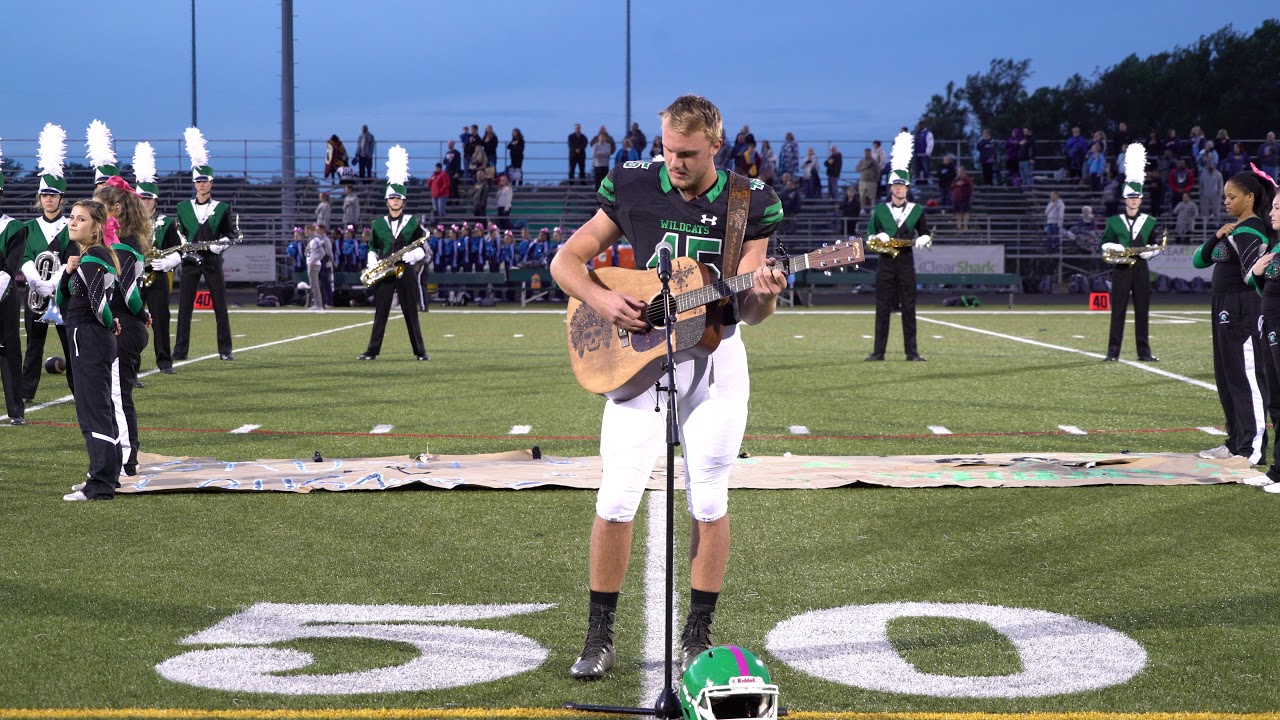
And then about two weeks later, we were in Washington D.C., New York City, and LA, all within a week of each other, all on TV. It was crazy.
Had you played much before surviving the house fire?
No. My family always had a guitar around, but neither of my parents are musically inclined, although they are fans of music. We have a very big palate – top 40, classic rock, bluegrass, all that stuff.
A rubber bridge sounds like a bass. It’s so smooth, but it’ll rattle the change in your truck door
And then when I got started on my own stuff it was a lot of Zeppelin, Chris Cornell, and Black Rebel Motorcycle Club. The way they layer their guitars together is just awesome. And I remember really loving Kip Moore, Drake White, Randy Houser, and Lee Brice.
Some of your songs, like 2022’s Greenbroke, are played in alternate tunings. What are your favorites?
Make a Liar [on Magnolia Sage] and Greenbroke were written out of open drop C tuning. It’s like playing a D chord without pressing anything, then the E string is tuned to the B string. You can go major or minor with it. Lee plays in a bunch of open tunings; Randy plays in a bunch of open tunings.

Did you do it for the sonic qualities or was it more out of convenience of not having to move your fingers as much?
My extremities have been broken quite a few times, so they physically can’t! I look at my guitar player all the time, like, “Dude, if I could move my fingers that fast, do you know what I could do?”
Most guitars, if you throw it in that tuning, it’s going to jangle and rumble. And because I’m a loud singer, I need something loud. I can’t sing the way I do and flatpick, you know?
The Taks are so well balanced that being dynamic on them isn’t an issue, and with the show, everything we do is so dynamic. But convenience is definitely a driving factor behind using that to write songs all the time.
Why did you use a rubber bridge on Hey, Mississippi?
The rubber bridge phenomenon is that it kind of sounds like a bass. It can be made to rumble and still have the articulation. I think it’s really cool to write on – it’s like playing on a nylon or a gut string. It takes your tone somewhere else. It’s so smooth, but it’ll rattle the change in your truck door.
I hear some Muscle Shoals R&B in the guitar playing and groove of that song – and on Make A Liar and Be Your Man, too. How embedded is that in your DNA?
I think there’s an element of soul in the DNA of all country music. Just look at what Chris Stapleton’s doing right now – he's doing the Bill Withers thing, and it's awesome. Like, it’s moving, it’s grooving.
You’ve toured with Brothers Osborne, and of course, John Osborne is a great guitar player. Did you pick up anything from him?
It’s really hard to fingerpick when you write parts that you can’t play and sing at the same time!
They grew up, like, 35 minutes away from us. We’ve done quite a few shows with them, and watching John play is one of the coolest things. I don’t know how he plays mandolin – his fingers are huge, man!
When people ask, “What do you learn out there?” I’m like, “You learn how to execute moves, like watching Blake Shelton work a mic, watching Lainey Wilson do all of the icon shit, how to carry yourself as a professional. It’s all done through observation. You also learn you’re not ever gonna be as good as John Osborne!

To flip that around to the studio, are session players like Tom Bukovac or Brandon Aksteter – who plays in your band – inspiring what you do on guitar?
Where I sit in the sonic landscape of what we’re doing, every day out there on the road or in the studio, I’m a shaker, pretty much. I’m starting a lot of these songs and setting the pace, setting the tone. It’s a texture you can feel, and it’s noticed when I’m not playing. And it’s so fun because I’m a real rhythm guitar player.
I can fingerpick and everything – on [2024’s] Heavens to Betsy, the whole front half is all fingerpicking. I love that I didn’t play with a pick for the first four years of playing guitar. But it’s really hard to do that when you write parts that you can’t play and sing at the same time!
I love the song stripped down and done in that fashion. But for the full band, being engulfed and surrounded by it, it’s just the best.
- Magnolia Sage is on sale now.

