




It happens at some point in every guitarist's career. Whether you finally want to play 'Hotel California' or 'Wish You Were Here' properly, or just fancy trying an instrument a little different from your regular six-string, we all get the bug to try one of the best 12-string guitars.
A 12-string lends a totally unique tone to your playing thanks to its doubled strings, with the bottom four strings doubled an octave higher and the top two doubled in unison. A 12-string will add a completely different timbre to those tired old licks and chord progressions, allowing you to inject new life into your songwriting and performances.
12-string guitars feel a little weird to play at first thanks to those doubled strings, but once you've warmed up to them they're not that different from a regular guitar, and handily don't require you to change your chord shapes or scale patterns. They can be a little cumbersome to tune thanks to the additional six tuning machines, but once you start playing, you'll realize their incredible shimmery sound is worth the effort.
Whether you're a beginner to 12-string or you're looking for something more premium, we've picked out a range of guitars that will cover all the bases. If you want to know more about 12-string guitars, check out our FAQ section which answers loads of common questions. Otherwise, keep scrolling for our top picks...
Best electric

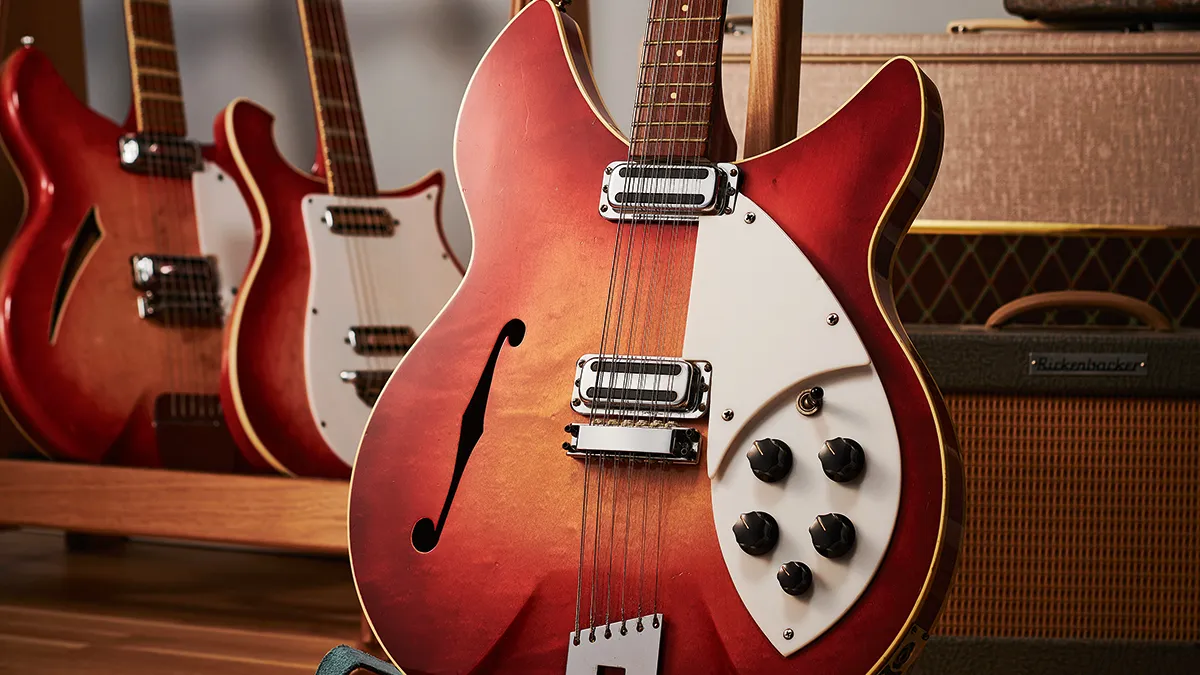
This is the most iconic 12-string you can get your hands on. It’s the semi-acoustic that George Harrison played on the Fab Four’s debut US tour – a 1963 360/12, gifted to him by Rickenbacker’s Francis C. Hall. It’s the sound of The Byrds, The Beach Boys, and its jingle-jangle brightness changed music history for keeps.
It’s not cheap but it is unbeatable, and very practical for a 12-string. Those Schaller tuners are arranged alternately so you can see which string you are tuning, a feature that Harrison liked immediately.
One of the coolest features on the 360/12 is the Rick-O-Sound parallel-mono outputs, meaning that you can split your signal and send one pickup to one amplifier and the other to another, adding more depth and spread to the sound.
Just step on an old analog phaser or a flanger and watch people melt into their surroundings. Pure psychedelic nirvana comes as standard, but of course you can play it clean for pop-folk jangle, that resonant semi-hollow maple body sure lets it sing.
Best budget electric

The hockey stick headstock is back! This time thanks to Squier’s new installment in their perpetually fascinating Paranormal range. For psych-rock aficionados, the Jazzmaster XII is the stuff dreams are made of, and this thing has all the jangle you can shake a (hockey) stick at.
There are many thoughtful options on display here, such as an easily accessible truss rod for incremental action adjustments. Wrestling with high action is challenging on a 6-string – on a 12-string, it’s a whole new world of pain, so this is a welcomed feature. Furthermore, this Jazzmaster also has a graphite-reinforced neck. 12-string guitars are synonymous with warped necks, due to the double tension, so the graphite reinforcement will hopefully extend the longevity of this wacky guitar.
Equipped with two Fender-designed alnico single-coil pickups, this Jazzmaster will give you all the chime you need. Also, If you’re an upgrader, the pickups are standard Jazzmaster size, meaning you can install a new set pretty easily. Available in either Olympic White or Lake Placid Blue, the Jazzmaster XII presents itself as a wonderful option for those looking to experiment with 12-strings but don’t want to remortgage their house doing so.
Best mid-priced electric

Gretsch’s vintage rock ’n’ roll mojo translates perfectly into the 12-string format. The attention to detail on the current Electromatic series is incredible, the finishes perfect. From the bound f-holes to the G-Cutout tailpiece, the smaller late-50s spec headstock, to the multi-ply binding, the Gretsch G5422G-12 Electromatic Hollowbody is one of the finest looking instruments in our round-up of the best 12-string guitars.
The thin U profile neck is slim enough for some quick jazz comping and switch rock double-stops but just as you plug in and dial in the slapback echo the 12-string width and chime hits you right in the face. This is a Gretsch for sure, the Black Top Filter’Tron pickups offering a little snarl before the 12-strings rounds out the attack.
The Gretsch G5422G-12 Electromatic Hollowbody is a little more rock, a little hotter than the other electrics on the list, and while this can occupy vintage psych if required, try playing it through some fuzz and playing with reverbs, because it feels like a great guitar to broaden your horizons on.
Best acoustic

The 652ce is one of the best 12-string guitars money can buy. In a world where the 12-string has a reputation for wonky intonation, the Taylor 652ce Builder's Edition finds the sweet spot between engineering and craft to build an instrument that is nigh-on perfect.
Just take a look at the hardware, for example. We’ve got a Curve Wing Micarta/Tusq-saddled design with double-mounted string anchoring so there are just six bridge pins instead of the 12, and a little more room for a trio of piezo transducers that help make Taylor’s Expression System 2 deliver such undiluted amped tones. The Gotoh tuners are exceptional.
This being a Builder’s Edition series instrument, Andy Powers’ V-Class bracing is under the hood, guaranteeing sustain and volume. How does it feel? Well, effortless to play, with a beveled armrest and subtly rolled body edges to make it comfortable for long sessions. That’s good, because you won’t want to put this 12-string down.
Best budget acoustic

The Fender Villager 12-String has been kicking around since 1965, and it wears the era’s style well. Just look at that hockey stick headstock. That’s something, right? The Newporter body shape is a Fender design, but it positions itself as an auditorium, with all the focus and midrange presence that suggests.
At this price, it’s good to see some solid spruce on top of the Fender Villager 12-String – the guitar wears it well and there seems to be a slight vintage tint. The solid spruce helps add detail and trebly chorus to the Villager’s voice like any good 12-string should have.
The Fishman electronics are not bad either, with a three-band EQ to help you find your place in the mix and an onboard tuner – because this is a 12-string guitar and a reliable tuner is mandatory. That said, the slim C profile neck is very welcoming, and the Modern Viking bridge is a nice staging post from which to strum those big open chords.
Best mid-priced acoustic

Sure there are 12-strings out there dripping in bling, which scream for your attention, but what the Yamaha LL16-12 lacks in pizzazz it certainly makes up for in build quality and playability. Yamaha’s build quality isn’t a hidden secret, it's a well-known fact that their instruments are created with intricate passion, however, it still blows us away every time.
The LL16-12 features an A.R.E treated solid spruce top, solid rosewood back and sides with a 5-ply mahogany/rosewood neck. These quality materials result in a big 12-string boom which is further catapulted across the room thanks to the jumbo-style body shape. This big sound is a direct result of its big body, but if you’re on the smaller side, perhaps this isn’t the guitar for you.
The 5-ply neck isn’t just for show either, the additional wood results in a stable neck that will manage the tension of a 12-string with ease. Plugged in, this guitar is equally impressive, although the SRT Zero Impact pickup is passive, meaning no onboard EQ controls, you won’t have to do a lot of amp tweaking to get a pleasing sound due to its fantastic acoustic qualities.
An attractive price tag, flawless build quality and powerful tone culminate in a fantastic instrument that will serve as a loyal workhorse for anyone out there who needs one.
Best jumbo

Guild has been making 12-string guitars since the 1960s, when the company escaped New York and decamped to its Hoboken, NJ, facility, where it grew under Bob Bromberg’s supervision and Carlo Greco’s design expertise. And yet the Guild F-2512E Archback looks and feels like a holdover from its 50s production, its arched back a legacy of the jazz boxes Guild used to build, only this time matched with a flat maple top.
All that maple makes its presence felt in the F-2512E’s presence. This best 12-string guitar contender has phenomenal detailing, a star-dust tone profile when playing chords, and a harpsichord-esque vibe when playing single notes.
The pearl rosette and tortoiseshell ’guard complete the retro feel. But there are some concessions to modernity here, with the Guild AP-1 Archback pickup offering the option of going through an amplifier, and pau ferro in situ as a legacy of the CITES restrictions on rosewood.
12-string guitar glossary
- Action: The height of the strings above the fretboard, affecting playability.
- Body: The main part of the guitar, which can be hollow (acoustic) or solid/semi-hollow (electric).
- Bridge: The component that anchors the strings to the body and transmits vibrations.
- Dreadnought: A popular large-bodied acoustic guitar shape, sometimes used for 12-strings.
- Headstock: The end of the neck where tuning machines are mounted; wider on 12-strings to fit extra tuners.
- Intonation: The accuracy of pitch along the fretboard, crucial for 12-string tuning stability.
- Jumbo: An extra-large acoustic body style, often used for 12-string guitars for enhanced resonance.
- Machine Heads: The tuning pegs or tuners used to adjust string pitch.
- Neck: The long, thin section of the guitar supporting the fretboard and headstock.
- Nut: The grooved piece at the top of the fretboard that guides and spaces the strings.
- Octave Pair: On a 12-string, the lower four string courses are tuned in octaves.
- Pickup: For electric 12-strings, the electronic device that converts string vibration into sound.
- Resonance: The ability of the guitar body to amplify and sustain sound.
- Scale Length: The vibrating length of the strings from nut to bridge, affecting tone and tension.
- String Gauge: The thickness of the strings; lighter gauges are often preferred for 12-strings.
- Tailpiece: On some electric guitars, the hardware anchoring the strings at the body’s end.
- Truss Rod: A metal rod inside the neck that adjusts neck relief to counteract string tension.
How to choose a 12-string guitar
A 12-string guitar offers a unique and shimmering sound that sets it apart from its 6-string counterpart, thanks to its doubled courses and rich harmonics. Choosing the right 12-string guitar, whether for studio work, live performance, or home enjoyment, requires careful consideration of several important factors.
Here’s a detailed guide to help you make the best choice for your musical needs.
Define your purpose and playing style
First, determine why you want a 12-string and how you plan to use it. If you’re drawn to the classic, lush tones heard in folk, rock, or pop recordings, or you want to add new textures to your music, a 12-string can be a great addition.
Some players use 12-strings for rhythm work, as their naturally full sound complements chords and open tunings. Others might want it for fingerstyle or soloing, though this can be more challenging due to the doubled strings.
Deciding between acoustic and electric
Acoustic 12-strings deliver a natural, booming resonance ideal for unplugged sessions, singer-songwriter performances, and genres like folk or country. They’re self-contained with no need for extra gear and can be played anywhere.
Electric 12-strings, on the other hand, are perfect for live bands, studio recording, and genres like classic rock or jangle pop. They offer easier playability with lighter strings and can be shaped with amps and effects for a wide range of tones. If you want portability and simplicity, acoustic is often the best choice. If you need versatility and amplification, go electric.
Consider playability and comfort
12-string guitars have wider necks and higher string tension than 6-strings, which can be challenging for some players. Try out different neck profiles and body shapes to find what feels comfortable. If you're worried about finger fatigue, look for a guitar with lower action and lighter-gauge strings.
Quality and construction
Examine the guitar’s build quality. Solid wood tops (like spruce or cedar) usually offer better tone and sustain than laminate. Check for stable tuning machines, a well-seated bridge, and even fretwork. For electrics, inspect the pickups and electronics for reliability and sound quality.
Basically, choosing a 12-string guitar is about matching your musical goals with the right features and feel. Play several models, consider acoustic versus electric based on your needs, and select the one that inspires you to play more.
FAQs

Where did the 12-string guitar originate?
Their rise to prominence in a pop-cultural sense arrived during the 1960s, just as The Beatles’ influence was shaping the Laurel Canyon scene. Of course, that influence then boomeranged back to Merseyside after the release of The Beach Boys’ timeless Pet Sounds.
It was in the psychedelic fevers and big ideas of the 1960s that the 12-string guitar found a sense of purpose in popular music, or rather a sense of force, so it’s no surprise that some of the models in our guide to the best 12-string guitars have designs conceived in that very era.
Hypothetically, you could see the new wave of technically adventurous acoustic players taking 12-string guitar further, or maybe, a new frontier in rock can be opened up by a player with an ear for the electric 12-string’s potential when played through a fuzz pedal or the transformative ambience of a multi-‘verb unit. Only time will tell.
Is it hard to play a 12-string guitar?
Playability can be a tough one with 12-string guitars. That’s because you are fretting two strings at once, and need to apply more pressure to fret the notes. Here a lower action can be immeasurably helpful. Even those of us who prefer a little fight in our guitars are won over by low action on a 12-string guitar.
Are 12-string guitars hard to tune?
More than it being difficult, it simply takes more time to tune a 12-string guitar. As you tune the neck tension will be adjusted, so with 12 tuning pegs you can often find once you've gotten to the end those first few strings now sound a little flat.
Intonation is also an issue with 12-string guitars. Of course, intonation concerns are a problem with any guitar, but here are doubled with a cherry on top. But there’s nothing like a good design to circumvent these niggles, and here we’re seeing a lot of clever revisions to the 12-string guitar format that minimizes if not outright eliminate such issues.
Oftentimes, it comes down to detail. Is the spacing between the string pairings consistent at the nut and the bridge? That’s important, and definitely something to look out for when auditioning instruments.
Are 12-string guitars more expensive?
Like their 6-string counterparts, 12-string guitars come in at a variety of different prices. You can pick up a 12-string on a shoestring budget if you so desire, on the other hand, the best 12-string guitars can cost thousands. However, be cautious of the dirt-cheap 12-strings out there. Since you are doubling up the strings, the tension the guitar is under is also increased, quite dramatically. Cheap materials will struggle to hold such tension, and over time, you might encounter a warped neck or a lifted belly. A decent guitar that has been made with sturdy materials will result in much more longevity. All the guitars included on our list fall into this category.
Is it more difficult to play a 12-string guitar?
With twice the amount of strings, is it twice as hard to play a 12-string guitar? Well, it will probably take a little time for you to adjust, but playing a 12-string guitar shouldn’t be much more difficult than your 6-string counterpart. Perhaps what people struggle with most is the picking hand, it can feel a bit cluttered, especially when you want to individually pick out the notes. However, after sitting down with a 12-string for 10 minutes, you’ll start to get used to it and your muscle memory will ease off a little. Barre chords can also be a little trickier on a 12-string guitar, it can feel like a workout for your hand, but again, this will get easier and easier the more you practice and build up your left hand's strength.
These minor inconveniences are minimal and the inspirational pleasure of playing a 12-string guitar far outweighs the small contrasts you may have to overcome.
How we test

At Guitar World, our team of writers are big fans of the sweet sound of 12-string guitars, and we get it – you want something cool that matches your vibe. Our writing team has picked out this list with years of strumming and practical testing under our belts. Many of us are musicians in our local music scenes and our collective experience from reviewing gear all the way to playing festival sets, informs our recommendations across various categories.
When it comes to finding the best 12-string guitars, we keep it real. We mix insights from our own experiences, reviews we've conducted ourselves, and discussions with our editorial team. It's a process that guarantees you get your pick of the very best 12-string guitars out there.
As fellow players, our goal is simple – help you find an instrument that matches your style. We look for that sweet spot of playability, style, and that extra sonic charm. We meticulously consider factors such as accuracy, ease of use, and durability to compile a list that authentically represents the best 12-string guitars in today's musical landscape.
Find out more about how we make our recommendations and how we test each of the products in our buyer's guides.
Why trust us?

☑️ A global audience of 3.8 million guitarists monthly
☑️ 1,200+ reviews on GuitarWorld.com
☑️ 30+ years of product testing at Guitar World
Guitar World boasts over 44 years of expertise and stands as the ultimate authority on all things related to guitars. The magazine and website feature expertly written gear round-ups and top-quality, authoritative reviews penned by a team of highly experienced industry professionals.
Guitar World's inaugural print issue hit the shelves in July 1980, and ever since, it has been captivating players and enthusiasts with engaging lessons, insightful interviews with the biggest guitar heroes, and priceless buying advice for newbie players.
Furthermore, GuitarWorld.com continues this legacy online and serves as the hub of the world's foremost authorities on guitar playing. The site not only hosts content from Guitar World but also showcases articles from respected publications such as Guitarist, Total Guitar, Guitar Techniques, and Bass Player. With a reach extending to 3.8 million players each month, GuitarWorld.com is a go-to destination for guitar fanatics globally.
Related buyer's guide
You can trust Guitar World Our expert reviewers spend hours testing and comparing guitar products so you can choose the best for you. Find out more about how we test.
- 10 best acoustic guitars for beginners
- The best acoustic guitar strings for all budgets
- Best guitar cables for acoustic, bass and electric guitars
- The best guitar capos to stock up on now
- The 12 best guitar amps from tube to modeling amplifiers

