

Guitar World Verdict
The addition of the TV Jones Ray Butts pickups is a masterstroke, offering a wide range of authentic Filter’Tron tones. The colour scheme may not be for everyone, but who wants ‘standard’ anyway? It’s a Gretsch Penguin, after all!
Reasons to buy
- +
Eye-catching.
- +
Wonderfully smooth to play.
- +
Versatile pickups sound magnificent across a range of musical genres.
Reasons to avoid
- -
The finish may be too cool for some.
- -
A more vintage-correct nitro finish would be good.
- -
Bridge could be pinned more firmly.
You can trust Guitar World Our expert reviewers spend hours testing and comparing guitar products so you can choose the best for you. Find out more about how we test.
What is it?

The Gretsch 6134 Penguin is among the rarest and most elusive of all vintage guitars, with collectors paying six figures to pick up one of the few (rumoured to be less than 50) originals that left the Brooklyn factory between 1955 and 1962.
On its 1955 release (no doubt in response to Gibson’s brand-new Les Paul model of 1952) the Penguin was effectively a fancier Duo Jet with top-of-the-line White Falcon appointments, a striking white finish, gold hardware, fancy inlays and DeArmond Dynasonic single-coil pickups, along with a smart gold ‘Cadillac’ ‘G’ tailpiece. A new one in 1959 would cost roughly $490.
To put that in context, a Gibson Les Paul Standard, now known as a ’Burst, would have only set you back roughly $265. In today’s vintage market, purchasing either would raise that figure to the hundreds of thousands…
The first major revision to the Penguin’s spec came in 1958 with thumbnail fingerboard inlays. Crucially, there was also the addition of the new Chet Atkins approved ‘Patent Applied For’ Filter’Tron Pickups (designed by engineer Ray Butts) to remove the hum associated with the single-coil Dynasonic pickups.
Debate still rages in quiet corners of the internet as to whether Ray Butts or Gibson’s Seth Lover (or indeed others) invented and first patented the guitar humbucking pickup.
The pickups Gretsch has chosen to fit to this Limited Edition Penguin are the TV Jones Ray Butts Ful-Fidelity units – accurate recreations of his original 1950s design that are not wax-potted, promising more high-end sparkle and a tighter bass response than regular TV Jones Classics.
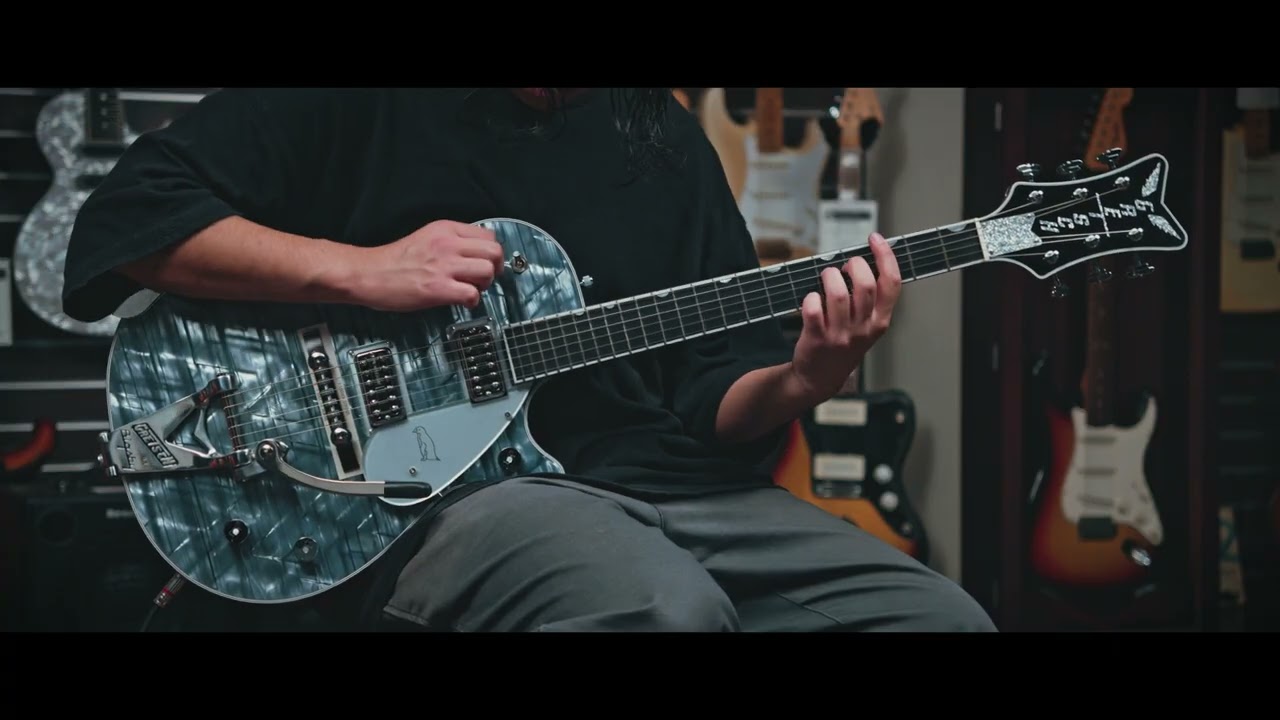
Although listed as part of Gretsch’s solidbody line, the Penguin actually features a chambered mahogany body with an arched maple laminated top, and – if you haven’t noticed it already – a particularly eye-catching top finish that Gretsch refers to as ‘Light Blue Pearl’. It’s not vintage-accurate for a 1950s White Penguin, but it totally nails the finish found on some vintage Gretsch drum kits of the 1960s.

While the body outline nods to a slightly bigger Les Paul, a Gretsch Penguin’s 337mm (13.25-inch) wide and 51mm (two-inch) deep body – also used for the Duo Jet models – is easily differentiated on a dark stage by the huge, magnificent headstock borrowed from the White Falcon with its ever-so-subtle Gretsch logo and regal Grover Imperial tuners.
The set U-shaped mahogany neck features a beautiful dark 305mm (12-inch) radius ebony fingerboard featuring 22 medium jumbo frets, ‘Luminlay’ glow-in-the-dark side dots, and surprisingly restrained Neo-Classical thumbnail inlays.
Adding more bling for the buck, silver sparkle with w/b/w purfling features just about everywhere and joins a hefty chrome-plated arm guard (typically idiosyncratic Gretsch and a feature borrowed from banjos), chrome ‘Jeweled G-Arrow’ (in Gretsch parlance) control knobs for the individual volume controls for each pickup, and the treble bleed cap-loaded master volume control.

The dual switches are a standard three-way pickup selector accompanied by a three-way tone switch that uses different value capacitors to give preset tone control sounds.
The strings rest on a vintage-looking partially pinned Space Control bridge, which has significant movement back and forth for intonation control but can move under aggressive string bends and string changes.
The modern string-through Bigsby B3CP vibrato tailpiece is a marvel of engineering for anyone who has ever struggled with changing strings on a traditional Bigsby unit. Special mention also to the screw-on strap locks that have been a welcome addition to Gretsch guitars since the 1950s.
Specs

- PRICE: $3,799 | £3,699 | €3,999
- ORIGIN: Japan
- TYPE: Single-cutaway, chambered body electric
- BODY: Mahogany body with arched maple top and vintage chambering
- NECK: Gloss-finished U profile mahogany set-neck
- SCALE LENGTH: 625mm (24.6”)
- NUT/WIDTH: Bone/42.86mm (1.6875”)
- FINGERBOARD: Ebony with mother-of-pearl Neo Classical Thumbnail inlays
- FRETS: 22, medium jumbo
- HARDWARE: Bigsby B3CP String-Thru vibrato, Grover Imperial Tuners, Space Control bridge, Jeweled G-Arrow Control Knobs, chrome banjo-style arm rest and hardware
- STRING SPACING, BRIDGE: 52.4mm
- ELECTRICS: Twin TV Jones Ray Butts Ful-Fidelity Filter’Tron pickups, 3-way pickup selector switch, individual pickup volumes, master volume, classic Gretsch tone switch
- WEIGHT (kg/lb): 4.0/8.8
- RANGE OPTIONS: G6134TG-58 Limited Edition 1958 Custom Penguin with Bigsby in Nightbird Emerald finish (£3,739)
- LEFT-HANDERS: No
- FINISH: Light Blue Pearl (as reviewed)
- CONTACT: Gretsch
Build quality, usability and sounds

Taking the Penguin from its plush hard case, at 4kg (8.8lb) we are immediately stuck by both its heft and sheer presence. Unmistakably Gretsch in its opulence, the striking Light Blue Pearl finish and all that chrome and silver sparkle is a colour scheme that reminds you that you’re playing something special.
The Penguin’s chambered mahogany body contributes a wonderful sense of smooth, airy warmth and depth to our first few unplugged strums. Single notes and chords have a rounded attack and a smooth and surprisingly long sustain, not something we’d usually associate with smaller-bodied Gretsch models especially, but it bodes well for plugged-in adventures.

While the Penguin’s single-cut body shape might suggest a typically Les Paul midrange heft, plugging the Penguin into our Princeton Reverb puts us more in mind of a good ES-335. There’s less midrange and immediacy to the attack; instead the Penguin has a smoother, more open and sparkly voice.
Perhaps it’s all that air in the chambered mahogany body with the laminate maple top, or the combination of floating bridge and the most musical of vibrato units adding sonic sparkle.
If you haven’t spent much time playing Filter’Trons then we urge you to do so, particularly these TV Jones Ray Butts units. Warm yet gritty, these pickups have plenty of sparkle and bite with a tight low‑end, sitting somewhere between a classic Fender single coil and a Gibson humbucker – a versatile yet instantly familiar sound.

Carefully balancing the individual pickup volume controls with the master volume with its treble bleed capacitor allows a huge range of tones, from clean snappy Beatle-y chime to gritty snarl perfect for Neil Young Americana and country runs when plugged into a Tweed amp.
The surprisingly useful tone switch is bypassed in the middle setting, rolls off some treble in the down position, and is most useful in the upper position by virtue of engaging a different value tone capacitor. It gives a superb almost cocked-wah midrange boost for additional textures and is great for punching lead lines out of a mix.
Up the amp or pedal gain, and you’re greeted by harmonically rich tones with superb note definition and a beautiful compression that gels notes perfectly even under serious volume and gain. As AC/DC found, along with many alt-rock artists in the late ’90s, it’s just about the perfect rock rhythm tone.
Verdict
Verdict: ★★★★½

Modern Gretsches are built to more exacting standards than so many of the vintage originals, and this Limited Edition Penguin is no exception – it is a visually striking and beautifully voiced bird.
Guitar World verdict: The addition of the TV Jones Ray Butts pickups is a masterstroke, offering a wide range of authentic Filter’Tron tones and – once you become accustomed to the idiosyncratic controls – hours of inspiration. The colour scheme may not be for everyone, but who wants ‘standard’ anyway? It’s a Gretsch Penguin, after all!
Hands-on videos
Gretsch

Empire Music

三木楽器 / MIKIGAKKI 公式チャンネル