

Guitar World Verdict
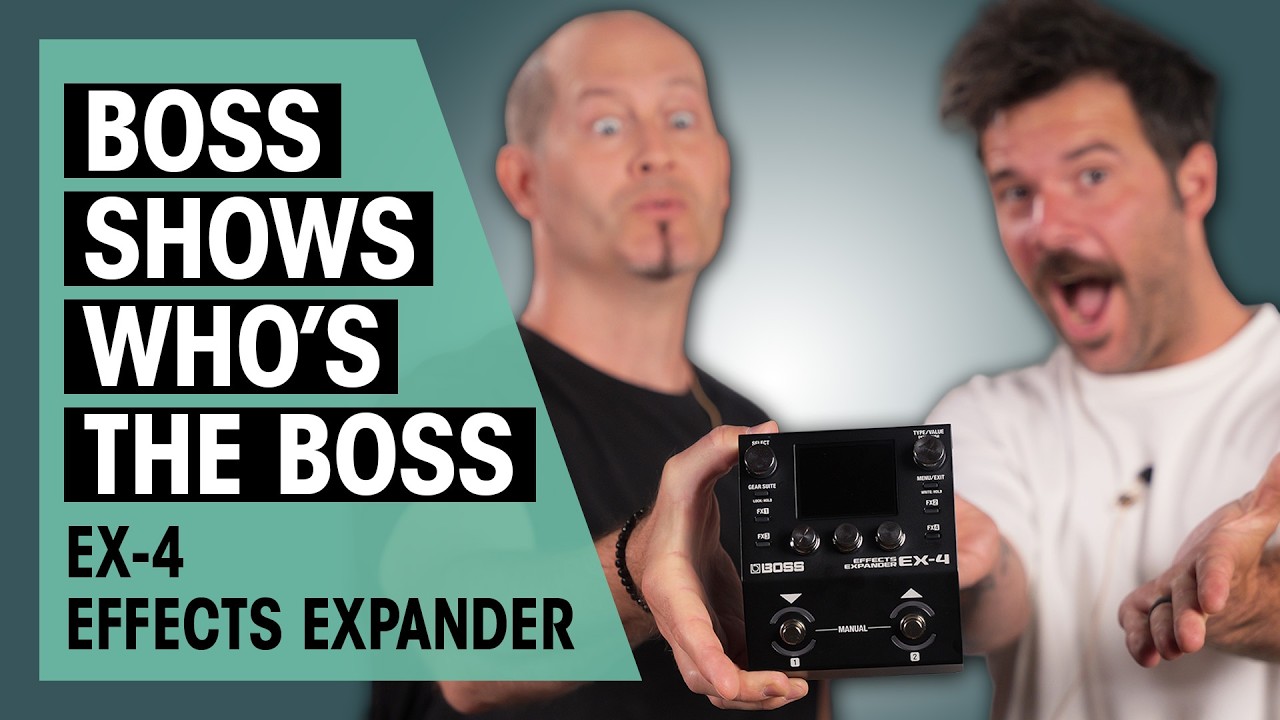
The Boss EX-4 Effects Expander does what its name implies - expands the sonic possibilities of your pedalboard as a problem-solver. Some well-thought-out features, a large collection of great sounds, and a rugged build make for a carefully considered multi-effects unit that could slot into anyone’s pedalboard.
Reasons to buy
- +
Compact.
- +
Covers everything from sensible to outlandish effects.
- +
Built-in effects loop.
Reasons to avoid
- -
Drives aren't the most dynamic.
- -
A few text-heavy menus.
You can trust Guitar World Our expert reviewers spend hours testing and comparing guitar products so you can choose the best for you. Find out more about how we test.
What is it?
With a lineage dating back to the ‘70s and hundreds of pedals released, Boss knows a thing or two about guitar effects. The company's catalogue of products covers everything a guitar player will need, whether that is a classy overdrive, an over-the-top modulation, or a space-creating reverb. Naturally, with all that in the locker, Boss has a number of multi-effects pedals in its lineup too, but none quite like its newest multi-effects release - the Boss EX-4 Effects Expander.
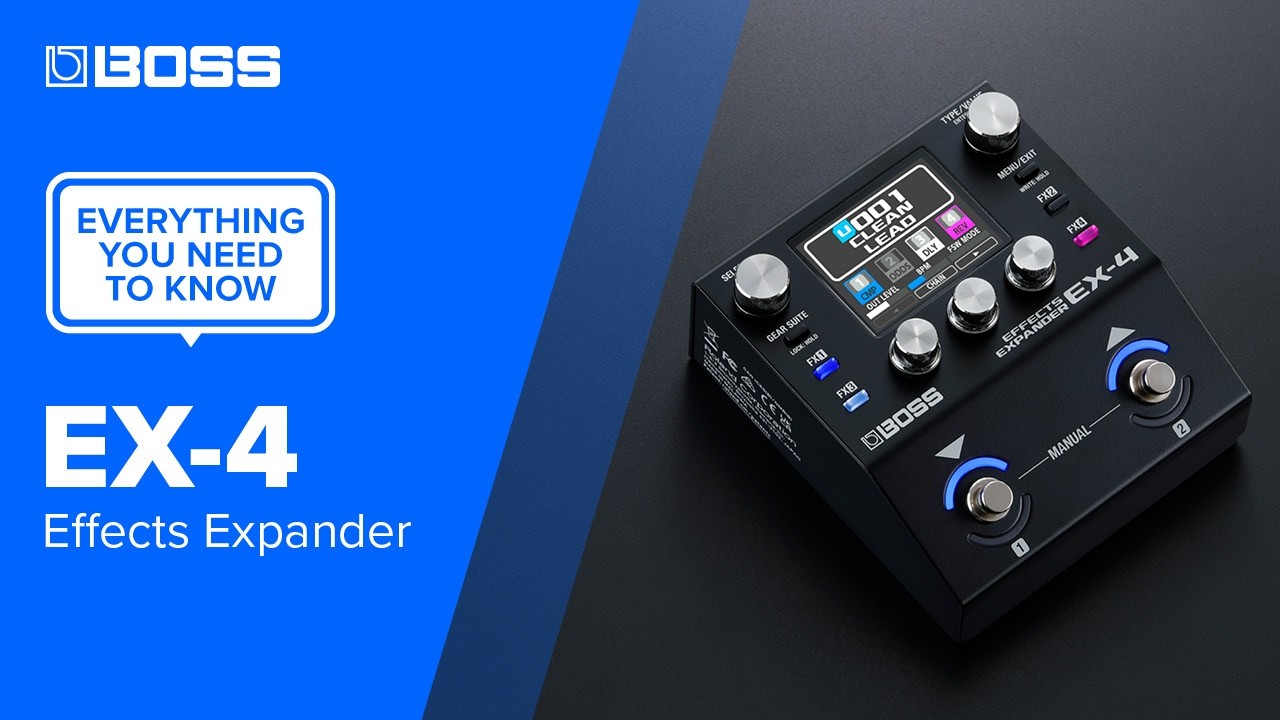
The EX-4 takes 120 Boss effects compiled from the likes of the GX series of multi-effects, some classic stompboxes, and discontinued legends like the SG-1 Slow-Gear, and crams it all into a two-footswitch pedalboard-friendly chassis capable of running any four effects at once.
Adding to this is a number of features that could make the Boss Effects EX-4 Effects Expander the perfect pedalboard companion.
Specs

- Launch price: $329 | £289 | €349
- Type: Multi-effects unit
- Controls: 2 x encoders for menu browsing, 3 encoders for parameter editing, Menu, Gear Suite, 4 fx buttons, 2 footswitches
- Features: 4 effects at a time, Boss Multi-effects, Gear Suite effects presets, 128 factory and 128 user presets
- Connectivity: Stereo in and out, effects loop (when in mono), MIDI in and out, EXP/CTRL input, USB-C
- Power: 9v, 300mA, center negative
- Dimensions: 117x138x63mm/4.6"x5.4"x2.4"
- Weight: 1.7lbs/800g
- Contact: Boss
Build quality

Build quality rating: ★★★★★
Boss is known for making pedals that will probably outlive most of its users. The EX-4 is no different, thanks to a metal chassis that feels like it would withstand all but the most unreasonable punishment, and a collection of buttons and controls that give an equally hardy impression.
The centerpiece is the display, which keeps things compact at 2.4”. It is not a touchscreen, nor is it high resolution, but a touchscreen would be difficult to use at this size; the simple images and text are clear, and the screen is more than bright enough for difficult lighting conditions.
Usability and features

Usability and features rating: ★★★★½
Speaking of size, at 117x138x63mm, the EX-4 is impressively small for the amount of I/O featured, and will easily slot onto most pedalboards. At 300mA, the current draw is reasonable for a digital pedal, and something that most pedalboard power supplies will support too.
That I/O consists of stereo 1/4” inputs and outputs, MIDI In and Out, an Expression pedal input, and USB-C connectivity. Cleverly, if you are not using the stereo input and output, the right side can operate as an effects loop.
As the name suggests, the signal chain consists of four effects. This may sound limiting, initially but there are a wealth of options here.
The effects can be freely moved around within the blocks of each path, making everything feel pretty versatile.
Firstly, the chain can be set to five different preset signal paths, allowing for different configurations of serial and parallel paths in both mono and stereo setups. The effects can then be freely moved around within the blocks of each path, making everything feel pretty versatile.
The effects parameters line up with the three encoders along the bottom of the screen so that I can simply turn the encoder to adjust the aligned parameter. Pressing the outside encoders will scroll the page left and right to further parameters if needed. Easy.

Changing effect types and moving them around means using the two larger encoders at the top of the unit’s front panel. These encoders are also used to browse the menus.
Some of those menus can be a little text-heavy, but those are mostly reserved for things like global settings, footswitch assignment and behaviour, etc. Meaning that, although they are not that much fun to navigate, you probably won't need to be diving into them during a gig, which goes some way towards redeeming them.
At said gig, there are only two footswitches to play with, but this can be expanded (pun intended) via the EXP/CTRL input for another two switches, or via MIDI with a MIDI footswitch. Without this, two of the four effects are assigned to the footswitches, with the other two effects remaining on, unless turned off by one of the four small FX buttons that correspond to each effect block.

Personally, I see this pedal as being utilized by players to cover the odd effects used only once or twice throughout a gig. For example, that one song you need a rotary effect for. In this context, having only two footswitches isn’t that much of a drawback, as you are highly unlikely to need to switch more than two of these effects within a song.
There are 256 presets altogether (128 factory, 128 user). The footswitches can be in Manual mode, which means turning individual effects on or off within a preset, or Preset mode, which means, well, navigating up and down presets.
Which mode you are in is clearly shown by bright LED’s around the footswitches. These LEDs are also color-coded to indicate the effect type assigned to them when in manual mode. Again, all very straightforward and a lot easier to figure out than it may first sound.
Lastly, the Gear Suite button takes the user to a selection of expertly crafted presets for each effect. A great way to get beginners started on effects they may be unfamiliar with, or for experienced users who want a shortcut to good sounds.
Sounds

Sounds rating: ★★★★☆
And that shortcut may be a significant time saver, as there is a lot to play around with, ranging from the staples to the wild. All are usable; some are brilliant, some are not as great.
Starting with a highlight from the sensible column, the Compressor is wonderfully transparent and capable of subtle evening of your dynamics or super-squashy funk strumming. It makes playing those Nile Rodgers riffs on my Stratocaster nothing short of addictive.
Similarly, the Slow Gear is a ton of fun. The original Compact Pedal is sadly discontinued and somewhat legendary among collectors, so it is great to see a version of it in the EX-4. The idea is that it fades in your signal in a violin-like way, with its simple parameters of just Sensitivity, Rise Time, and Level allowing for a surprising amount of control over this function.
I am also surprised by just how good the Acoustic Simulator is. The low end sounds a bit artificial, as there is just too much of it, but it is a relatively convincing acoustic tone that is devoid of the plinky-ness associated with affordable acoustics and cheap piezo’s. In fact, I would choose this simulated tone over a low-end acoustic piezo pickup any day of the week.
The Sitar sim, however, does not live up to this bar. Rather than emulating the iconic Paint It Black lead riff, it just makes my guitar sound anemically thin.

Moving on to more typical electric guitar effects, the modulations are brilliant. The Chorus is a good example, adding lovely wobble that still retains enough brightness and transients to be heard in a mix.
Of all the modulations here, however, the Rotary is my favorite. Its strength is in its versatility, as its controls include Speed Select, Slow Rate, Fast Rate, Level, Rise Time, Fall Time, Mic Distance, Balance, Drive and Direct. With these, I am able to create many iterations of a rotary sound, making for an effect that is a lot of fun to dive into.
There is plenty of space here too, with a wide selection of Reverbs and Delays. The Reverbs are a little mixed, as, to me, most of them sound a bit separated from my dry signal. However, the Spring Reverb does not suffer from this and adds a convincing spring sound that wraps the guitar in some comforting space.

The Drives are where I feel the Effects Expander EX-4 is weakest. My biggest pet peeve is that they don’t clean up particularly well on the volume control, resulting in tones that aren’t the most dynamic.
Some specific models are a bit of a miss too - for example, the T-Screamer feels too thin at lower gain levels, and the ‘60s Fuzz is just thin in general.
I would choose the Acoustic Simulator over a low-end acoustic piezo pickup any day of the week
The Delays, in contrast, are hard to fault. The options here are varied, delivering everything from subtle slapback to The Edge-like soundscapes. The Space Echo, for example, gives out warm repeats that stay out of the way of your mix, perfect for fattening solos. The Giga Delay is the opposite, recreating the input in a much more pristine way that is well suited to rhythmic delay parts.
But that does not mean there aren’t some great sounds to be had. For example, crank the gain on the T-Scream, and it's a thick, mid-forward, chewy drive that is spot on for lead sounds. On the heavier side, the A-Dist provides some equally thick high-gain sounds, whilst retaining high-end definition.
Lastly, it is worth noting the weird ones. The Guitar Synth does what it says on the tin, whilst leaning on the more bity side of the synth world, and the Humanizer adds vowel sounds to your signal, akin to a cross between an envelope filter and Korg's infamous Miku pedal.
The point is, everything is covered.
Verdict

A capable little device
What this all adds up to is a capable little device that offers a huge amount of versatility.
When this sort of versatility is crammed into a unit so small, it can often mean that things get a little difficult to use. While there are some text-heavy menus, the EX-4 is straightforward where it matters most and manages to avoid annoying hidden functions altogether.
Whether you need a few one-off outlandish effects, or some more sensible options that don’t quite justify separate pedal purchases, the EX-4 has you covered with a range of great sounds, as well as a few that could be better.
Guitar World verdict: The Boss EX-4 Effects Expander does what its name implies - expands the sonic possibilities of your pedalboard. Some well-thought-out features, a large collection of great sounds, and a rugged build make for a carefully considered multi-effects unit that could slot into anyone’s pedalboard.
Test |
Results |
Score |
|---|---|---|
Build quality |
Boss's usual level of rugged gig-worthiness. |
★★★★★☆½ |
Usability and features |
A few text-heavy menu's, but straight-forward for everything that you may need to quickly access during a gig. |
★★★★½ |
Sounds |
Mostly great, with some that don't quite hit the same high bar set by the rest. |
★★★★☆ |
Overall |
A robust pedal, with versatile tones that is not too difficult to use. |
★★★★½ |
Also try

Hands-on videos
Boss
Pete Thorn
Thomann