

Guitar World Verdict
The Shure GLXD16+ is a complete wireless guitar system that integrates seamlessly with your pedalboard. It’s robust in every sense of the word; the hardware is reassuringly durable, and the strength and quality of wireless connectivity is unassailable. As a former wireless-guitar-rig curmudgeon, I am converted.
Reasons to buy
- +
Automatic, dual-band wirelessness
- +
Completely transparent, low-latency sound
- +
Fits on your pedalboard
Reasons to avoid
- -
High price of entry
- -
No cable capacitance simulation
- -
Angled footswitch sometimes a nuisance
You can trust Guitar World Our expert reviewers spend hours testing and comparing guitar products so you can choose the best for you. Find out more about how we test.
What is it?
Wireless guitar systems were once the prohibitively expensive reserve of bands successful enough to afford a crew. They were stadium-rock fare, used to free up the performances of guitarists prone to wandering and to remove the potential for on-stage technical difficulties caused by yanked, tripped-over, or otherwise broken guitar cables, problems a tech couldn’t feasibly solve from sidestage.
Since the 1990s, wireless guitar systems have grown and become more accessible, but how many of them were truly trustworthy on tour? It takes a lot to trust something you can’t see; for my part, and as someone not often on large festival stages, I’ve traditionally favored the pure simplicity of plugging cable into thingy. But that was before I tried the Shure GLXD16+. I am now a wireless convert, and it is with sole thanks to the unignorable utility of this unassailable system.
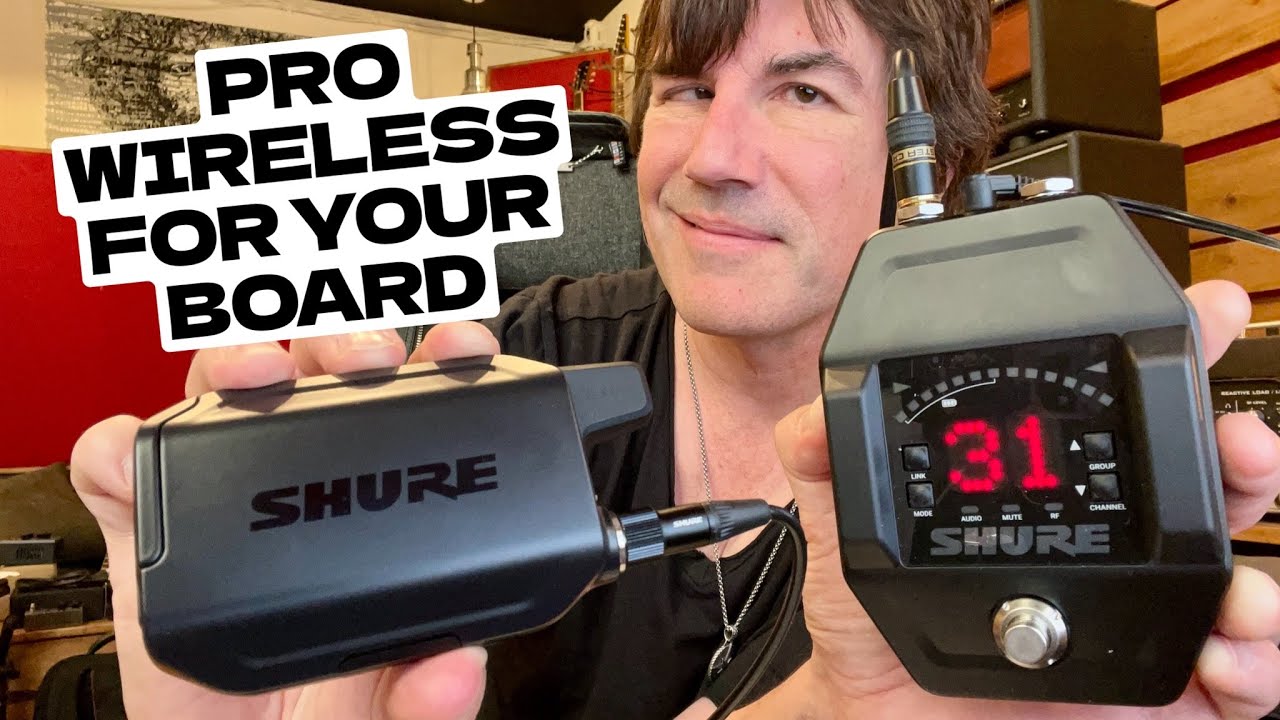
The Shure GLXD16+ is a complete pro-grade wireless system for guitars, comprising a transmitter pack and a receiver pedal. It’s a dual-band system, capable of running in 2.4GHz and 5.8GHz; as well as some clever automatic interference-avoiding tech, the system is capable of transmitting up to 60m – far longer than most festival main-stage runways, let alone the width of any stage you’re likely to play.
The pedal portion of the Shure GLXD16+ system contains the brains of the system. From the pedal, you can manage connectivity between transmitter and receiver; it also has a built-in guitar tuner that switches between Needle and Strobe modes and fine-tunes between 432 and 447Hz. The pedal footswitch engages the tuner and mutes the output, but can also be used to switch between the wireless signal and an analog signal coming through the pedal’s ¼” jack input. The pedal is, at once, a receiver, tuner, killswitch, and ABY box.
Under the hood, a plethora of routing, transmission, and tuning options for practically every scenario – controlled by the four buttons that sit on each side of the receiver’s dot matrix display. These functions are especially useful when you have multiple GLXD16+ systems on stage, or two transmitters to switch between (which you can also do, by the way).
Speaking of which, the transmitter bodypack has a battery life of around 12 hours, with more on tap if you use just the 2.4GHz band; in a pinch, 15 minutes of charge will grant around 90 minutes of playtime, so you’re not likely to be caught short before it’s go-time at a show.
Both transmitter and receiver unit seem built to withstand your average thermobaric blast, with sturdy metal enclosures. The transmitter also has a pre-attached metal clip, which gets a solid purchase on your guitar strap, belt, or other such on-person item. This is rugged stuff, decidedly gig-proof in pretty much every way.
Specs

- Launch price: $637 | £559 | €579
- Type: Wireless system
- Range: Up to 100 ft (30 m) indoor/typical; up to 200 ft (60 m) line-of-sight outdoors
- Controls: Receiver: Footswitch (Tuner/Bypass toggling), Link button, Mode button, Channel button, Group button | Transmitter: Power switch
- Features: Dual-Band operation (2.4 GHz & 5.8 GHz), automatic frequency management and channel backup, built-in chromatic tuner with needle/strobe modes and customizable pitch/detune settings, multi-transmitter pairing support
- Connectivity: Receiver: 1/4" Instrument Input, 1/4" Instrument Output, USB-C (for firmware updates), 9V–15V DC Power Input | Transmitter: TA4M 4-pin mini connector input, USB-C (for charging)
- Bypass: True Bypass
- Power: Receiver: 9V–15V DC power supply (400 mA min, center-negative or center-positive | Transmitter: Included SB904 rechargeable Lithium-Ion battery (up to 12 hours runtime; fast-charges via USB-C)
- Dimensions: Receiver: 5.4" x 3.7" x 1.89" / 138 x 95 x 48 mm | Transmitter: 4.5" x 2.6" x 1.1" / 115 x 67 x 29 mm
- Weight: Receiver: 1.23 lbs (560 g) | Transmitter: 0.33 lbs (150 g)
- Options: Available regional frequency configurations (Z2, Z3, Z4, Z5 tuning bandwidths); spare SB904 Lithium-Ion batteries, SBC10 USB-C wall chargers, right-angle guitar cables (WA305 included is straight TS to TA4F)
- Contact: shure.com
Performance

Being a relative newcomer to wireless guitar rigs myself, I was expecting a half-day of ginning up on electronics, high-frequency radio principles, and the user manual of the GLXD16+ – but I couldn’t resist setting it straight up on my pedalboard first. And then I turned it on. And then it just worked.
The GLXD16+ system automatically pairs when turned on, finding the most viable channel from the jump, then continually moving between channels to keep the connection and signal strong. The default setting picks the best channel across both 2.4 and 5.8GHz, keeping interference to a minimum. To my ear, latency was functionally non-existent, and my guitar sounded indistinguishable from when I plugged in with a standard jack lead.
Before I got everything set up, I had a bit of housekeeping to do. The transmitter bodypack’s battery is packaged separately and needs to be installed – a process as simple and familiar as putting a battery in a digital camera – then fully charged before use. I left it charging overnight to be safe, since I intended to gig with it the next day, but I’m fairly sure the first charge took less than a few hours.

The GLXD6+ receiver, of course, is pedal-powered. It’s got a standard barrel jack port, is happy running on anything between 9V and 15V, and is even happy receiving either center-positive or center-negative polarity. The only limiting factor (quite literally) is the unit’s current appetite.
Shure recommends using its own provided power supply, or an isolated pedal power port with a minimum 400mA current rating. No problem if you’re rocking one of the best pedalboard power supplies on the market, but a bit of a problem for me, whose only available slot was a 120mA port; bundling the provided wall wart in with my pedalboard was no problem, though, and, if anything, guaranteed cleaner power for gigging.
Speaking of which, my road testing took the GLXD16+ system to a basement venue in Leeds as part of a two-piece noisyband on a four-band bill. Soundchecks and changeovers were tight, so I didn’t have much room for fenagling. Luckily, and again, with both units powered up, they connected immediately.

I expected some nudging around to find and set a clean connection, but the GLXD16+ system, of course, handles that cleanly, undetectably, and automatically, even while you’re playing. Between soundcheck and the show itself, the GLXD16+ system was the least problematic part of my rig.
Admittedly, on this occasion, that might not be saying much. For this particular band, my guitar amp of choice is a 1960s PA head with more dead spiders than transistors in it, and my pedalboard is a hodgepodge of boutique pitch- and time-based effects, ‘80s distortion pedals and home-made Harmonic Percolator clones held together with cable ties. It’s safe to say the GLXD16+ system was somewhat out of place, both on my board and on that bill. But it was also functionally and fault-wise invisible, and so, so practical. Having one less cable to trip over on stage is a hugely underrated experience.
The common assumption about wireless rigs is that they exist purely to solve the problems created by short guitar cables on long or large stages, and maybe to simplify setup for festival shows too: the haunt of bands that have Tour Bus Money™.
But you don’t need huge stages or stacked gig calendars to justify a wireless rig; knowing you won't accidentally rip a jack lead out of your guitar or pedalboard at any show is worth the price of entry alone. And knowing you don’t have to risk dropouts or poor signal is worth the price of the Shure GLXD16+.

For my part, being hemmed in by my pedalboards, and prone to frequently turning to the drummer for count-ins, emotional support, and ‘the nod’, I’ll often accidentally wrap my guitar cable around one or both feet, increasing the risk of yankage when I get a little animated. With the GLXD16+ system, I was at my least clumsy and my most bouncy. Win-win.
During such bounce-ful performing, I found that, for the most part, the transmitter stayed where I put it, on my guitar strap, about six inches from the jack output. After a very energetic half-hour of jobbing around the stage like a loon, it hung on quite well. I was doing a lot, and it would take a lot more to make this transmitter fly.
I found the tuner highly reliable during both soundcheck and set, too. My only bugbear was somewhat edge-case, relating to the shape of the receiver pedal’s chassis. My board usually has the tuner on the top row, so I can more easily access momentary effects on the bottom; the slanted front and angled footswitch made it difficult to access the tuner/mute switch from behind the bottom pedal. The dozens of you that’ll want to do the same will need some form of riser.
Across all of my testing, I never had to menu-dive for anything. This system is truly plug-and-play, which is a marvel when pro-grade utility equipment like this is so often pointlessly impenetrable. And I think this is exactly what you want from something like the GLXD16+. It just works. Remarkably well. Invisibly so.
Verdict

Truth be told, nothing much like the Shure GLXD16+ system exists on the market. Plenty of other wireless guitar rig options exist, most of which are significantly cheaper, but none offer this level of resilience, convenience, and quality in one pedalboard-friendly format. This is the only wireless guitar system I’ve seen that I would trust on a tour.
Naturally, such quality comes at a price, and it’s not a price many casual guitarists will feel comfortable paying. But if you spend any amount of time on more than one stage, this wireless system should catch your notice. It’s foolproof to use, seamless, and excellent-sounding. Coming from a long-time wireless-rig skeptic, the Shure GLXD16+ is a hard thing not to recommend.
Guitar World verdict: The Shure GLXD16+ is a complete wireless guitar system that integrates seamlessly with your pedalboard. It’s robust in every sense of the word; the hardware is reassuringly durable, and the strength and quality of wireless connectivity is unassailable. As a former wireless-guitar-rig curmudgeon, I am converted.
Test |
Results |
Score |
|---|---|---|
Build quality |
Featuring rugged metal enclosures, both the transmitter and receiver are built like a tank and designed to withstand the rigors of touring. |
★★★★★ |
Usability and features |
The system offers effortless plug-and-play setup with automatic dual-band pairing and continuous frequency hopping, but the footswitch can be awkward on some boards. |
★★★★½ |
Sounds |
Audio performance is completely transparent with imperceptible latency, perfectly preserving your guitar's natural tone. |
★★★★★ |
Overall |
The Shure GLXD16+ is an unassailable, professional-grade wireless system that sets the benchmark for pedalboard reliability and performance. |
★★★★½ |
Also try
Hands-on videos
Shure
Pete Thorn