

When I think of pioneers in guitar design – true heavyweights like Leo Fender, Ned Steinberger and others – it’s no stretch to say that Andy Powers will likely be regarded in much the same way as those legends.
Not only has he made great strides for Taylor Guitars in building musically appealing acoustics, but his forward-thinking innovations like V-Class bracing, Action Control Necks and the use of urban-harvested tonewoods, among other imaginative details, only reinforce the fact that he’s relentlessly tenacious in his passion for improving the instrument.
Now, Powers has turned his sights on building his very own electric guitar model, something he’s been mulling over for some time. “It’s kind of like writing songs,” he says.
“You put all those things on your mental bookshelf. Once in a while, you take those thoughts down, blow the dust off and examine them a little bit. I have all the pieces I need mechanically, and I’m feeling the right kind of aesthetic inspiration right now. I’m going to put all these pieces together.”
But don’t call it a side hustle; Powers is still manning the helm at Taylor. By forming his own company – Powers Electric – a brand completely separate from Taylor, Powers has made his passion project a reality. And by doing so, he has poured all his childhood inspirations into a completely original electric guitar design that embodies Southern California nostalgia and culture. In essence, Powers’ A-Type guitar offers a fresh perspective, one that hits closer to home.
“The world of acoustic guitars is a fairly traditional mindset,” he says. “Most of the time, you’re celebrating beautiful wood and subtle finishes. I love that world – I spend most of my life in it – but I wanted this guitar to live somewhere different.”
At what point did you decide to design your own electric guitar?
I’ve built a lot of electric guitars for different players over the years, and having worked on a lot of them, you kind of absorb what these guitars do and their quirks. You can exaggerate and learn how to tweak them, modify them, refine them, all that. So I thought, wouldn’t it be kind of fun to build a guitar that I wish I had had?
One day I was talking about that with Kurt Listug [co-founder of Taylor], and he said, “Why don’t you just build a guitar you want?” All right, that sounds like fun. I went home and started drawing and putting all these different kinds of things that I had thought about for the last 30 years into this guitar that I wanted.
Most people would say guys like Leo Fender got it right the first time. But here you are building a new guitar from the ground up. When I play it, it seems you’ve got it right the first time.
I appreciate that. It is a challenge because in some ways, you’re right; the forefathers of the electric guitar got it right the first time.
And that’s very hard to do. Did you begin by studying those classic guitar designs and factor in what had already been done?
I made the first one in my home shop. A friend of mine saw it and liked it. Another friend said, “Can I have one?” Before I knew it, I realized I was going to need some help
Let’s imagine if I had been alive back then, living in Southern California. If I’d been around at the dawn of electric-guitar development, what would I have made? So you go through this kind of mental exercise and go, “What would that be like?”
There are no parts catalogs to buy stuff from. And you don’t know about what has already been done, right? So, you’re going to have to make it entirely new. You’ll have to make every part. That could be an intimidating thing, or – for someone like me – I find that idea incredibly attractive, and I get to make every part exactly the way I want it.
I love woodworking, metalworking, engineering and understanding exactly how every piece functions. How to make it, how to shape it, how to hold it, what I should make it from. I came at the design from that angle.

Once you decided to build everything yourself, where did the design actually begin?
I made the first one in my home shop. A friend of mine saw it and liked it. Another friend said, “Can I have one?” Before I knew it, I realized I was going to need some help. Every line was considered.
You’ve got to have curves that look good, feel good, sit right on you and look good under different paint colors. People would discover that it sits perfectly on your lap, and it balances when you hang it by a strap. It’s easy to get around on. That’s what I wanted. Something that felt intuitive.

The guitar is a hollowbody. Why did you decide to design it like that?
I’ve always loved hollowbody guitars. I love the way resonant chambers behave, the light weight and the way the instrument feels alive in your hands. What I don’t love is uncontrollable feedback; rather than accepting that as the tradeoff, I wanted to figure out how to keep the responsiveness of a hollow guitar while eliminating the feedback that causes it to take off onstage.
The body became an engineering exercise. Instead of treating the top and back as two separate vibrating surfaces, I designed them to work together. The sound posts couple the top and back so they move as one structure instead of pumping against each other.
That lets the guitar retain the liveliness of a hollow body while dramatically reducing feedback. Everything comes back to how the guitar manages vibration. Every piece affects the next, and every decision is about directing energy where you want it to go instead of letting it get away from you.

The neck joint is unlike anything we’ve seen before. How did you come up with it?
Every neck joint has strengths and compromises. I’ve built bolt-on, set-neck and neck-through guitars, and each transfers energy differently. I wasn’t interested in repeating any of those designs. I wanted the neck and body to become one mechanical structure.
The joint is essentially a horizontally oriented dovetail that locks itself together as it’s assembled. The geometry pulls the joint tighter as it seats, automatically aligning the neck while creating an incredibly rigid connection.
The glue isn’t doing the work – the geometry is. That idea of coupling became one of the guiding principles throughout the guitar. The better the two parts work together mechanically, the more efficiently they transfer string energy, and the more musical the instrument becomes.

Some companies focus on the shape of the headstock. You’re more concerned with its function.
Most people think about the scale length between the nut and bridge, but the string continues vibrating beyond both of those points. The short section behind the nut has a tremendous influence on how the neck resonates and how the guitar feels. I positioned each tuner according to the string length I wanted behind the nut.
Once the tuner locations were correct, the headstock shape simply grew around them. The headstock and fingerboard function as one continuous structure. Even before the strings go on, you can tap the neck, and it rings like a marimba bar.
You landed between the traditional Fender and Gibson scale lengths, settling on a 24⅞-inch scale length. Why?
I wasn’t trying to land on one or the other. I wanted a scale length that felt natural, where the strings stayed articulate without becoming stiff and where bending notes still felt easy and expressive.
Twenty-four and seven-eighths inches turned out to be that sweet spot. It’s familiar enough that players immediately feel comfortable, but it’s different enough to give the guitar its own personality.

Tell me about the pickups.
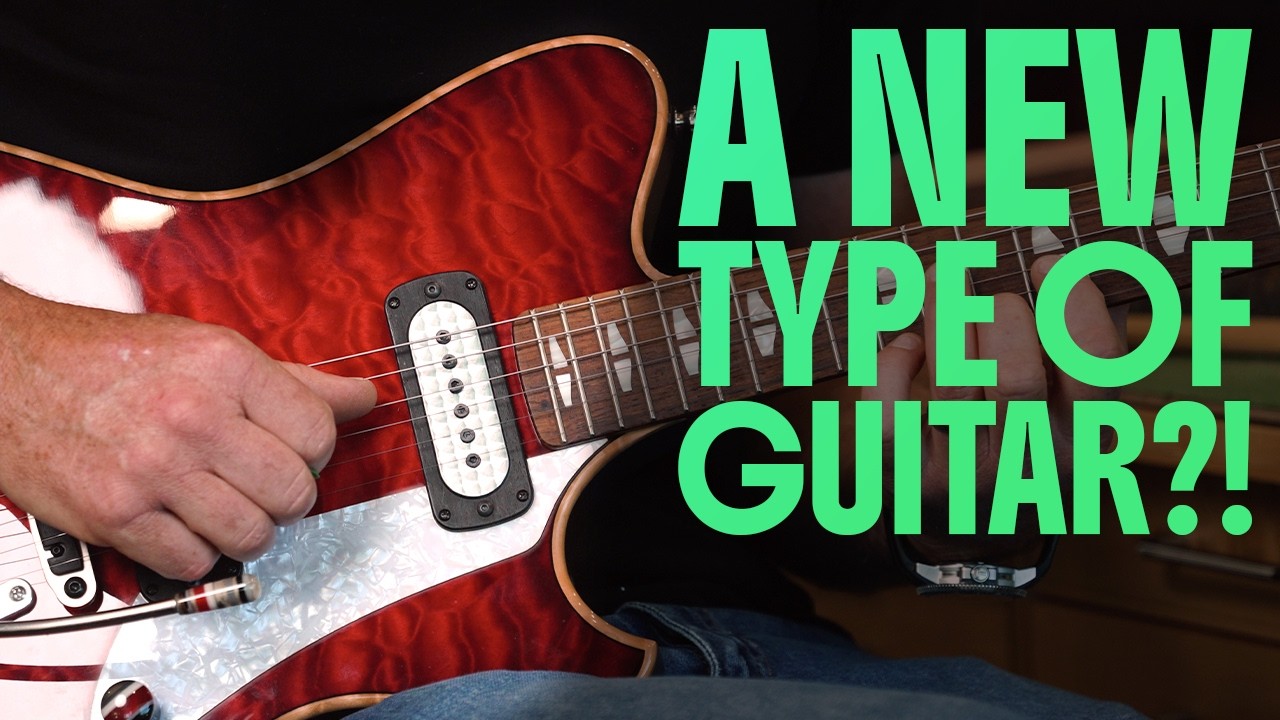
I spent a lot of time designing the guitar as an acoustic instrument first – as a string-holder. The first question was, “How do you make a string vibrate predictably, dynamically and musically? Well, don’t ruin it with a pickup.” That led me to experiment with neodymium magnets.
They’re normally considered too strong and bright for guitar pickups, but by combining neodymium with aluminum, I could diffuse the magnetic field instead of concentrating it. You hear more of the string’s natural harmonic content without damping it, and the design creates an almost perfect Faraday cage that dramatically reduces noise.
From there, I could shape the pickup’s voice rather than simply increasing output. One of my favorite things is that people describe these pickups with words that don’t usually belong together. They’ll say they’re “warm and clear.” The low notes stay articulate, but they’re cushioned by warmth instead of becoming harsh.

What about the tremolo design?
I’ve always admired how pedal steel guitars keep chords in tune with themselves as they’re bent. Traditional vibrato systems don’t really do that because every string changes pitch by a slightly different amount. There have been some brilliant attempts to solve the problem, but I decided I didn’t need perfection.
If I could make it 90 percent right instead of chasing 100 percent, I could build something much simpler and more musical. After working through the math of string tension and scale length, I designed a cam mechanism that lets each string travel a different distance while keeping the pitches relatively even. I also built in a positive zero point, so every time you release the arm, it returns to concert pitch.
Where did the guitar’s visual identity come from?
Designers have their own vocabulary, just like musicians do. Mine was shaped by growing up in Southern California around hot rods, surfboards, skateboards, custom paint and all the different ways people personalized what they built.

That’s why you’ll find bold, solid colors and finishes inspired more by automotive design than traditional guitar making. Once you start exploring automotive paint, you realize there aren’t just a handful of colors – there are thousands. That world is endlessly inspiring, and I wanted to build a guitar that could wear those ideas naturally.
The knobs come directly from my love of surfing. They’re made from surfboard resin. Originally, I used hardened resin that dripped onto the shop floor while boards were being glassed. You’d machine and polish it, and suddenly something that was basically trash became beautiful. I loved that because it reminded me of an old hot-rod tradition when cars were painted by hand; layers of overspray would build up inside paint booths.
Eventually, people started digging those colorful fordite layers out of the trash and turning them into shift knobs and dashboard pieces. Surfboard resin felt like the equivalent – something discarded becoming something worth keeping. Those little details matter because they connect the guitar to the culture that inspired it.
Even with the first dozen instruments, it was amazing to hear how differently musicians interpreted it
What do you hope players will discover when they pick up this A-Type?
If I ask someone what a Stratocaster sounds like, you probably don’t describe the guitar – you start naming players. Jimi Hendrix. Buddy Guy. Stevie Ray Vaughan. The instrument becomes part of each player’s voice. That’s exactly what excites me about this guitar. Even with the first dozen instruments, it was amazing to hear how differently musicians interpreted it.
One of the things I’ve appreciated most recently is hearing a player get one of these guitars and then, within hours or a day, they say, “This is what I want to walk on stage with. This is what I want to play.” So, all right, you found something you loved in this. I can think of nothing better than that.
- For more information, see Powers Electric.
- “Could this be one of the most unique and musically inspiring electric guitars we’ve ever encountered?” Powers Electric A-Type review
- This article first appeared in Guitar World. Subscribe and save.
