

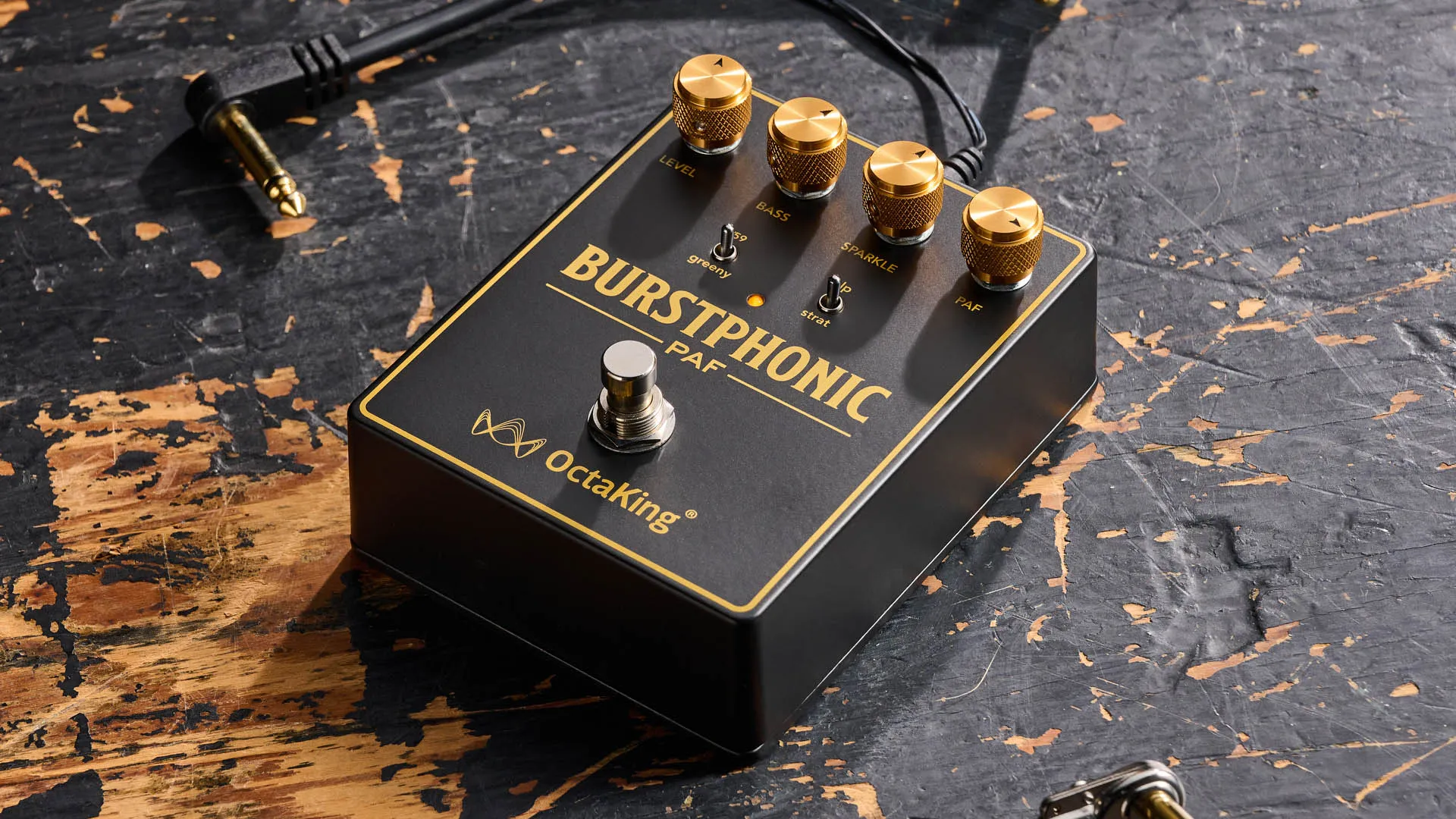
Born out of a chance meeting between songwriter/producer Aryan King and P.A.F. pickup specialist Alexey Dovnar, Octaking Labs has announced its first pedal, the Burstphonic PAF.
This debut release sees the company teaming up with guitarist Jack Moore – son of Northern Irish legend Gary Moore – to create a pedal that aims to “authentically capture the Greeny Moore legacy” via its “massive headroom, rich, clean harmonics, and that unmistakable, soaring out-of-phase sound.”
The 100 percent analog pedal features controls for level, bass, sparkle and P.A.F., with two mini switches to select between ’59/Greeny and LP/Strat modes.
Octaking is calling it “the world’s first ever guitar pedal” because it was designed to reproduce the tonal identity of the storied 1959 Gibson Les Paul Standard that was owned by Peter Green and Moore before it made its way into the hands of Kirk Hammett.
Instead of emulating amplifier saturation, the pedal reshapes the input signal to reflect vintage P.A.F. response curves, midrange complexity and bloom, as well as the natural compression and harmonic richness of aged tonewoods.

“Dad’s sound was never just distorted guitar,” Jack Moore tells GW. “It was a living thing – mid-forward and singing, with this bloom after the note that made even a simple bend feel like it had air around it.
“There was grit, but it was musical grit. The amp and the guitar talked back to him. You could hear the pick attack, then the note would open up and hang there just long enough that he didn’t have to rush.”
This particular relationship with tone was undeniably symbiotic – the sound of the guitar and the amp together inspired the much-missed blues giant to find the right lines and phrases to play.
“When the sound has that kind of sustain and harmonic richness, you start writing phrases around it,” Moore adds. “You hold a note because it wants to be held. You leave space because the decay is doing half the work. You bend slower because the overtones are already doing the drama.
“A drier, tighter tone would have pushed him toward shorter, more percussive ideas. His sound invited melody, vibrato, and those little vocal-style inflections. The gear didn’t replace his hands – it gave his hands a voice that matched how he heard music.”

As for sonically replicating one of the most recognizable guitars in rock and roll history, Octaking deliberately chose not to pursue the instrument itself and instead opted for a more empirical and forensic approach to the project.
“We gathered primary source data, including measurements from Gary’s late-’90s signature model,” Aryan King explains.
That’s the point: preserve the character of the tone so people can use it, not just admire it
Jack Moore
“We also had access to Stripe – Gary’s iconic 1959 Les Paul heard on Still Got The Blues. Alongside these, we analyzed isolated DI tracks from benchmark songs like Parisienne Walkways and Need Your Love So Bad, and selections from the Blues For Greeny album.”
The company’s engineering team mapped the electrical profile of the original pickups using a spectrum analyzer – precisely tracking inductance, impedance, and the resonant peak response.
“A massive part of the pedal’s architecture accounts for the famous accidental Greeny mod,” explains Director and co-founder Alexey Dovnar. “The flipped neck-pickup magnet polarity that created Gary’s piercing, nasal, out-of-phase middle position.
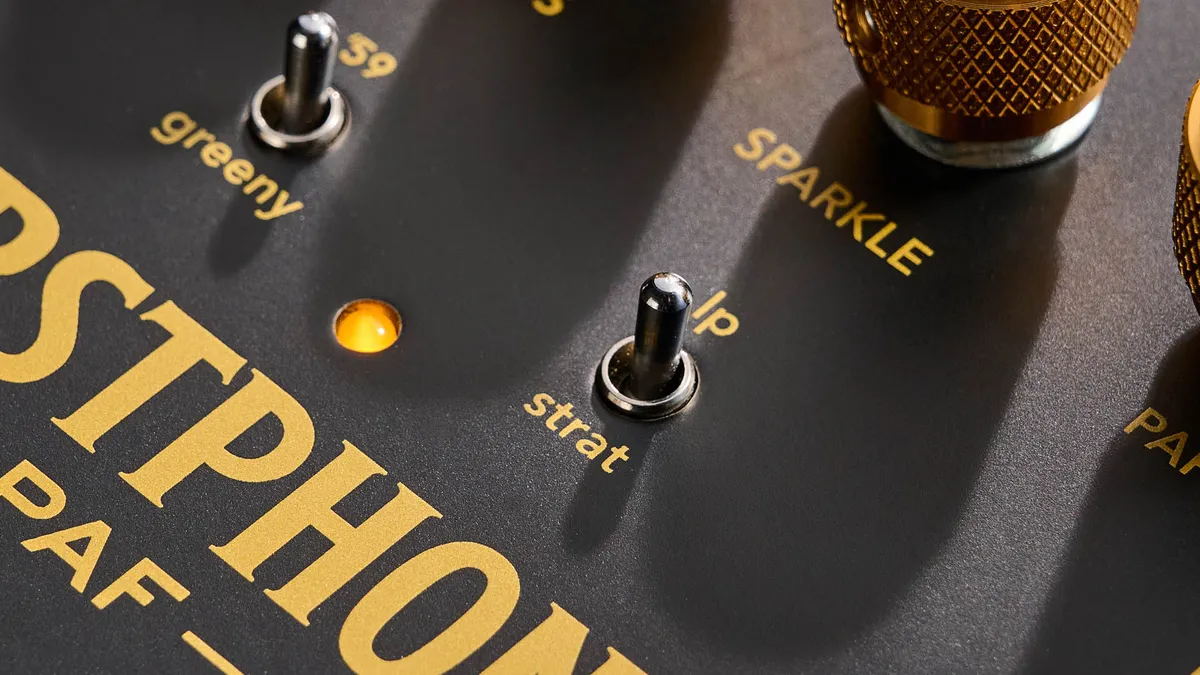
“We modeled that exact phase cancellation and frequency curve inside the circuit to ensure that when the Greeny mode is engaged, the pedal delivers that unmistakable hollow, vocal bite. And then the ’59 mode captures the broader dynamic envelope of an authentic late-’50s P.A.F. ’Burst, with the woody lower-mid bloom, transparent top-end clarity, pick attack sensitivity, and smooth sustain.”
The final thumbs up came from Jack Moore, who had been working with Aryan King on the pedal prior to the company being launched, offering his personal insight, feedback, and – ultimately – approval.
“For the family, this release is very personal,” Moore says. “My dad’s voice is still in the room. For fans, it’s respectful and useful. They’re not being sold a costume. The best tribute isn’t imitation for its own sake – it’s when a kid in a bedroom hears that midrange bloom, writes a line they wouldn’t have written on a sterile clean amp, and the music keeps moving forward.
“That’s the point: preserve the character of the tone so people can use it, not just admire it.”
- Head to Octaking for more information.

