


In the mid-’90s, the Los Angeles-based post-grunge/alt-rock trio Dogstar (guitarist-singer Bret Domrose, bassist Keanu Reeves and drummer Robert Mailhouse) established a loyal fanbase thanks in part to a solid debut album, 1996’s Our Little Visionary, and dedicated touring. Oh, there was that other thing – their big-time movie-star bassist. That didn’t hurt.
But celebrity can only take you so far, and curiosity seekers showing up at gigs to see Mr. Hollywood Guy on stage discovered that Dogstar had the musical goods going for them.
Perhaps due to Reeves’ booming movie career, which took off into the stratosphere following the release of The Matrix in 1999, Dogstar released only one more record, Happy Ending, before coming to a halt in 2002. The band drifted back together in 2020 during the height of the pandemic, but it wasn’t until two years later that they formalized their reunion.
Their 2023 album, Somewhere Between the Power Lines and Palm Trees, was a spunky and freewheeling collection of alt-rock that explored existential themes with sunny optimism. While that record was a solid comeback, Dogstar truly solidify their return with their latest release, All In Now.
The album is punchier and hookier than anything they’ve ever done. Singles like Joy and This Sphere pack brilliant moody textures, and the driving rocker Exalted is a winning trip down alt-rock memory lane (it’s a perfect combination of early U2 and Queens of the Stone Age) that somehow still feels forward-thinking.
Noted post-punk producer Nick Launay (Nick Cave and the Bad Seeds, the Yeah Yeah Yeahs, Arcade Fire, among others) widens and magnifies the group’s sound – there’s the occasional trippy effect, doubled vocals and guitars – without sacrificing an ounce of their raw, live urgency.
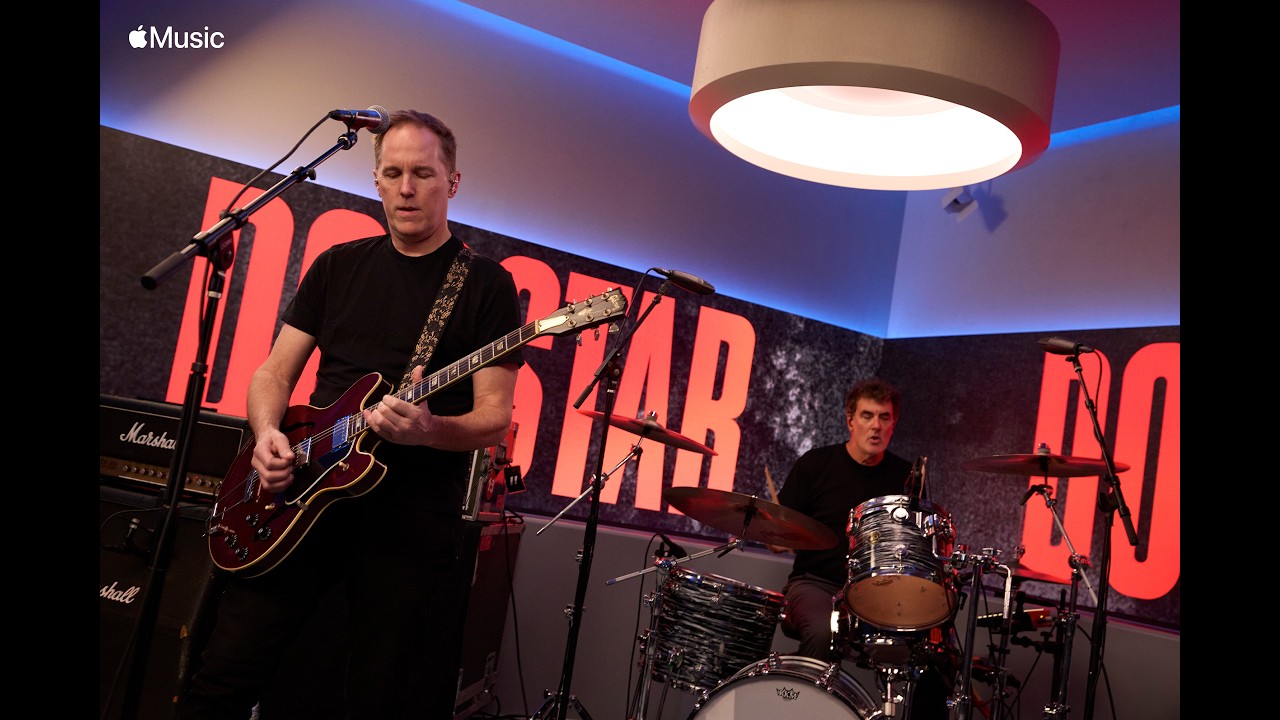
Reeves has an idea why the record turned out so well. “I feel like I came in and said, ‘Let’s try and get some rock going,’” he says. “These songs just had a lot more rock in them.”
Domrose offers a different analysis, suggesting that the group’s extended hiatus has resulted in a feeling of rejuvenation.
“I think that if we had been playing together all that time, you know, grinding it out every day for 35 years, we’d probably hate each other or something. We’re not burned out. We’re coming back, and we feel young and happy and fresh. In many ways, it’s like we’re starting over.”
What is your musical common ground? Which bands and artists do you agree on?
Keanu Reeves: The band Venn diagrams, where do we overlap?
Bret Domrose: They cross like this much. [He gestures a tiny space between his thumb and index finger.] Every time we try to pick a cover song to play, it’s like, “What about this?” “No, no, no. What about that?” Thank God there’s only three of us.

When you get together to rehearse or write, do you loosen up with some covers?
Domrose: We should go away on a retreat, the three of us, and just lock ourselves in the cabin and play covers for a month. We’re really bad at that. We can’t seem to agree on anything.
Reeves: We’re on a cover search, so right now we’re looking at Can’t Hardly Wait by the Replacements.
Domrose: The Cult – She Sells Sanctuary.
Reeves: We looked at White Wedding by Billy Idol.
Domrose: Sabotage by the Beastie Boys. You brought that in the other day, and then we quickly realized I’m not singing like that.
So you haven’t actually tried those out yet?
Reeves: On our last tour we were doing the Cure’s Just Like Heaven. I think we can all agree that we like the Cure.
Domrose: They are part of the Venn diagram.

Help me out here. That nearly 20-year-period when the band was inactive, was it a breakup or a hiatus?
Domrose: It was a break. Bo “up” was involved. [He and Reeves laugh.]
Just like in Friends. You were on a break.
Domrose: Yeah, we just drifted. We were like three pieces of flotsam on the ocean, and one day we just drifted back.
There was never a plan to get back together?
Domrose: Well, over the years we had gotten together. Rob’s got a studio in his house, so every couple of years we would play with no intention other than just to have fun. We never wrote. We’d touch on some old songs and just have fun. “What’s going on? How have you been?” It wasn’t like I didn’t talk to anybody for 20 years and they didn’t talk to me, but there were years where we didn’t really talk to each other.

When you decided to make another record, what intrigued you about working with Nick Launay?
Domrose: We had our own list of producers, but when Nick’s name came up from management it kind of rose to the top immediately based on the work that he’s done. We’re big fans of a lot of records he’s made over the years. He’s a veteran guy. We were excited to even have the opportunity to meet with him, let alone work with him.
Reeves: He did Public Image, Gang of Four, Kate Bush, INXS, Midnight Oil, Nick Cave and the Bad Seeds, Yeah Yeah Yeahs… He played some of the new stuff he was doing with Amyl –
Domrose: Amyl and the Sniffers. One of the fun things about his discography is that he’s all over the place. He’s current and he’s classic and he’s everything in between.
Reeves: When you go into a studio, you need a producer to help mix, produce, set the microphones – production! You need it with composition. You invite them into rehearsals, and they hear how you play.
They may have ideas on songs. “How do you want to listen to it? What are you guys looking for? What are you feeling?” A producer can be like a conductor or a shepherd. He can become part of the band.

How are you guys as far as criticism? What about when Nick says, “That was really good, but it can be better”?
Domrose: Our egos are in check, and we’re really open-minded. There was one song where we just said, “Okay, go ahead, Nick. Do your thing.” And it got pretty far away from where we started, like, “Maybe that’s changing too much.” That song didn’t make the record, but it wasn’t because of bad feelings or anything.
It was just like, “Okay, that’s your take on that.” Nick added so much to the songs that did make the record. He changed some drum parts. He restructured some things, like, “Do two choruses here instead of one.” If a producer has your confidence, then he brings out the best in you, for sure.
On songs like Joy and This Sphere, it sounds like there’s an early U2 vibe. Would that be a fair assessment?
Domrose: It’s in there.
Reeves: Fair enough.
Domrose: But not consciously. It’s interesting to hear the comments people are making, because I couldn’t name you one Queens of the Stone Age song, and I get Queens references a lot. There’s a lot of accidental influences. I mean, there’s only so many sounds and so many notes. Eventually, you’re going to start to sound like something else at some point.
![[from left] Dogstar’s Bret Domrose, Robert Mailhouse and Keanu Reeves](https://cdn.mos.cms.futurecdn.net/NW8ZXTpFKLbc8oWyBFypC7-1200-80.jpg.webp)
Bret, you play a lot of drone chords and arpeggios on the song Exalted. That’s kind of an early U2 thing. Keanu, while he’s doing that, is it up to you to keep things driving as a bass player?
Reeves: I try. I try to keep the low-end and the beat on the ground with Robert, our drummer, but I also do a lot of melody off of what Bret’s doing. I mean, sonically Bret’s in stereo. He’s such a versatile guitar player. Bret, what do you think? I kind of keep it simple with a little bit of melody.
Domrose: It’s a different set of responsibilities in a three-piece band. You don’t have keyboards filling gaps. You don’t have another guitar player taking care of stuff. We have to be really mindful of who gets to go where.
You brought up Exalted. In the choruses I’m playing just F sharp minor 7th, but I’m changing to minor 7th add 9. I’m not changing notes – I’m just changing voicings. Keanu is actually driving the melody underneath that, but he’s got to play the main melody of the chorus. If he doesn’t, the song’s going to sound ridiculous because I’m playing one chord.
![[from left] Dogstar’s Keanu Reeves, Robert Mailhouse and Bret Domrose](https://cdn.mos.cms.futurecdn.net/CJRYB9PG9jwTvH4yDujdm6-1200-80.jpg.webp)
Bret, you’ve primarily been a Fender Stratocaster guy, right?
Domrose: Yeah, growing up it was all Strat, but I do go between Gibson and Fender.
We understand that you got a Gibson ES-335, and that sparked you to write the song Joy.
I’m playing PJs most of the time now. I’m doing a single on the bridge pickup and a split on the neck pickup
Keanu Reeves
Domrose: That was the one guitar that was on my list to complete my dream collection. I finally got it, and it did way more for me than I ever expected. It sounded so different, and we were getting tones and weird overtones and feedback. Because it’s semi-hollow, that guitar does things no other guitar can do.
Keanu, you’re a dedicated Fender Precision Bass player, right?
Reeves: I’m playing PJs most of the time now. I’m doing a single on the bridge pickup and a split on the neck pickup.
You’re a longtime pick player. Have you experimented with fingerstyle?
Reeves: We used to have some songs where I played with the fingers. I don’t slap, but I do like playing with the fingers. It all depends on the songs. When we have some of our folkier tunes, I used to play with the fingers. I like the percussiveness of the pick in this band. And just the tonality of it… I think the fingers don’t have that kind of high-end attack. Plus, I’m using rosewood necks. I have kind of a warm tone with a percussive attack.

Have you tried basses with five strings, or are you a traditionalist?
Reeves: [Laughs] I’m still trying to figure out the four strings!
We’re pure, old-school tone guys. I played around with that stuff, but it’s not what I need
Bret Dorman
In terms of effects and amps, what are you two using?
Domrose: I use a Dunlop Cry Baby. That’s the only pedal. I have one piece of rack gear that I use, a Roland DEP-5 multi-effects from the ’80s. I grabbed it early. I send one side to a Marshall 50-watt JCM800, and the other side goes to a Matchless DC-30 212 combo. It’s my dream setup.
Keanu, how about you?
Reeves: I’m simple. I’ve been playing Gallien-Kruegers since the ’90s. So it started with RB 500s, but on the last tour I was playing the Fusion 1200S out of two RBH 410 cabinets. On this tour, I’m going with four 410 cabinets.
No amp modeling for you.
Reeves: No, man.
Domrose: We’re pure, old-school tone guys. I played around with that stuff, but it’s not what I need.
You need to feel that air.
Domrose: Well, look at Mr. 16 Speakers over here. If anyone reading this is going to be in the front row on Keanu’s side, you’ve been warned.
Reeves: Hey, I’m sensitive to stage volume, Bret!
Domrose: Your hair is going to move, but in a good way.
- All in Now is out now via Dillon Street Records.
- This article first appeared in Guitar World. Subscribe and save.

