


The first time I had a pickup fitted to an acoustic guitar was a disaster. I didn’t know any better.
It was an instrument that I loved and I had been looking forward to an amp’d up version of its voice, maybe a splash of reverb, some delay – keeping it tasteful, of course. Instead, what I got was the malignantly ugly quack and logarithmic anti-dynamic range of a primitive under-saddle pickup. Marvellous.
Upon discovering that the installation had also affected the acoustic sound, I ripped it out with my bare hands and vowed never again. It was at that moment that I joined the legions of acoustic guitarists searching for a workable, musical plugged-in sound.
I recognise that some readers will be hoping for hard and fast answers to this puzzle. I don’t believe there are any – I’ve looked. There are no shortcuts, either – I’ve looked there, too. What I can offer is some advice from my own experience and that of other guitarists I have spoken with.
Prior to the one-two punch of Tracy Chapman’s debut album and Eric Clapton’s MTV Unplugged, the acoustic guitar had languished in the hair-metal doldrums for years, consigned to duty as a laminated stage prop to be wheeled out for the erogenous moments, and sadly not everyone was writing ballads of the calibre of Extreme’s More Than Words or Mr Big’s To Be With You (that Paul Gilbert solo remains a sublime masterclass).

A common element of the above examples is a distinct lack of the plastic piezo ping that children of the ’90s had learned to accept as inevitable. Instead, these recordings have a natural sound – actual air molecules being shifted by a braced wooden soundboard. Just delicious.
There remains a place for that piezo voice, though. In a loud band context very few systems can provide the volume necessary while remaining resistant to feedback like an under-saddle pickup.
There are even some (admittedly rare) musical contexts where the sound just works: imagine the dark majesty of Wyclef Jean’s 911 recorded on a Fylde Oberon or a pre-war D-45, rather than a Fender Stratacoustic – all wrong.
Animal Magnetism

While initial forays into acoustic guitar amplification such as the Gibson ES-150 and Martin D-18E (which coincidentally was used by Tracy Chapman long before Kurt Cobain got his hands on one) featured magnetic pickups, it wasn’t until the advent of Jim Kaufman’s Sunrise design in the 1980s that a soundhole-mounted humbucker became a serious option for players such as Michael Hedges, Richard Thompson and Phil Keaggy.
Hot on its heels came Mike Vanden’s slimline Mimesis model – now made under licence as the Fishman Rare Earth in a variety of permutations – and the LR Baggs M1A with its floating coil, which can pick up body taps as well as the string sound without the feedback potential of an internal mic.

Soundhole acoustic guitar pickups have several advantages; the initial attack is a lot more rounded and warmer than a piezo, but sometimes that translates into a voice that’s closer to that of an archtop than a flat-top. They are also a strong choice for players dealing in extended techniques such as tapping and slapped harmonics – in particular, they eliminate problematic wolf tones from tapped notes on the 12th fret.
By the late ’90s, acoustic guitarists had a dizzying array of choices and custom hybrid systems comprising multiple sources had become de rigueur.
It was not unusual to see an instrument with more than one output jack. Internal mics by Sony and DPA were also popular with players such as Isaac Guillory and Pierre Bensusan – in conjunction with a piezo or soundhole humbucker. But without a feedback buster, they could be asking for trouble. Ironically, the quest for a natural sound increasingly meant filling a guitar with wires, batteries and circuit boards.
Under the Bridge
The burgeoning global acoustic music scene and resulting spike in interest in luthier-made steel-string guitars of the early 2000s provided fertile ground for a renaissance in pickup technology.
While some companies pushed things to extremes with complex active electronics, multi-band EQs and blenders and so on, others concentrated on simplicity. Enter the under bridge-plate transducer.

This technology had been around since 1963 in the form of the Barcus Berry ‘Bug’. It was revived with the creation of the now legendary FRAP transducer system beloved of Neil Young, but these were expensive, fiddly and often overly dependent on active preamps to kick the required amounts of arse/ass. The same was true of the first generation Trance Audio Amulet.
The now ubiquitous K+K Sound Pure pickup was first developed in 1996, but it took a little while for the acoustic guitar community to catch up. This elegantly simple system is based on three sensors mounted under the bridge plate and it allows the true voice of a fine handmade instrument to shine through with an expressive dynamic and timbral range – which is ideal for fingerstyle players.
I was intrigued to hear from Andy McKee that he is now using the passive version in all his Greenfield guitars through a Neural DSP Quad Cortex when playing live.
Alan Gogoll also favours this design in his new Åstrand guitars signature model. Other similar systems such as the McIntyre Feather and Dazzo offer their own tweaks and have found vocal supporters clubs on guitar forums around the world.
And in the End
Amplifying an acoustic instrument is always a fine balance. Much depends on the player and instrument in question. There are now more options than ever, and even cheaper systems can work well.
The most natural sound may not be the most practical, but if you think of a pickup as a camera lens and decide what aspect of the guitar you want to focus on, there will be something out there that does the job!
Three modern acoustic guitar pickup systems
K+K Sound Pure Mini ($172/£130)
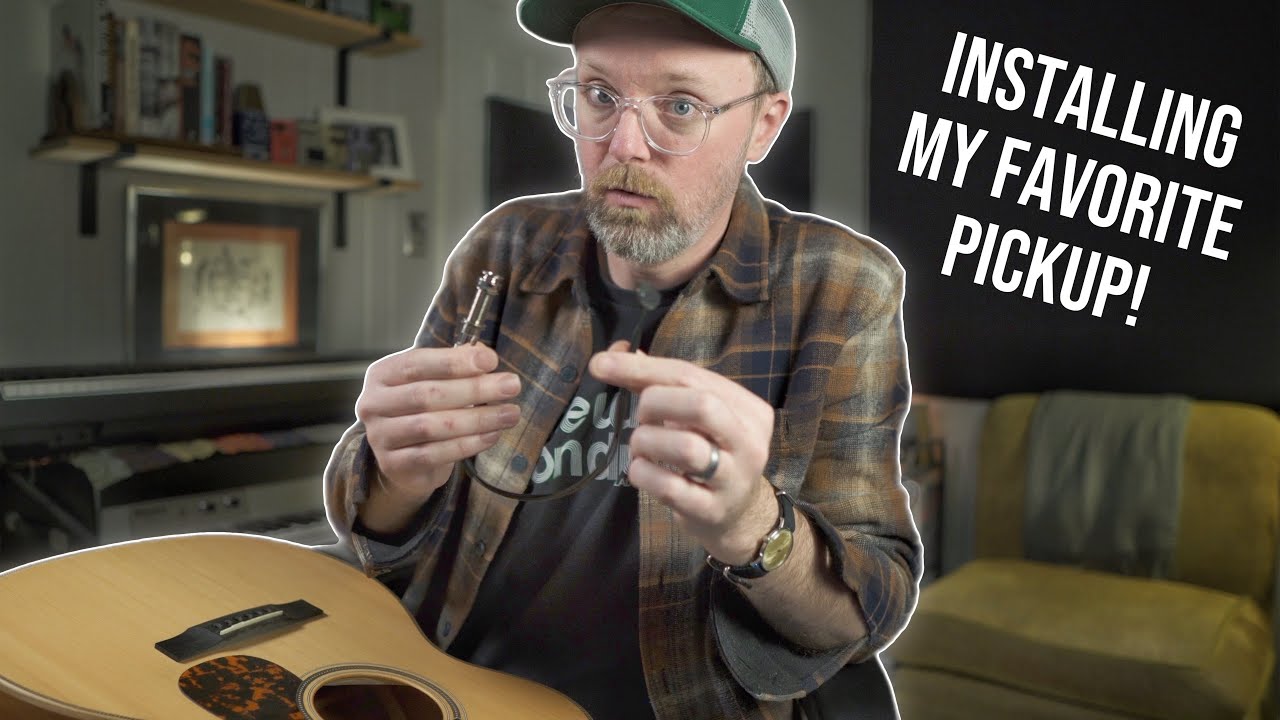
Regarded by many modern fingerstyle players as a vital part of their sound, this bridge-plate-mounted transducer system has become the industry standard for a natural, woody plugged in voice.
Responsive and musical, the Pure Mini is an ideal choice for high-performance luthier-made guitars – on its own or as part of a hybrid solution.
NV Tone Swan ($286)

Made in Ukraine, this soundhole-mounted condenser mic system delivers the sort of extraordinary detail and nuance you’d normally expect from an external studio mic.
Lightweight, easy to install and well made, the NV Tone Swan has already been seen in the guitars of extraordinary players such as Antoine Boyer and Kent Nishimura.
LR Baggs Anthem SL ($229/£249)
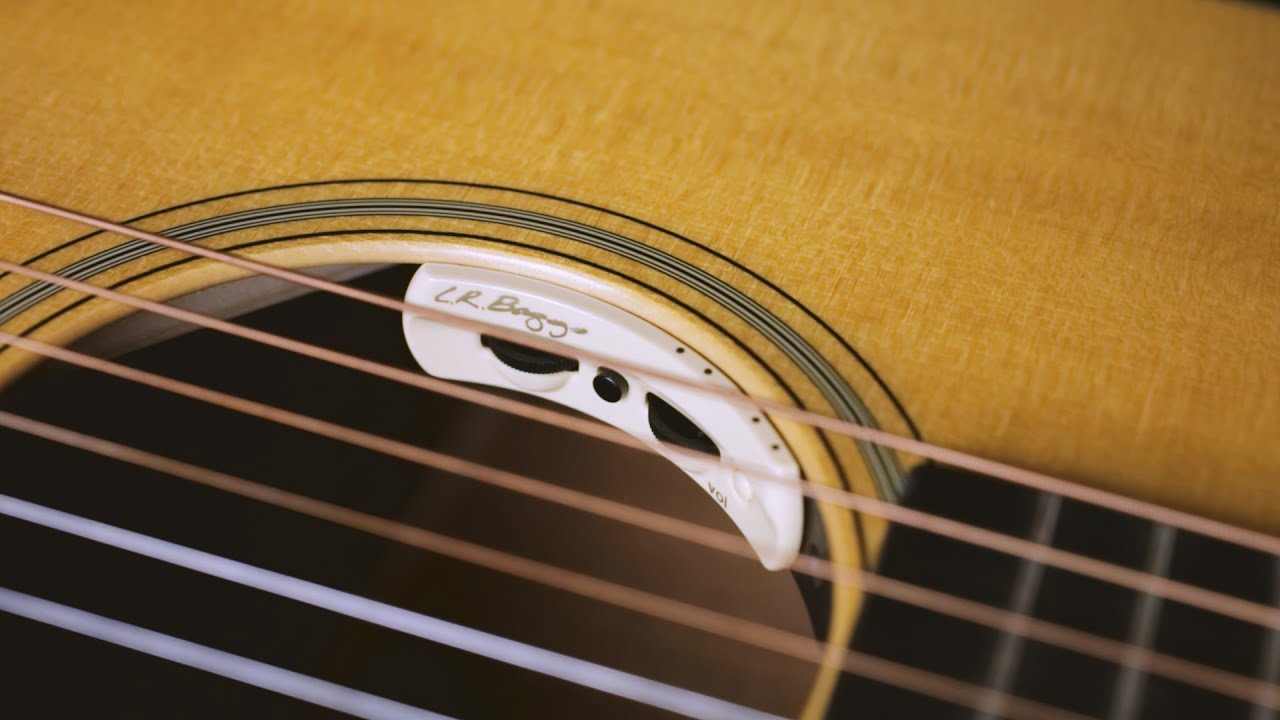
LR Baggs has been a major player in the acoustic pickup world for decades, and while its revolutionary M1A humbucker is a solid choice, the Anthem SL hybrid system combines the volume level potential of an under-saddle pickup with a Tru-Mic condenser mic mounted under the bridge plate. Active electronics with minimalist controls – and why not!
- This article first appeared in Guitarist. Subscribe and save.
