

Starting in 1996, Guitar World was honored to publish a handful of lesson columns authored by Led Zeppelin bassist John Paul Jones. The following column, from our April 1997 issue, has been edited for use online.
A mature musician exercises restraint when the situation calls for it. In other words, what you don’t play is just as important as what you do. It actually takes more discipline to stick to an ostinato (repeating) figure for eight or 16 bars than it does to throw in gratuitous fills that don’t necessarily add to the music.
There are times, however, when playing a high melodic figure is most effective. The key is to know when to walk and when to run, or when to “stomp” and when to “noodle.” I’d like to illustrate this concept by citing a few contrasting examples of bass (and keyboard) parts I’ve played, and explain why I chose to play what I did.
First, let’s look at Trampled Under Foot, from Physical Graffiti. For the main verse figure in G minor, I simply stayed on the low G root note and locked in with Bonzo [John Bonham]’s kick drum. I also took this same “four-on-the-floor” approach with the clavinet part. The lesson here is: don’t mess with a great groove.
A fine example of a tune that epitomizes both approaches – “hard” and “soft” – is The Song Remains the Same, which we looked at briefly in one of my previous columns.

For the D-Dsus4 parts I played a tight, punctuated bass figure together with the drums. But when it came to the “floaty” part (:36-:42), where Jimmy Page quietly strums Dm9 and G13 chords, I played a lofty melodic run high up on the neck using the D Dorian scale.
The slow part of the tune (the half-time verse section) also illustrates these contrasting approaches. After hitting the big kicks (C-C-G) with Page and Bonzo (2:02), I played a descending scalar figure (F# Mixolydian) and then an ascending arpeggio (F) behind Page’s jangly F#7-Fmaj7 changes.
For most of Kashmir (Physical Graffiti), I played rather straightforward and repetitive bass and Mellotron keyboard parts. The only exceptions were the sinuous “Arabian string symphony” Mellotron parts I improvised during the two choruses. If you listen to the recording, you’ll notice how those string melodies move independently of the rhythm of the underlying groove.

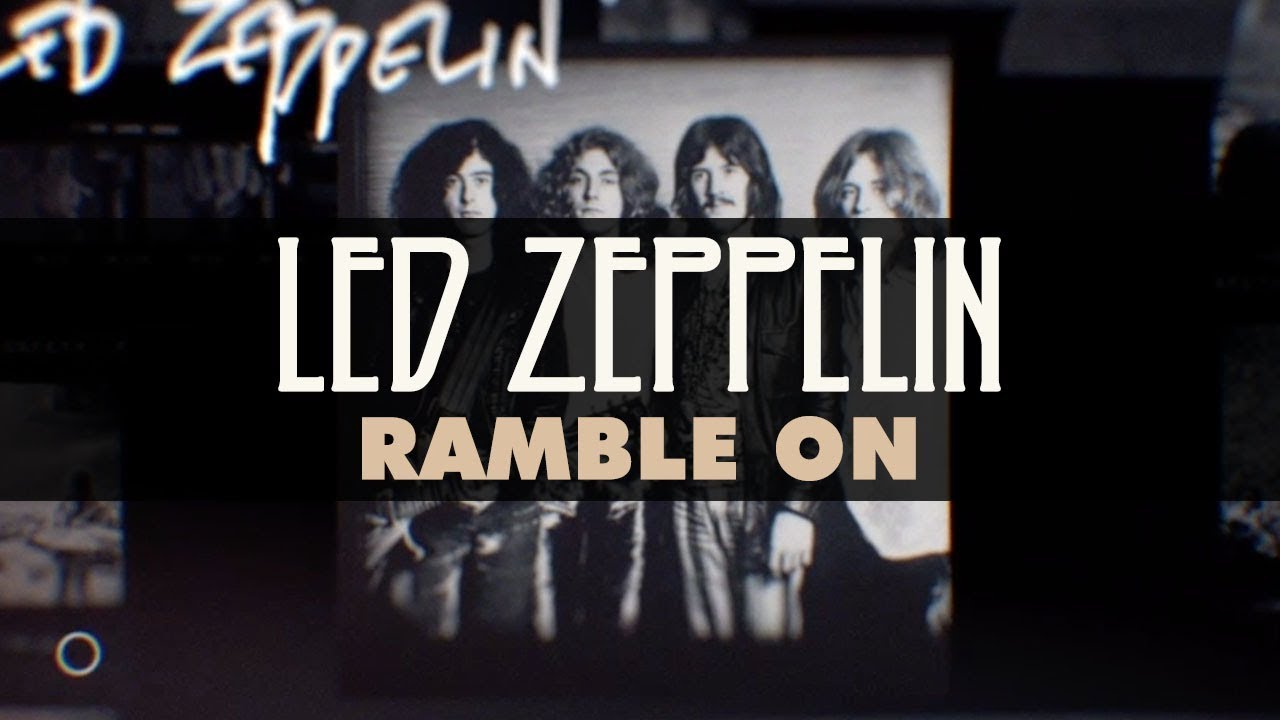
In quite a different vein is Ramble On, from Led Zeppelin II. Behind Page’s two-bar chord vamp during the verse sections, I repeated an upper-register bass counter-melody that ended up becoming one of the more memorable parts of the tune.
I took a similar approach in What Is and What Should Never Be (Led Zeppelin II), but with a bit more variation. Playing in this sort of casual, melodic way seemed like the best thing to do at the moment, considering the fact that Jimmy’s part was so simple and subdued (E9-A13 chords).
Notice on the recording how well all the parts mesh during the verse sections, especially the bass and drums, and how everyone comes together in locked-step fashion for the chorus.
The main point here is that when it comes to playing music, there’s a time and a place for everything. Listen carefully to the overall sound of the rhythm section, and make wise, unselfish decisions as to what you should play at any given moment.
Approaching every arrangement in terms of opposites or contrasts between different sections – loud vs. soft, loose vs. tight, floaty vs. busy – will ultimately make your music more interesting.