



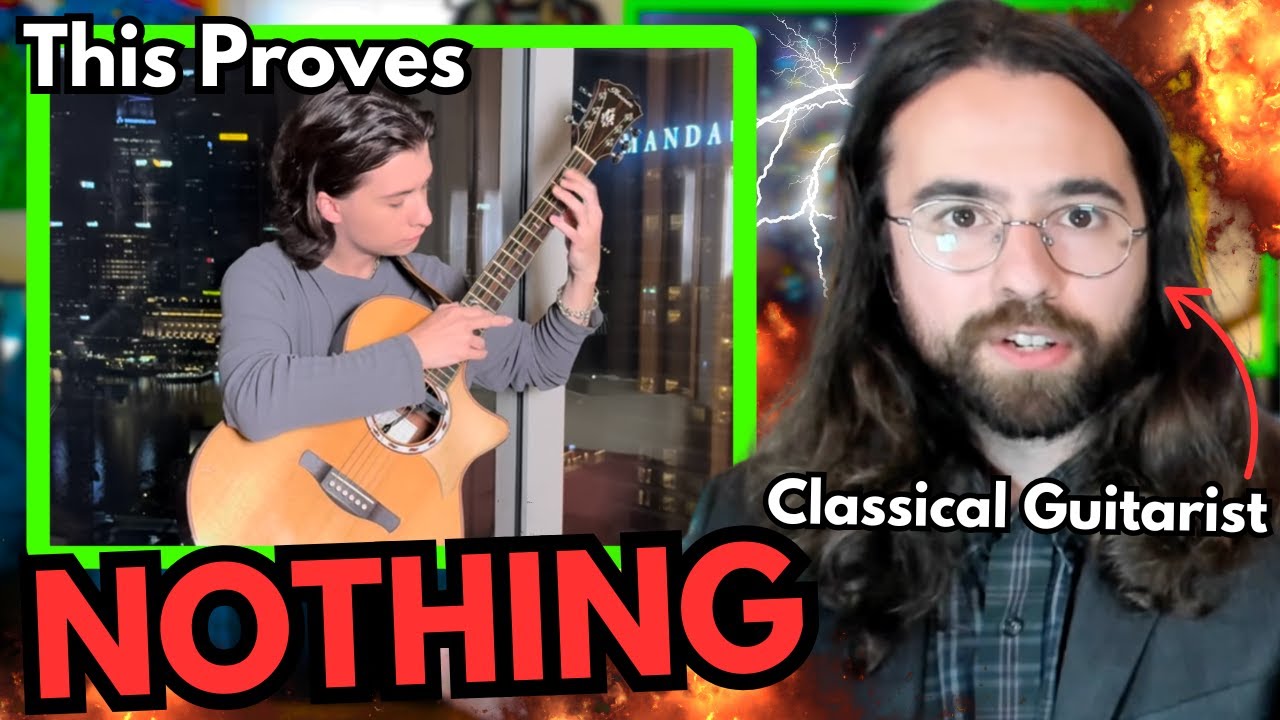
Late last year, Polish acoustic guitar virtuoso Marcin released a video titled “Proving I'm Not Fake (Once And For All)”, a response to a video titled, well, “Proof that Marcin is Fake (Once And For All)”, released by classical guitar teacher Cameron Fernandez – aka Sor Hands on YouTube.
In his video, Fernandez takes issue with a claim Marcin makes at the end of a music video he made for a composition called How Music Works; that all of its parts – the bassline, his trademark right-hand percussive work, and a melodic line of rapidly-picked 16th notes – “were performed at the same time on one instrument.”
Fernandez presents his argument to the contrary in granular detail, subsequently arguing in a video responding to Marcin's response to him (an intimate, phone-recorded hotel-room performance of the same piece), “I am not saying that Marcin’s guitar playing is fake. I’m saying that most of it is real and it’s weird that he faked this one little part (the melodic 16th notes).
“You’re not morally obligated to have it actually be one-guitar recording. You’re allowed to layer things. You have no moral obligation to not use two guitar parts.”
Now, I happen to have seen Marcin play, up closer, I'd wager, than most. I was present in Guitar World's New York City studio – sitting, at the most, 10 feet away from him – when we shot this and other videos in summer 2024.
Fernandez certainly isn't insinuating or claiming this by any means, but I can attest that what you see on screen isn't a Wizard of Oz situation, nor a Milli Vanilli for the 2020s – the guy is one hell of a player, without digital manipulation.
It's not just Marcin, either – fellow social media guitar giant Ichika Nito recently shared an unedited one-take performance in the wake of a viral video from Jacobra Records – titled “I prove Ichika Nito is the ultimate FAKE guitarist” – that similarly picks apart some of the Japanese Ibanez endorsee's performance videos.
So what does being a “fake” mean, then, in this day and age?
If your mind hasn't already gone there, one must also consider the much-discussed saga of Giacomo Turra, the Instagram guitar phenomenon whose career came crashing down last year amidst accusations that he plagiarized the compositions of less popular guitarists, and in some cases sold tabs of them for his own profit.
Further controversy came when guitar YouTube king Rick Beato revealed that he had filmed a video with Turra that he chose to not release because, in his words, “he couldn’t play well enough.”
“I have standards,” Beato explained. “Some of you may not like some of the people that I've had on here, but I respect the musicians that I've had on, even if it's not of your taste.
“And when somebody comes in here and they can't play their own songs, or they can't even play stuff that they've stolen from other people... although I think the thing that he played here was, maybe, his own tune.”

Beato does point out that Turra's greater sin was, obviously, passing the compositions of others off as his own, and that even some of the greats have mimed performances – particularly back in the earlier days of TV.
And more recently, too. Flea – who can be found in the top third of our list of the 100 greatest bass players of all time – admitted that, but for vocalist Anthony Kiedis, the Red Hot Chili Peppers mimed their performance of Give It Away at the Super Bowl XLVIII halftime show in 2014. Is he a “fake”?
So, does “fake” playing mean something different in the age of social media? Are the virtuosos of the 2020s – inevitably trying to grab eyeballs in the bottomless sea of social media content – being held to a different standard than the heroes of the days of yore who mimed on TV?
Is it the case that performance audio is being airbrushed to an impossible standard? Or simply that it doesn't match the more casual video setting?
Does “fake” mean simply using additional guitar tracks in a performance video? Or do you have to make a point of saying it was one take at one time? Does the accused need to lose to the accuser in a Crossroads-style guitar duel to be fully deemed a “fake”?
What does “fake” guitar playing mean to you? Let us know in the comments below.

